
by Lidia Paulinska | Jul 1, 2015
Ori Inbar is the organizer of the Augmented World Expo and the Executive Director of AugmentedReality.org. After a slight delay from the scheduled time at the show while Ori was addressing physical realities of the dynamics of a several hundred attendee show logistics on opening day, we sat down for a short talk on AR, VR, where the industry is and where he thinks it is going.
The first topic was will the technology hold this time and is there a monetization model for it. Ori felt that just like mobile, the monetization plan starts with the business and industrial sector. There is a ramp and a learning curve and the tech has to get a foothold, but once it does the applications advance and the products become standard. This is what is happening now with Augmented Reality (AR) in the enterprise and life science space. Manufacturing, ICT & Enterprise are both embracing and driving the monetization of the technology in the areas of training and for technicians. This is the first stage like the transition from “block” phones to flip phones in Mobile.
The next transition was moving these flip phones to large display phones/PDAs and then smart phones. This was a consumer driven cycle and primarily driven by the experience of the phone. This is similar to Virtual Reality (VR) which is still incubating and trying to hone in on the correct experience for the market. Just like the smart phones were driven by the content of the app creation marketplace, a similar content availability needs to take place for VR.
Ori continued, that there is a use model difference, since VR is a closed screen, it is a download based product. All of the content is created and scripted for consumption such as films, games, travel replays and documentary style information. AR on the other hand is a see-through overlay type of experience. The content is typically streamed to the unit in real time based on the situation and feedback from a camera or the user and providing direction. This creates a dynamic content environment, and it is also much more familiar to the user. The AR market is starting to get consumer gaming and other interactive tasks in development already. An example is companies like Lyteshot that are at the expo.
All of this means the evolution is progressing. There are new and exciting applications coming to market every day such as Recon Instruments new ReconJet eyeware to bring AR glasses as an overlay display device for an SAP mobile app. The Recon Jet comes preloaded with software for sports and athletes. Cyclists and runners can see their performance metrics such as speed/pace, distance, duration, ascent/descent, heart rate, cadence, and power. The eyeware has a developer’s kit for further integration with smartphones and that sort of work will bring the product to the consumer market.
He continued that right now the AR and VR worlds are diverse and competitive, but standards are coming in. This will help developers as they can target larger markets for their efforts, not must one model or vendor and it should help with the content creation and availability issues. Another big advance is common terminology; there is an effort to standardize a language for AR and VR which will allow the community to converse and share ideas more rapidly. Ori indicated that this is what is needed to help tie the community together. In short – AR will stick in the market this time, and VR has a good chance also, but it is up to the community to listen to the customers, not just develop for themselves.

by Lidia Paulinska | Jun 25, 2015
At E3 2015 we had a chance to sit down for a 1:1 with Loot Interactive co-founder David Sterling at their first “press and partner” evening event held at the show. In a very well attended event at a local Mexican restaurant we talked to David about the Indie game marketplace and how Loot Interactive was trying to stand-out from the crowd.
Unlike most indie publishers, they are not targeting just F2P games on the mobile phone & tablet platforms. Instead they are going for the console market because the environment is more immersive, a directed action (you are choosing to play a game not killing time until a bus or train) with a bigger screens. While the games they are currently publishing are based on the Unity flow and not epic graphics crazy, the ability to build challenging stories for the game allows them to present a new spin on the discovery game genre.
The console, due to its closed operating system, known hardware configuration and now integrated connectivity allows the games to streaming based so there are options for more engaging action than a single download mobile game. As an indie publisher, they can search for games from innovative developers from different genres and bring the games together. The purpose was to help expose these interesting games and unique stories that otherwise would not be told to a large audience. It also allows them to developmentally, try different content approaches to AR and VR with products like the Sony Morpheus platform. This can bring new experiences to the user, and as an indie publisher, bring a variety of titles to the product rather than relying on just continuation of a single franchise title.
At this time, David is focusing on finding new titles, and new developers to bring into their publishing fold. Down the road, the group will be looking into implementation of the transmedia angles on the titles they produce. Being able to support other types of media – books, table games, TV, movies, etc is always important for a creative story – but for now, Loot Interactive is focusing on the console game aspects. David indicated they need to full establish themselves and get a foot hold in the market, before branching off into to many other things – that is how companies get lost in the growth cycle.
by Lidia Paulinska | Jun 24, 2015
When asking the question of what the weather will be tomorrow, we can easily find the answer paging through the morning newspaper, turning the dials on the radio or TV stations, or just by surfing on the Internet. The weather forecast is an essential piece of information which allows us to make an immediate decision, such as what kind of clothing to wear, depending on the temperature climate, in order to not get too warm or too cold. It can also let us know if our flight to San Francisco was cancelled due to extreme weather conditions. Such dependable information gives us the comfort of awareness, but our lives will not be endangered if we do not have any knowledge about it.
The situation seems completely different when inquiring about one’s health for the next day, week or month. There are three possible scenarios: we will wake up in great shape, we will wake up being sick, perhaps with a cold or flu, or we will find out our future will never be the same because we will get diagnosed with a terminal illness.
So, how can we predict one’s well-being as accurately as we can predict the weather?
The answer for this question is crucial for our human existence, so why don’t we know the answer? Presently, we do not have the answers yet, but it looks like this is going to change very soon. Temporary medicine is going in the direction of predictive and preventive.
Biotechnology is driving these changes. The widespread availability of sensors and transmitters, massive use of mobile devices, increase in sophistication of the Internet and data analytics, make them happen rapidly.
These tremendous hopes come from a discovery of human genome, that give us an unprecedented opportunity for contemplate our own biological and psychological make-ups. Thanks to rapid progress in the technology arena, the cost of genome sequencing came to the consumer world. The full genome analysis is still for many of us out of financial reach but for an affordable price it is possible to get a sample of personal characteristics and evaluation of risk to certain illnesses and their ancestries. That opens the door for personalized medicine where drugs are prescribed specifically for the patient’s biochemistry instead of blind errors.
American biologist, expert in biotechnology field, Leroy Hood, described the future of medicine as 4P: Predictive, Preventive, Personalized and Participatory. Predictive and Preventive use the genome characteristics and environmental conditions to forecast what is necessary to maintain wellness and prevent future illnesses. Personalized and Participatory because it is target certain individual who is involved in collecting and interpreting the data about his/hers health condition.
Often or non-stop monitoring the body functions and transferring this data to medical personnel can be very helpful in preventive and personalized medicine. Not that long ago, the medical patients were going through routine, basic medical tests and their data information were stored in the medical clinics until their next visit. Today digital health goes mainstream. Smartphones, our personalized computers, stores our medical data and give us the opportunities like never before. Due to many applications on its screen we can monitor our sleep pattern, measure blood pressure, evaluate the stress level or monitor taking prescribed drugs and storage all those information for easy access for a patient and medical personnel.
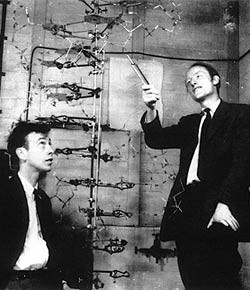
Today medicine changed our approach to diagnosis and cure the illnesses as well as our thinking about longevity. It hard to imagine that DNA sequencing was discover only 60 years ago.
by Lidia Paulinska | Apr 20, 2015
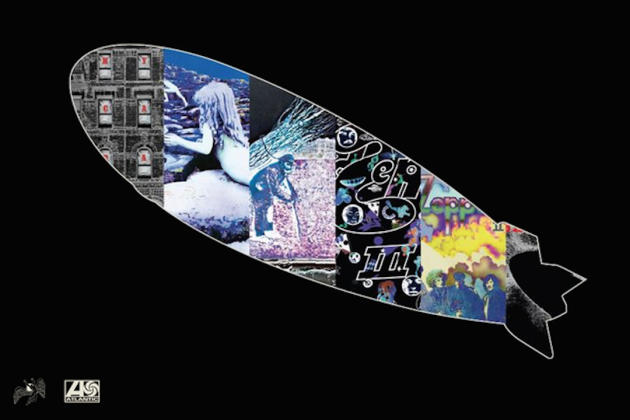
Occasionally in life we have a rare opportunity to re-live some of the more exciting and memorable cultural experience of our past. And so it was this week when we had the unique opportunity to enjoy an extraordinary big-screen showing of selected historic performances by the incomparable Led Zeppelin, one of the most creative and influential rock bands of all time. This one-night-only cinematic extravaganza spanned the band’s incredible career from 1970 to 1979. The film that featured several classic live performances was cleaned up, converted to digital and had the sound track remastered under the oversight of Fathom Events.
Viewers were treated to a larger-than-life concert experience featuring the band’s legendary performance from London’s Royal Albert Hall in January 1970, their historic dates at New York’s Madison Square garden in July 1973, their triumphant five-night run at London’s Earl’s Court in May 1975, and their record-breaking shows at England’s Knebworth Festival in August 1975.
The genius of singer-lyricist Robert Plant, the shrieking guitar brilliance of Jimmy page, the unrelenting power-drive of drummer John Bonham all combine in a synergistic amalgam to create what is probably the greatest rock and roll band has ever known…a seamlessly unified whole that was the sum of its genius parts. And although Led Zeppelin is known as one of the progenitors of heavy metal, the influences that shaped them are varied as their music: acoustic folk ballads, pop guitar, James Brown, country, Motown, traditional riffs, and what’s been called the trance-inducing element of blues repetition, all resulting in such varied works as “Whole Lotta Love” (’69), “Kashmir” (’75), “Rock & Roll” (’71), “All My Love” (’79), and “Stairway to Heaven” (’71).
But their time of personal glory was not to last. In September 1980, drummer John Bonham died suddenly of asphyxiation as a result of alcoholism and the tragedy of that loss marked the end of the magical synergy that was Led Zeppelin. A press release at the time read, “We wish it to be known that the loss of our dear friend, and the deepest sense of undivided harmony by ourselves … have led us to decide that we could not continue as we were. “ Signed simply “Led Zeppelin”. The “undivided harmony” was shattered forever and the music fell silent; the combined effect of all their creative geniuses was essential to sustain the whole and suddenly that unity was lost, but their extraordinary legacy was alive for us this week on the big screen, four decades and a lifetime after its inception, and for that we are very grateful indeed.
by Lidia Paulinska | Apr 19, 2015
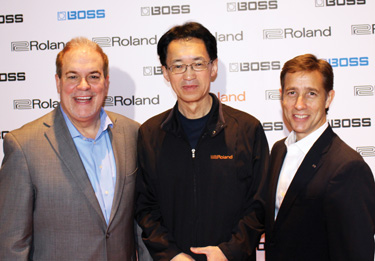
While at NAB 2015, we had a chance to have a 1;1 talk with new Global President of Professional AV for Roland Corp Kim Nunney. Kim steps into this role from his recent position of North American President for Roland Corp. Kim and his team were credited with the turnaround on the North American marketplace for both the consumer and professional products.
To kick off the discussion, as there is so much encroachment of consumer level up into the professional market place with features and motivation to produce more price aggressive and lower entry points of the professional market what is “pro AV for Roland”? Kim defined this space under two themes – the Professional AV space is a B2B marketplace, it deals with performers, studios and stages. The core technologies for these markets are live sound and broadcast audio & video. The Roland path is to develop hardware to simplify the live performance and broadcast control with new UIs for the equipment.
Kim went on to discuss that device they are making are focused on high level content – 4:4:4 for broadcast, 4:2:2 for live events for the video side, 24bit/96K for the audio both in the digital domain. These ae important as the use of the devices for streaming applications should be treated the same as for “live” as they are both temporal delivery without the option to miss capture or mess up on playout. The professional line is for reliability, repeatability and configurability so they can not only be setup as needed, but are always available when call on.
For these applications, the Roland Pro AV products deal with the front end of the signal flow – DRM, wrappers, metadata, security & encryption are done after the hardware in post or before the equipment on ingest. The newest generation of the product are all network integrated and aware, which makes for connectivity on an in-house or hybrid (in-house and cloud) workflow are supported in native mode for the devices.
Kim indicated that the trend is to continue this same high reliability both mechanically and electrically on the products to be able to produce the best live performance & broadcast experience and simplify the control & interface with software.
The company has a strong history in the Pro AV space and the newly re-vitalized Roland is aggressively moving towards delivering new modular products to the market that have the capability to address emerging audio and video standards, without having to make the customers develop new workflows. Kim hopes to be able to duplicate the North American business units success on a global basis with the professional products.