

Artificial intelligence is impacting the music industry at a rapid pace, offering tools for impromptu creation, production, and even performance. Along with text, images, and videos, generative AI can also produce music, assist with songwriting and production, and even replicate voices in a matter of seconds. Deep learning is based through its training data, which through its underlying patterns and structures is used to produce new data based on the input, which often comes in the form of natural language prompts.
There are numerous websites that use this technique, such as Suni, AIVA, Udio just to name a few, that can generate a complete song with music and lyrics in a certain style, mood, instrumentation, genre, and vocal style with just a brief description and a click of a button. These prompts can be entered directly or created using external tools like ChatGPT, which generates the lyrics.
For example, the user can enter into the Suni song description field “a song in the style of classical music about a ballet dancer struggling to find success in her career”. In just seconds with a click on the “create” button, the user will be able to hear a complete song that sounds like it was written by a semi-professional songwriter, with fairly decent lyrics.
Now, anyone can create music…well at least generate it.
Will the listening music public start listening to music produced entirely by A.I. instead of the real music we know and love?
The answer is many of them already are without really knowing it.
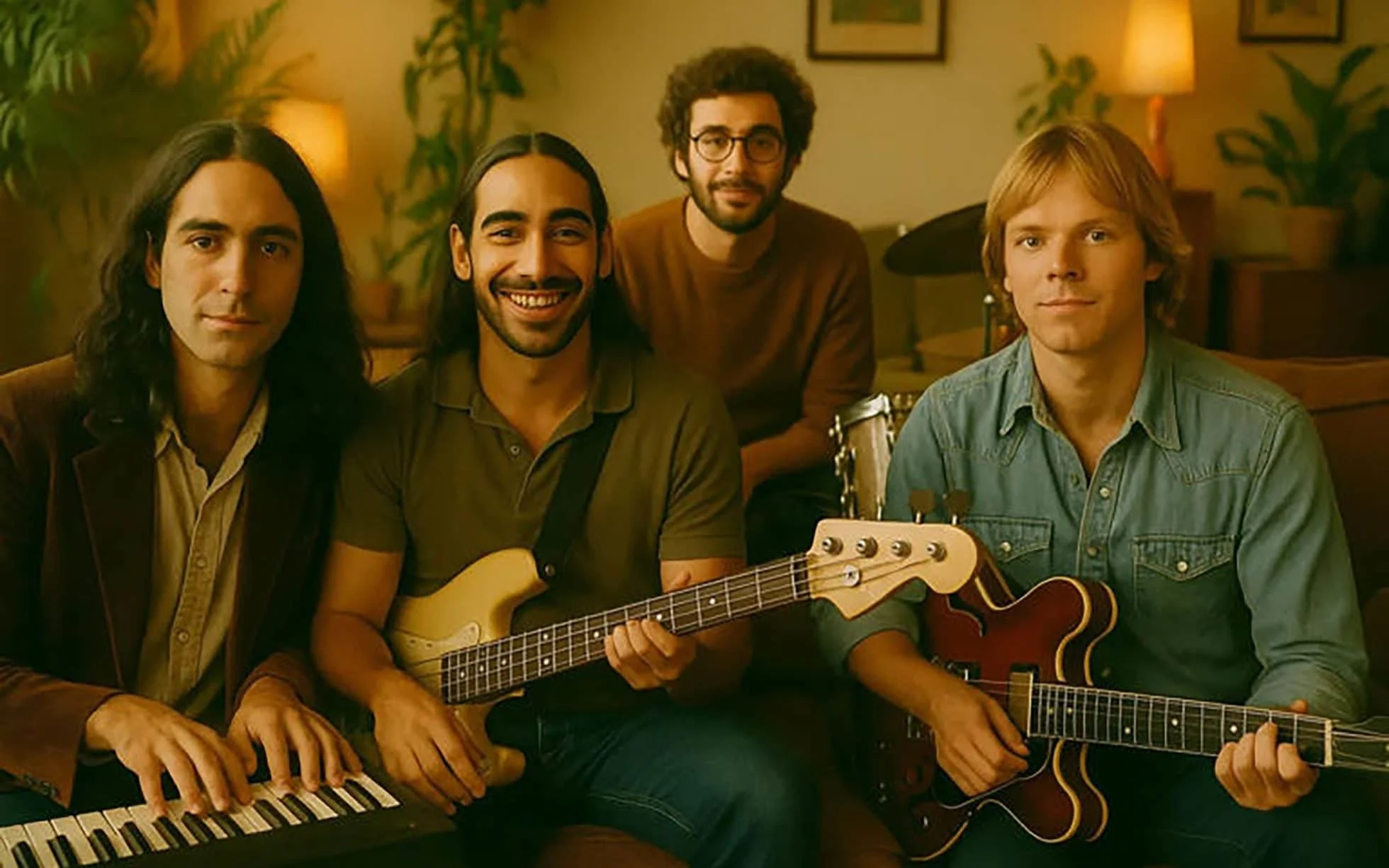
For example, last June, “The Velvet Sundown” (named after “The Velvet Underground”) came out of nowhere and released its first albums on Amazon Music, Apple Music, Spotify as well as other music streaming services: “Floating on Echoes” on June 5, “Dust and Silence” on June 20, and then another on July 14th called “Paper Sun Rebellion”. At their peak, they had well over 900,000 monthly listeners on the streaming platform with their opening track “Dust on the Wind”, (not to be confused with the iconic Kansas song) played over 2.7 million times.
However, there were soon allegations on the bands social media pages that the band was A.I. generated. There was no evidence that this band ever existed. There were no tours, interviews, group websites or any clues whatsoever online. Even many listeners commented that The Velvet Sundown’s music was “soulless” and was missing the “human element”.
The “band” denied all allegations on its X account, claiming it was “absolutely crazy that so-called ‘journalists’ keep pushing the lazy, baseless theory that the Velvet Sundown is ‘AI-generated’ with zero evidence.… This is not a joke. This is our music, written in long, sweaty nights in a cramped bungalow in California with real instruments, real minds and real soul.”
Just a week later, the apparent hoaxer, using the name Andrew Frelon, admitted that he impersonated the band on X and falsely claimed to be a spokesperson for the band in interactions with the media, including a phone interview with Rolling Stone magazine. Frelon finally admitted that the band was 100% A.I. generated using the Suni platform for all the “band”.
“It’s marketing. It’s trolling. People before, they didn’t care about what we did, and now suddenly, we’re talking to Rolling Stone, so it’s like, ‘Is that wrong?’” Frelon questioned.
As with the Spotify subscriber numbers since the “bands” breaking news, over 500,000 subscribers removed their names from the “bands” playlists, a drop of 55% from its peak, as it continues to drop quickly on a daily basis.
The bands Spotify bio eventually changed their description:
“All characters, stories, music, voices and lyrics are original creations generated with the assistance of artificial intelligence tools employed as creative instruments. Any resemblance to actual places, events or persons – living or deceased – is purely coincidental and unintentional. Not quite human. Not quite machine. The Velvet Sundown lives somewhere in between.”
The real issue is its sudden emergence of its popularity and a growing concern about the future of art, culture and authenticity in the era of advanced generative artificial intelligence. It’s both astounding and appalling that music from A.I. can amass and defraud so many listeners in a relatively short amount of time.
“Personally, I’m interested in art hoaxes,” Frelon continues. “The Leeds 13, a group of art students in the U.K., made, like, fake photos of themselves spending scholarship money at a beach or something like that, and it became a huge scandal. I think that stuff’s really interesting.… We live in a world now where things that are fake have sometimes even more impact than things that are real. And that’s messed up, but that’s the reality that we face now. So it’s like, ‘Should we ignore that reality? Should we ignore these things that kind of exist on a continuum of real versus fake or kind of a blend between the two? Or should we dive into it and just let it be the emerging native language of the internet?’”
In another similar hoax “project” from decades ago, one can’t forget the infamous story of the pop group Milli Vanilli and it’s producer Frank Farian, who may have pulled the biggest hoax in popular music history: selling over 7 million albums and 30 million singles, and winning a Grammy for “Best New Artist” by deceiving the public with a pair of lip-synching performance artists who did not sing one note on their records.
Even with the regret and humiliation that Milli Vanilli producer Frank Farian went through, at least their end product was “real music” that used professional musicians and was produced in a recording studio. That takes real talent.
In a notable moment for the music industry, an A.I.-assisted Beatles song, “Now and Then,” won the Grammy for Best Rock Performance in 2025. It was the first time an AI-assisted song received one.I-assisted song received one.
You can credit director Peter Jackson and his production team who worked on the 2021 “The Beatles – Get Back” documentary. They developed an A.I. tool (MAL) for the film and discovered that they could use it to extract John Lennon’s voice from a demo cassette tape recorded in 1974 that originally had Lennon’s piano and vocal on it. They were able to isolate the tracks mixed into a 2 track master and later combined the original 1995 guitar tracks that George Harrison recorded from their “Now and Then” recording session along with McCartney and Starr, who decided to re-record their tracks in 2023 for a true authentic Beatles recording.
Currently, unless you have access to Peter Jacksons MAL A.I. tool, it appears the only way to tell if the music is A.I. generated is if you have software such as Apple’s Logic Pro track splitter and finding “artifacts” from the inputted music files, as music producer Rick Beato calls it.
Also, the music streaming app Deezer, also uses its own tool to identify AI-generated content and declared that 100% of The Velvet Sundown’s tracks were created using A.I. Deezer labels that content on its site, ensuring that AI-generated music does not appear on its recommended playlists and that royalties are maximized for human artists.
Unlike generative A.I., there is nothing fake with the Fab Four latest song, “Now and Then”… it’s just real music with real musicians with a little help from A.I. and their friends; producers Peter Jackson, Giles Martin and George Martin with all of the original Beatles back together again.
“Imagine” that.
Originally published on https://mlsentertainment.com/2025/08/31/milli-vanilli-or-the-velvet-sundown-discerning-real-music-in-the-a-i-era/
