For years, the conversation centered on a simple comparison: human intelligence versus artificial intelligence. Then came a new generation of AI capable of generating text, images, music, and code. Today, the conversation is evolving once again with the emergence of Agentic AI—systems that don’t simply answer questions but can plan, reason, and carry out tasks on our behalf.
Understanding these three forms of intelligence is essential because they represent three very different capabilities.
Experiential Intelligence (EI) applies human wisdom.
Agentic AI takes action.
Rather than competing with one another, they represent three complementary layers of intelligence.
Artificial Intelligence (AI): Intelligence That Knows
Artificial Intelligence excels at recognizing patterns, analyzing enormous amounts of data, generating content, and answering questions with remarkable speed. Its greatest strength is computation. AI can summarize thousands of pages in seconds, identify trends hidden within millions of data points, and generate ideas almost instantly. However, traditional AI remains largely reactive—it responds when prompted. It knows.
Experiential Intelligence (EI): Intelligence That Understands
Experiential Intelligence is uniquely human. It develops through lived experience, personal relationships, successes, failures, intuition, and emotional growth. It is the intelligence that allows us to read between the lines, recognize subtle emotions, exercise ethical judgment, and make decisions when there is no obvious right answer.
While AI processes information, EI interprets meaning. AI may know every fact about leadership. Experiential Intelligence understands what it feels like to lead during uncertainty.
AI can explain empathy. Experiential Intelligence practices it.
Agentic AI: Intelligence That Acts
Agentic AI represents the next stage in the evolution of artificial intelligence. Instead of simply answering questions, it can pursue goals.
Give an Agentic AI an objective such as: “Plan my business trip.”
Rather than producing a list of suggestions, it can search for flights, compare hotels, organize an itinerary, reserve appointments, prepare meeting notes, update your calendar, and notify colleagues—all with minimal human intervention.
In other words, Agentic AI doesn’t simply generate information. It performs work. The difference is subtle but significant.
Traditional AI is like an exceptionally knowledgeable advisor. Agentic AI is more like an executive assistant capable of carrying out a sequence of tasks.
The Three Forms of Intelligence
Artificial Intelligence (AI)
Experiential Intelligence (EI)
Agentic AI
Learns from data
Learns from life
Learns from data and objectives
Recognizes patterns
Exercises judgment
Plans and executes tasks
Answers questions
Understands people and context
Pursues goals autonomously
Excels at speed and scale
Excels at wisdom and empathy
Excels at productivity and automation
Generates information
Creates meaning
Delivers outcomes
The Future Belongs to All Three
The future is not a contest between humans and machines. It is a collaboration between different forms of intelligence. Artificial Intelligence gives us knowledge. Experiential Intelligence gives us wisdom. Agentic AI gives us execution.
Imagine a physician diagnosing a patient. AI analyzes millions of medical records and identifies possible conditions. Experiential Intelligence enables the physician to understand the patient’s fears, family circumstances, and personal values. Agentic AI schedules appointments, coordinates specialists, orders laboratory tests, monitors follow-up care, and manages the administrative workload.
Each contributes something the others cannot.
The greatest opportunities will come not from choosing one form of intelligence over another, but from learning how to combine them wisely. As Agentic AI becomes more capable, Experiential Intelligence will become even more valuable. The more decisions we delegate to machines, the more important human judgment, ethics, empathy, and accountability become.
Technology can become increasingly intelligent. But only people can decide what is worth doing—and why.
Chapter 1 – Stop Calling It Artificial Intelligence
“When people hear the words ‘artificial intelligence,’ many react the same way they would to hearing ‘root canal.’ They simply don’t want to hear the term anymore.”
Perhaps the first challenge facing AI isn’t the technology itself but the language surrounding it. The phrase artificial intelligence has become so overused that it often creates anxiety rather than excitement. Before we explain what AI can do, people have already formed an opinion based on the name alone.
Maybe it’s time to rethink how we describe this technology.
Chapter 2 – From Artificial Intelligence to Augmented Intelligence
“Artificial intelligence isn’t replacing human thinking—it should be augmenting it.”
Some experts prefer the term Augmented Intelligence, emphasizing collaboration instead of replacement. In this view, AI is a tool that strengthens human decision-making through machine learning and deep learning.
The goal is not to create machines that think instead of us. The goal is to help people think better, make better decisions, and accomplish more than they could alone.
Chapter 3 – The Best AI Is Invisible
“Good AI reduces cognitive load.”
Technology succeeds when it quietly removes unnecessary effort from our daily lives. If interacting with AI requires extra steps, more typing, or additional mental work, it has failed its purpose.
The best products are intuitive. They work naturally, almost invisibly, allowing people to focus on their goals rather than the technology itself.
Great AI should disappear into the background.
Chapter 4 – Humans Should Stay in Control
“AI should always have an off switch.”
No matter how advanced intelligent systems become, users should always retain the ability to decide when AI assists them and when they rely entirely on their own judgment.
Control builds trust. AI should remain a tool—not the decision maker.
Chapter 5 – AI Should Make Humans Bigger, Not Smaller
“The best AI makes humans better—not smaller.”
Many AI demonstrations focus on proving that computers are smarter than people. That message unintentionally creates fear, especially among designers, artists, writers, and other creative professionals.
A healthier vision sees AI as a collaborator rather than a competitor. Technology should amplify human creativity, curiosity, and productivity instead of diminishing our confidence or replacing our role.
Chapter 6 – Maybe We Need a New Name
“Perhaps we shouldn’t call it AI anymore.”
Names shape expectations. Instead of Artificial Intelligence, perhaps terms like Experiential Intelligence or other human-centered descriptions would better communicate the value these systems provide.
Consumers rarely care whether a product is intelligent. They care whether it improves their lives.
Chapter 7 – Intelligence Isn’t the Product
“Maybe we should call it Artificial Work Ethic.”
People don’t buy products because they’re smart. They buy products because they save time, simplify tasks, reduce frustration, or help them accomplish something more efficiently.
The real value of AI isn’t intelligence—it is usefulness.
Chapter 8 – Solving Real Problems
Every new technology promises to be faster, smarter, and more powerful.
But consumers ask a much simpler question: What problem does this solve for me?
If AI cannot answer that question clearly, its intelligence becomes irrelevant.
Chapter 9 – Beyond the Hype
“Yesterday everything was smart. Today everything is AI-powered.”
Technology constantly reinvents its vocabulary. Often, the underlying product hasn’t changed nearly as much as the marketing language surrounding it.
Eventually AI will become so common that companies may stop advertising it altogether, just as nobody advertises products as “electricity-powered.” AI will simply become an expected capability.
Chapter 10 – AI Is Democratizing Creativity
“One thing AI has done exceptionally well is democratize entire professions.”
People no longer need years of formal training to begin creating. Writers can generate illustrations. Designers can write code. Programmers can compose music. Filmmakers can produce visual effects once reserved for large studios.
AI lowers barriers and allows individuals to explore creative fields that were previously inaccessible.
Chapter 11 – Why Do We Humanize AI?
“People instinctively say “please” and “thank you” to chatbots.”
We assign personalities to software. We describe machines as if they have intentions and emotions. Yet AI remains software—not consciousness.
Our tendency to humanize technology says as much about human psychology as it does about artificial intelligence itself.
Chapter 12 – Science Fiction Set Our Expectations
“There’s one elephant in the room nobody talks about.”
For generations we have grown up watching Star Wars, Star Trek, and Stargate. Their robots and computers understood context, emotion, humor, and human behavior almost effortlessly.
What we often forget is that those “intelligent machines” were fictional characters portrayed by actors and writers.
Real AI is very different.
It is powerful, impressive, and rapidly improving—but it is still far from the effortless intelligence we imagined in science fiction. Perhaps our greatest challenge isn’t building better AI. Perhaps it’s adjusting our expectations to match reality.
Universal Studio’s “The Odyssey” broke major pre-sale and box office records, including an unprecedented early launch where select IMAX 70mm tickets went on sale a full year in advance in July 2025. 95% of the seats of the limited 25-theater U.S. network able to show IMAX 70 mm vanished within the first hour.
To those who bought the $35 tickets early, the investment certainly paid off as the ticket prices today have been going through the roof at astronomical prices on e-bay.
It was reported last week that getting a ticket to “The Odyssey” in true IMAX 70 mm has become an epic journey of its own and fans are battling over sold-out showings at the city’s only capable theater as some resellers are demanding over $1,000 for a single seat at the Upper West Side’s AMC Lincoln Square 13 in New York.
Why are these tickets so highly sought after? Once you see the YouTube video below comparing IMAX 70mm (1:43:1) vs Standard (2:39:1), you’ll see why.
IMAX comparison vs Standard Widescreen for “The Odyssey” trailer
If there is any one director who has been pushing the technical boundaries of filmmaking in the last twenty years, it’s Christopher Nolan. He has been the major force getting people back to the “big screen”, whether it’s IMAX or in the regular movie theater. Every one of his movies that have been released have become must-see “events”, whether it’s his Batman films or his 2023 Best Picture winner, “Oppenheimer”.
Nolan has utilized IMAX 70 mm since 2008. No one will ever forget the opening sequence of the bank robbery to “The Dark Knight”, if they experienced it in IMAX 70 mm. Arguably, the most immersive action scene ever filmed in cinematic history. IMAX Audiences immediately felt like they were physically pulled right into the chaos of Gotham City streets.
The next five films that he directed, “The Dark Knight Rises” (2012), “Interstellar” (2014), “Dunkirk”(2017), “Tenet” (2020), and “Oppenheimer” (2023) tallied between 66 and 75 minutes of IMAX footage.
With “The Odyssey”, he has done what no other feature film director has done: made a full feature live action film shot entirely with IMAX cameras.
IMAX cameras and the underlying 15/70mm film system were developed in 1967. It was primarily utilized for specialized museum films, science centers, and nature documentaries due to the massive weight, loud noise, and short 2.5 to 3 minute runtimes of the analog equipment. Due to these limitations, filmmakers have only used IMAX for specific, large-scale action sequences until now.
The custom IMAX camera systems used for The Odyssey weighed around 400 pounds (181 kg) fully built. Developed specifically for the film, the camera—named the “Keighley” after longtime IMAX collaborator David Keighley—required a massive sound-dampening blimp to muffle the mechanical noise of the film movement for the dialogue scenes.
These cameras were notably quieter and smaller than the traditional 100+ pound OG IMAX cameras previously utilized. Despite the weight reduction for the new camera body, the massive acoustic enclosure system—described by the crew as being the “size of a coffin”—pushed the total weight of the rig to over 300 to 400 pounds, requiring special steel plating on the dollies to support it.
Now that “The Odyssey” is breaking box-office records at all the movie theaters globally, it’s a little discouraging that not everyone will be seeing the film as it was intended to be seen; in one of the twenty five IMAX theaters that are able to show it in the way Christopher Nolan intended it.
Artificial Intelligence has become one of the most talked-about technologies of our time, yet it is also one of the most misunderstood. Part of the confusion comes from the growing list of names used to describe it. Depending on whom you ask, AI is called Artificial Intelligence, Augmented Intelligence, Generative AI, Machine Intelligence, Cognitive Computing, Human-Centered AI, or even Adaptive Intelligence.
Each new name reflects a different attempt to explain the technology from a particular perspective. Engineers emphasize how AI works. Business leaders focus on the value it creates. Marketers search for language that sounds exciting and approachable. Ethicists highlight the importance of responsible and human-centered design.
Yet beneath these different labels lies the same fundamental question:
What role should intelligent technology play in our lives?
Should AI replace human effort, or should it amplify human potential?
Should it make decisions for us, or help us make better decisions ourselves?
Perhaps the answer lies not in finding another new name for AI, but in recognizing that there are two very different kinds of intelligence working together.
One is artificial—built from data, algorithms, and computational power.
The other is deeply human—shaped by experience, judgment, intuition, empathy, and wisdom.
I call this second form Experiential Intelligence (EI).
Rather than competing with Artificial Intelligence, Experiential Intelligence reminds us that technology is at its best when it enhances what makes us uniquely human.
Experiential Intelligence vs. Artificial Intelligence
Experiential Intelligence (EI) is the ability to apply knowledge, wisdom, and skills gained through personal experience. It is shaped by emotions, relationships, intuition, and the unique circumstances of real life. Rather than relying solely on facts, experiential intelligence draws upon human judgment, empathy, and contextual understanding to solve problems and make decisions.
Artificial Intelligence (AI), by contrast, processes vast amounts of data, identifies patterns, and generates predictions based on algorithms and machine learning. While AI can recognize emotional cues and simulate human conversation, it does not possess genuine emotions, personal experiences, or self-awareness.
Rather than competing with one another, experiential intelligence and artificial intelligence serve different purposes. AI excels at speed, scale, and analytical precision, while human experiential intelligence provides the judgment, ethical reasoning, creativity, and emotional understanding that machines cannot replicate. Together, they have the potential to complement each other, combining computational power with human wisdom.
Key Differences Between Experiential Intelligence and Artificial Intelligence
Learning Through Experience Experiential intelligence develops through lived experiences, reflection, and continuous personal growth. Artificial intelligence, on the other hand, learns from large datasets using algorithms and statistical models rather than firsthand experience.
Emotional Understanding Human experiential intelligence naturally incorporates empathy, compassion, emotional awareness, and ethical judgment. Although AI can recognize patterns associated with emotions and respond accordingly, it does not genuinely understand or experience human feelings.
Contextual Judgment Experiential intelligence allows people to interpret subtle social cues, cultural differences, and unique circumstances that often influence decision-making. AI primarily depends on patterns in data and predefined models, which may overlook important contextual nuances.
Adaptability Humans continuously adapt by drawing on past experiences and applying lessons learned to new situations. AI systems can improve over time, but they generally require additional training, updated data, or algorithmic adjustments before adapting to unfamiliar conditions.
Complementary Strengths
The future is not about choosing between human intelligence and artificial intelligence—it is about combining the strengths of both. AI can automate repetitive tasks, analyze massive amounts of information, and accelerate decision-making. Experiential intelligence contributes wisdom, creativity, ethical reasoning, emotional connection, and the uniquely human ability to navigate uncertainty.
The greatest breakthroughs will occur when artificial intelligence enhances human experiential intelligence rather than attempting to replace it.
Artificial intelligence is no longer just another layer of software. It is rapidly becoming the foundation of modern computing itself.
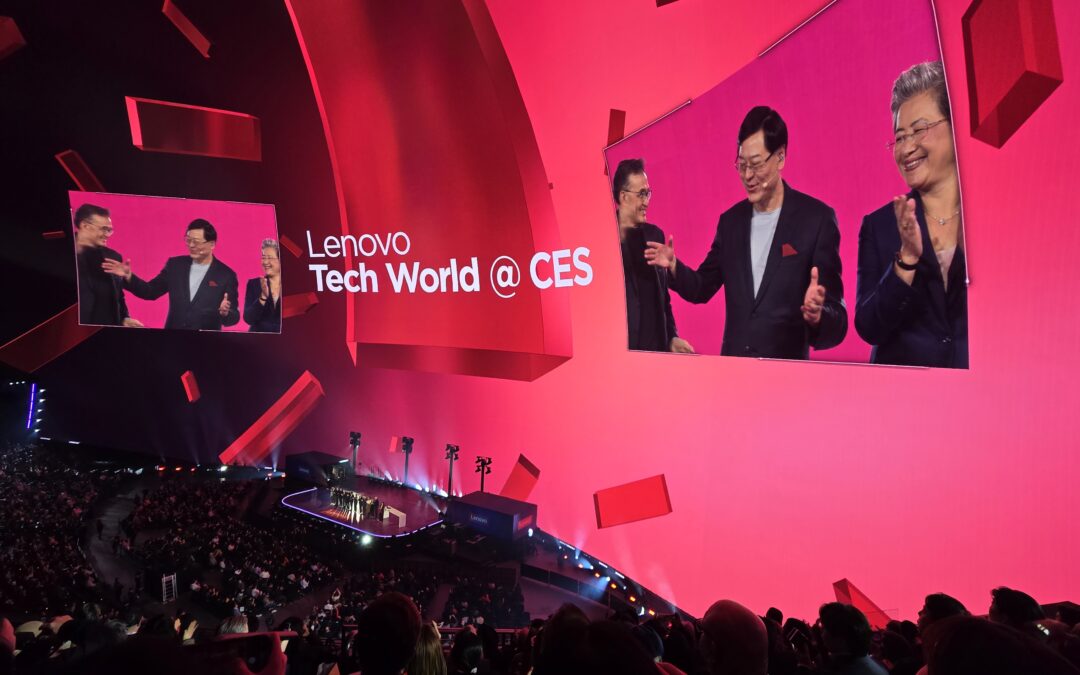
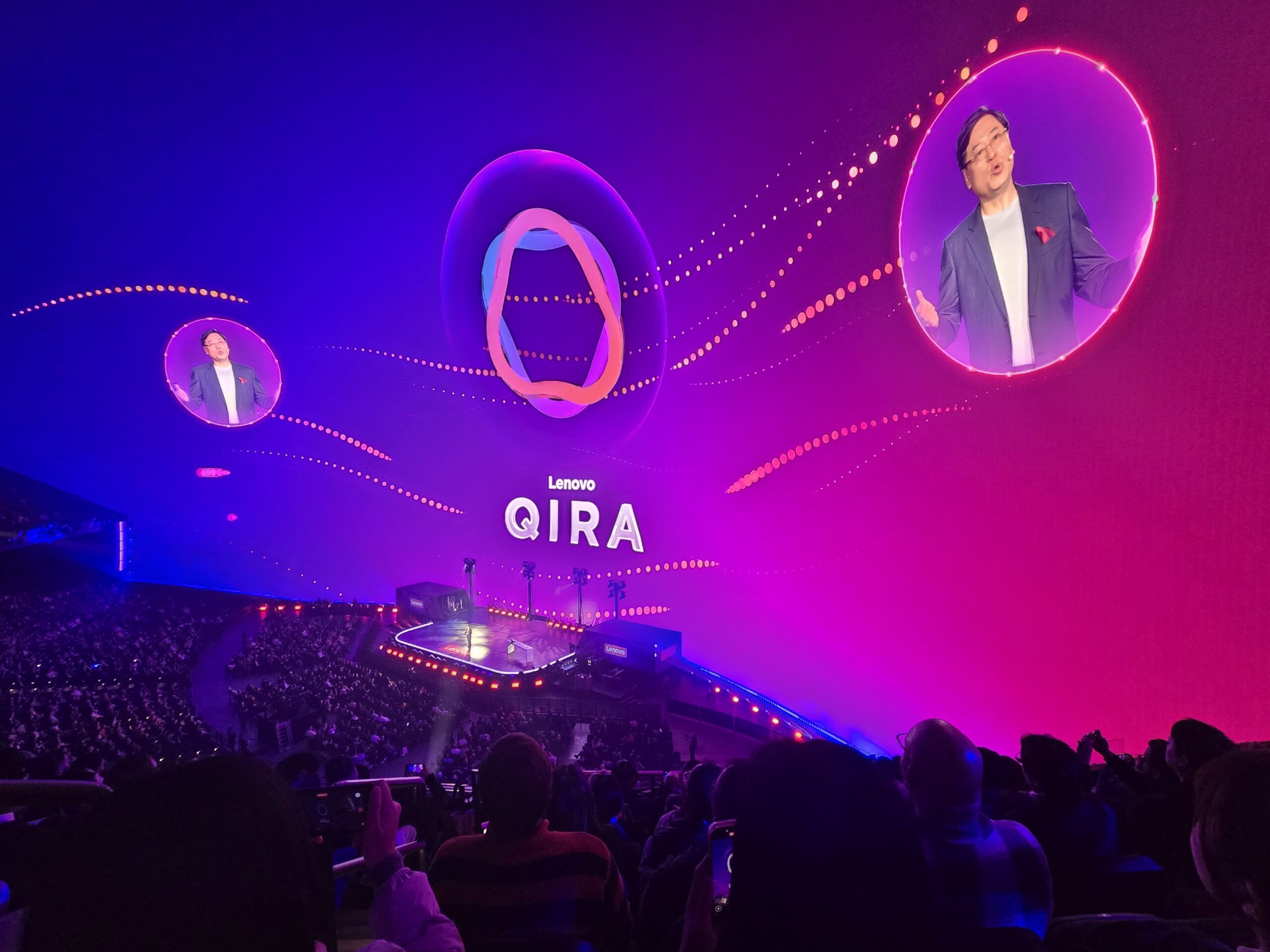
That message was unmistakable on Wednesday night as Lenovo hosted its annual Tech World event at the Sphere, Las Vegas’s landmark venue opened in September 2023. The scale of the setting matched the ambition of the message: the Sphere stands 366 feet high and 516 feet wide, spans 875,000 square feet, seats 18,600 people, and features a sound system of 167,000 individually amplified loudspeakers. Built over five years at a cost of $2.3 billion, it has quickly become one of the most technologically advanced entertainment venues in the world.
Against this backdrop, Lenovo Chairman and CEO Yuanqing Yang welcomed an extraordinary lineup of global technology leaders and partners to the stage, including Jensen Huang, founder and CEO of NVIDIA; Lip-Bu Tan, CEO of Intel; Cristiano Amon, president and CEO of Qualcomm; Dr. Lisa Su, chair and CEO of AMD; Yusuf Mehdi, executive vice president and consumer CMO of Microsoft; Angelina Gomez, Motorola’s head of software marketing; Jennifer Koester, president and CEO of Sphere; and Gianni Infantino, president of FIFA.
The event featured multiple product announcements and partnership reveals, capped by Lenovo’s unveiling of its new personal AI platform, Qira—a unified AI system designed to deliver seamless, real-time intelligence across devices and platforms. But beyond individual products, the message from global tech leaders was clear and consistent: AI is no longer an application layer—it is becoming the operating system of the future.
From Classical Computing to AI-Native Systems
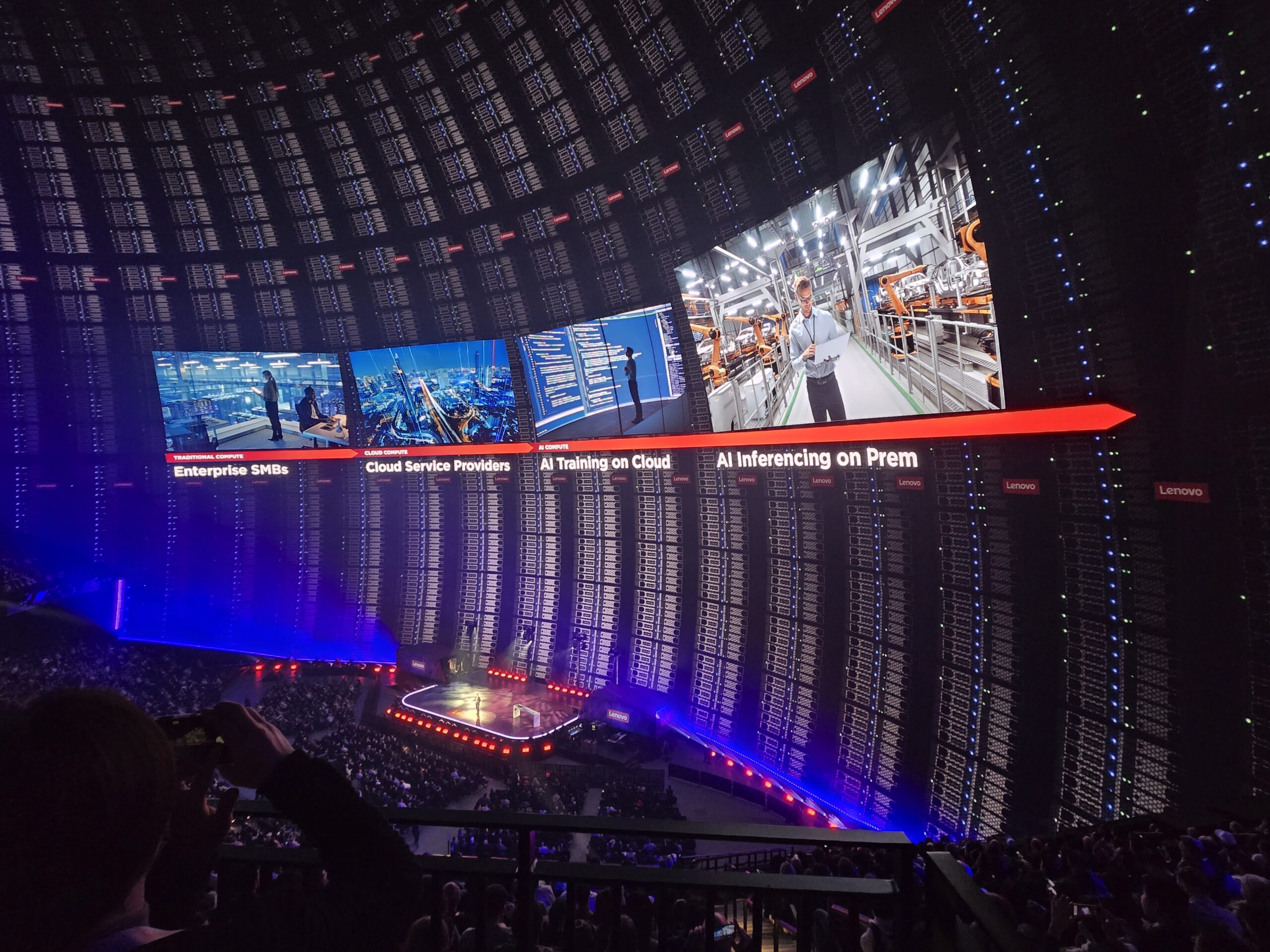
For decades, enterprise computing was built around applications written for CPUs and deployed in conventional data centers. That model is now rapidly being replaced by AI-native systems, where software is designed around large language models and executed on GPU-based, accelerated infrastructure.
Industry leaders described this transition as nothing less than a reinvention of the global IT landscape. Trillions of dollars in legacy systems, they said, will need to be modernized to support AI-driven workloads.
“This is not just a platform change,” one executive noted. “It’s a reinvention of the entire computing stack.”
AI Factories and Accelerated Infrastructure
At the core of this transformation is the emergence of what companies now call AI factories—purpose-built data centers designed specifically for AI training, inference, and deployment.
Unlike traditional data centers, these facilities are optimized for massive parallel processing, high-throughput workloads, and large-scale model operations. NVIDIA outlined multiple generations of accelerated computing platforms driving this shift, including Hopper, Blackwell, and the newly announced Vera Rubin architecture.
Each generation delivers exponential performance gains while lowering the cost of AI computation, making enterprise-scale AI deployment increasingly economically viable.
Agentic AI and the Explosion of Compute Demand
Another dominant theme was the rise of agentic AI—systems designed not merely to generate responses, but to reason, plan, reflect, and act autonomously.
These systems generate so-called “thinking tokens,” representing internal reasoning, decision-making, and multi-step planning processes. As AI models grow in complexity, computing demands are expanding rapidly. Executives noted that model sizes are already moving from hundreds of billions of parameters into the multi-trillion range, driving exponential growth in infrastructure requirements.
Hybrid AI: Intelligence Across Devices and Cloud
Lenovo outlined a hybrid AI architecture that distributes intelligence across multiple layers: personal devices, edge systems, private cloud environments, and large-scale AI factories.
In this model, smaller AI systems operate locally on devices, while larger models run in cloud infrastructure. Tasks are dynamically routed based on latency, performance, cost, and security requirements. The goal is to make AI more accessible while reducing complexity for both users and organizations.
Partnerships Powering Global Deployment
Strategic partnerships were presented as critical to scaling AI infrastructure worldwide.
Lenovo and NVIDIA announced an expanded collaboration to deploy AI factories globally, combining NVIDIA’s accelerated computing platforms with Lenovo’s manufacturing scale, cooling systems, and global services infrastructure. The objective: reduce deployment complexity and dramatically shorten the time from installation to operational AI use.
Intel and Lenovo also reaffirmed their long-standing partnership, focusing on AI-powered PCs, enterprise systems, and data center platforms designed to support AI workloads across devices and cloud environments.
From Intelligence to Action
Speakers emphasized that AI is moving beyond analytics and insight generation toward real-time action and automation.
Next-generation AI systems are increasingly being designed to execute workflows, manage operations, coordinate tasks, and operate autonomously across enterprise systems. This shift is expected to reshape industries including manufacturing, logistics, healthcare, entertainment, and even global sporting events.
A New Computing Era
Leaders at CES 2026 framed the current transition as one of the largest technological shifts in modern history—comparable to the rise of the internet or mobile computing.
In this new paradigm:
AI systems replace traditional application frameworks
The result is the emergence of an AI-native digital ecosystem.
Looking Ahead
As AI infrastructure, models, and systems continue to evolve, the boundaries between software, hardware, and intelligence are rapidly dissolving.
What is emerging is not simply a new generation of technology, but a new foundation for digital society—one in which intelligence itself becomes infrastructure.
At CES 2026, that future no longer appeared theoretical.
It is already being built.
The evening concluded with a live performance by Gwen Stefani, showcasing the Sphere’s immersive audio-visual capabilities and underscoring the fusion of technology, entertainment, and AI-driven experiences.
At the press conference Bosch executives: Tanja Rückert, board member and Paul Thomas, president of Bosch in North America unveiled a sweeping vision of how artificial intelligence and software are reshaping everyday life—from verifying product authenticity to redefining cooking, mobility, and industrial productivity. Drawing on its deep expertise across both the physical and digital worlds, Bosch demonstrated how intelligent technology can reduce complexity, eliminate stress, and empower people across skill levels.
Fighting Counterfeiting With AI
Bosch opened by introducing a revolutionary AI-powered authenticity verification technology. Using live video analysis, the system can quickly and reliably determine whether an item—such as sneakers, car parts, or artwork—is genuine. By bridging the physical and digital divide, this innovation has the potential to significantly disrupt the global counterfeiting industry and strengthen consumer trust.
AI That Serves People at Home
At the core of Bosch’s philosophy is a simple principle: technology should serve people, not the other way around. Nowhere is this more evident than in the kitchen. Bosch showcased how generative AI combined with advanced sensors can elevate cooking for everyone—from home cooks to professional chefs.
Celebrity chef Marcel Vigneron demonstrated Bosch Cook AI, a next-generation cooking assistant that builds on the brand’s AutoChef induction technology. By analyzing ingredients through images, understanding user preferences, and monitoring food in real time with Bluetooth temperature probes, the system precisely controls heat and cooking time to deliver consistent, high-quality results. The goal is not to replace human creativity, but to remove uncertainty and stress from cooking.
Appliances That Improve Over Time
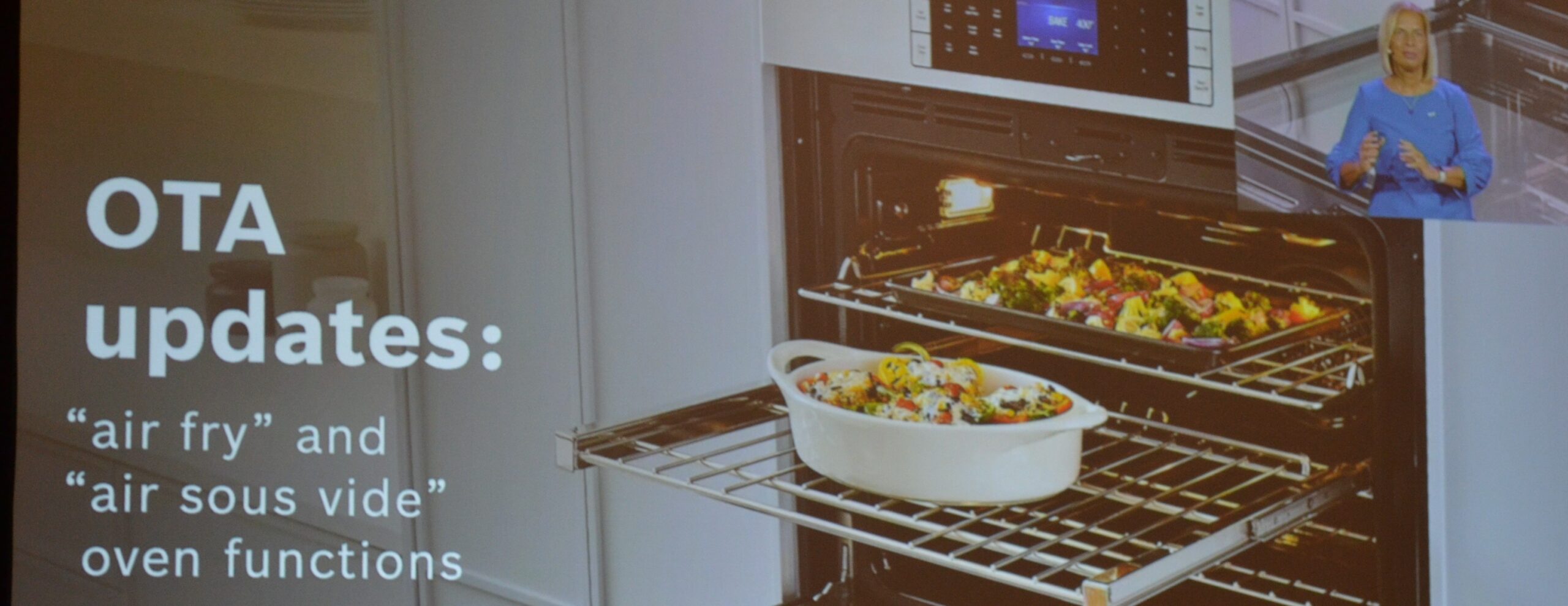
Bosch emphasized that modern appliances no longer need to be replaced to gain new features. Through connectivity and over-the-air software updates, existing Bosch products can evolve long after purchase. Recent updates have added new cooking functions, such as air fry and advanced heating modes, to connected ovens at no additional cost—demonstrating Bosch’s commitment to long-term value.
Software-Defined Mobility
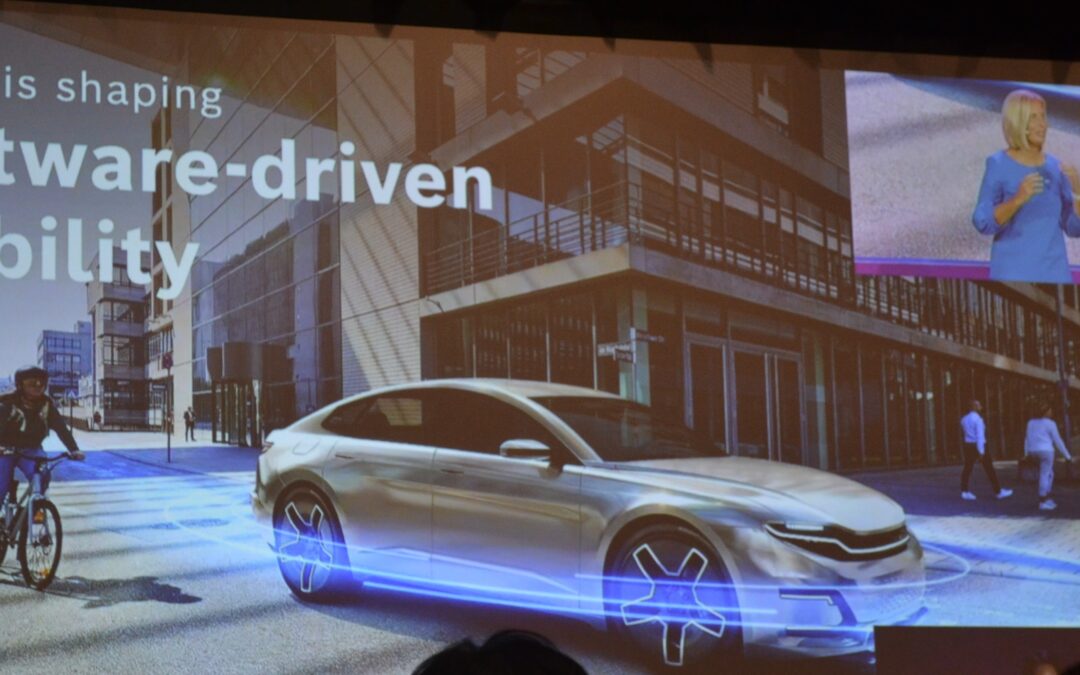
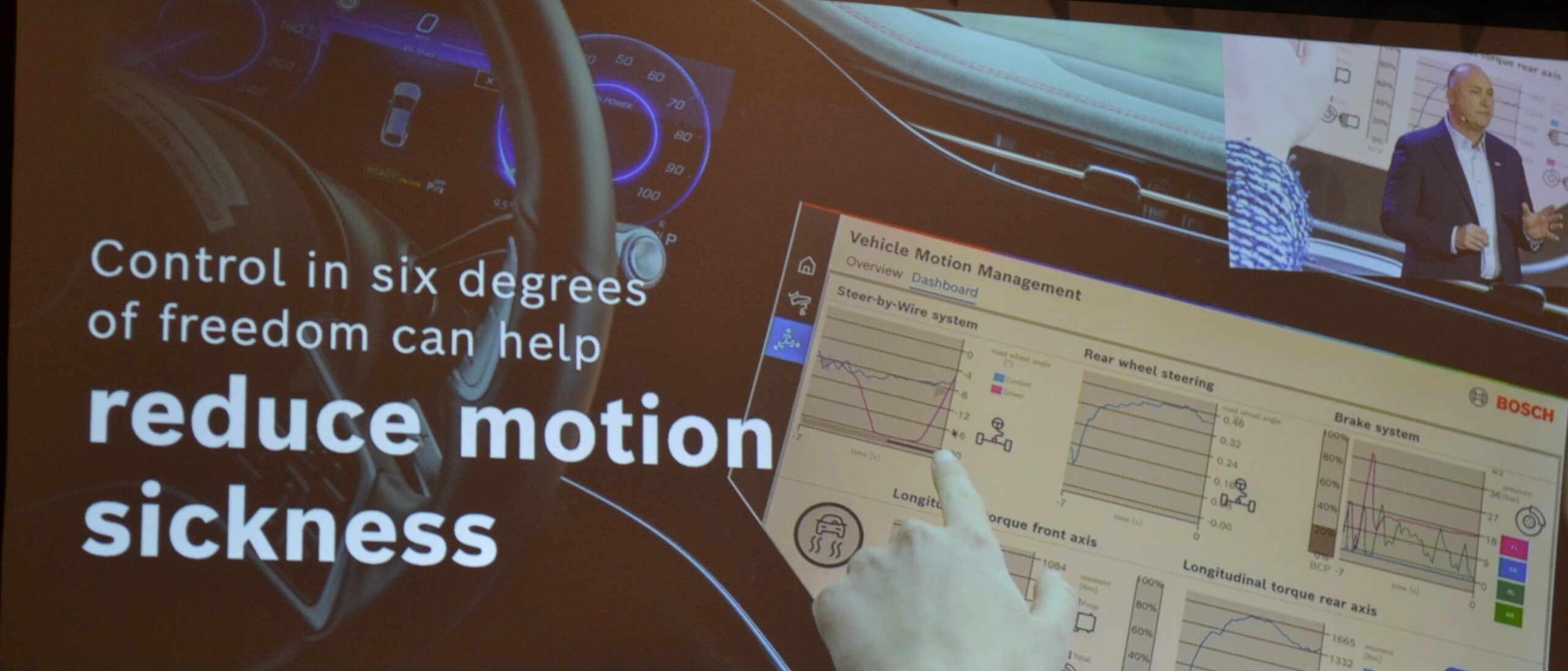
Beyond the home, Bosch highlighted how its software and hardware integration is transforming mobility. Its vehicle motion management technology allows cars to gain new driving modes and personalization features even after leaving the dealership. By intelligently coordinating braking, steering, powertrain, and suspension systems, Bosch’s software can improve comfort, safety, and driving dynamics.
One major advancement is six-degrees-of-freedom vehicle control, which helps significantly reduce motion sickness—an issue affecting a large portion of adults and a major barrier to autonomous driving adoption.
Building the Future of Software-Defined Vehicles
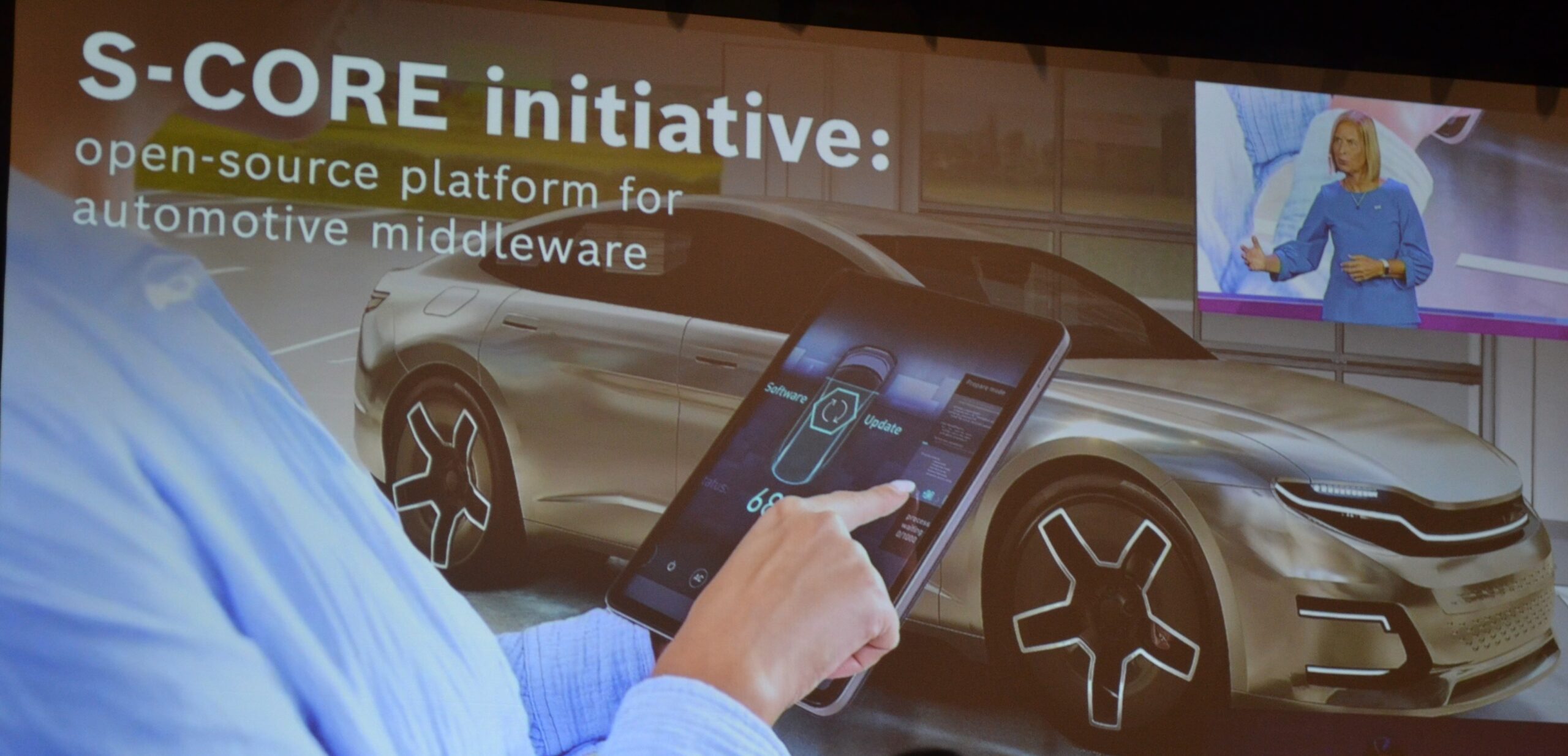
Bosch is playing a key role in the shift toward software-defined vehicles, a market projected to exceed one trillion dollars by the end of the decade. The company is developing open, high-performance middleware platforms that act as the “nervous system” of modern vehicles, simplifying development, lowering costs, improving security, and accelerating innovation for automakers worldwide.
Bosch also announced progress in key technologies such as steer-by-wire and brake-by-wire systems, essential components for future automated and autonomous vehicles. These systems are already moving into large-scale production with major global automakers.
AI That Sees, Hears, and Understands
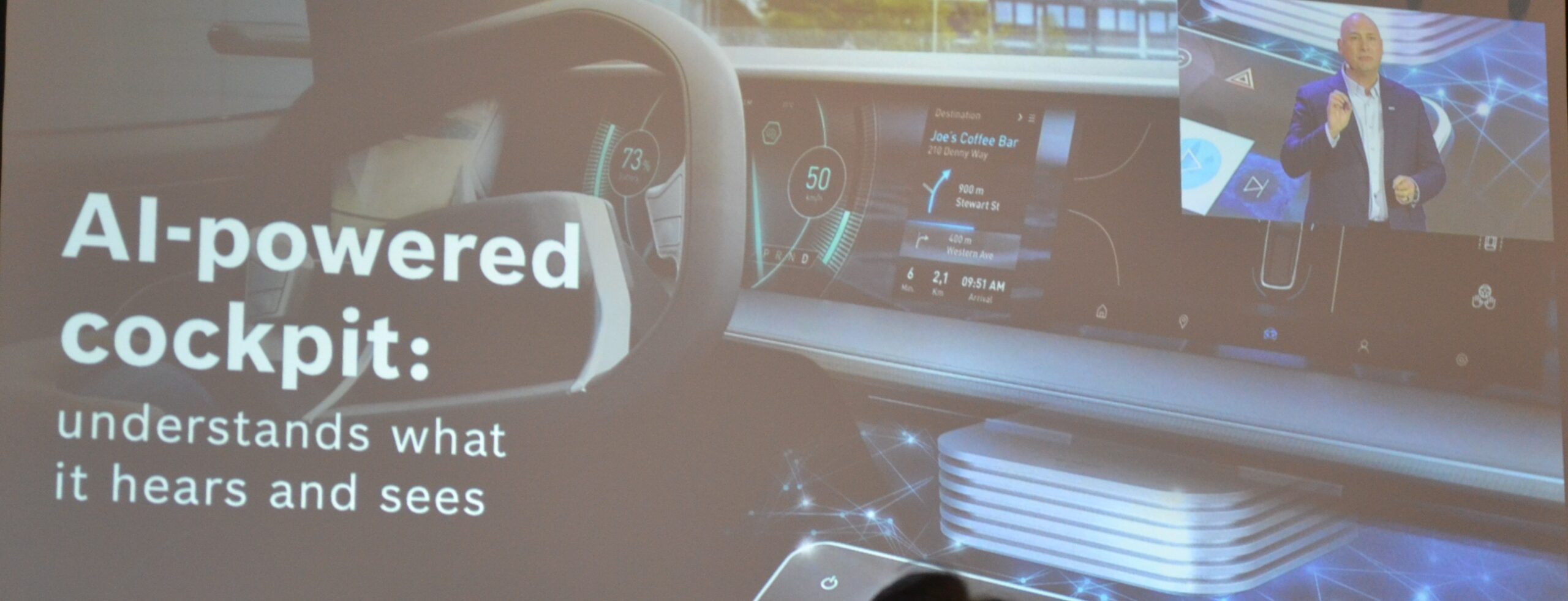
Artificial intelligence is central to Bosch’s automotive roadmap. The company showcased AI-powered cognitive vehicles capable of both seeing and hearing through advanced language models. These systems enable natural conversations with vehicles, intelligent perception of surroundings, automated parking, and even real-time meeting assistance while driving or riding as a passenger.
Bosch expects AI-based solutions for assisted and automated driving to become a multi-billion-euro business by 2035.
AI for Industry and Productivity
Bosch also demonstrated how its AI expertise extends into industrial applications. By partnering with technology leaders such as Microsoft, Bosch aims to apply generative AI to manufacturing environments, boosting productivity, efficiency, and flexibility in increasingly complex industrial operations.
A Unified Vision
Across all domains—consumer goods, mobility, and industry—Bosch’s message was consistent: its strength lies in combining hardware, software, and AI into complete systems and ecosystems. Rather than offering isolated components, Bosch is building intelligent platforms that deliver real-world benefits, improve quality of life, and prepare society for a more connected, automated future.
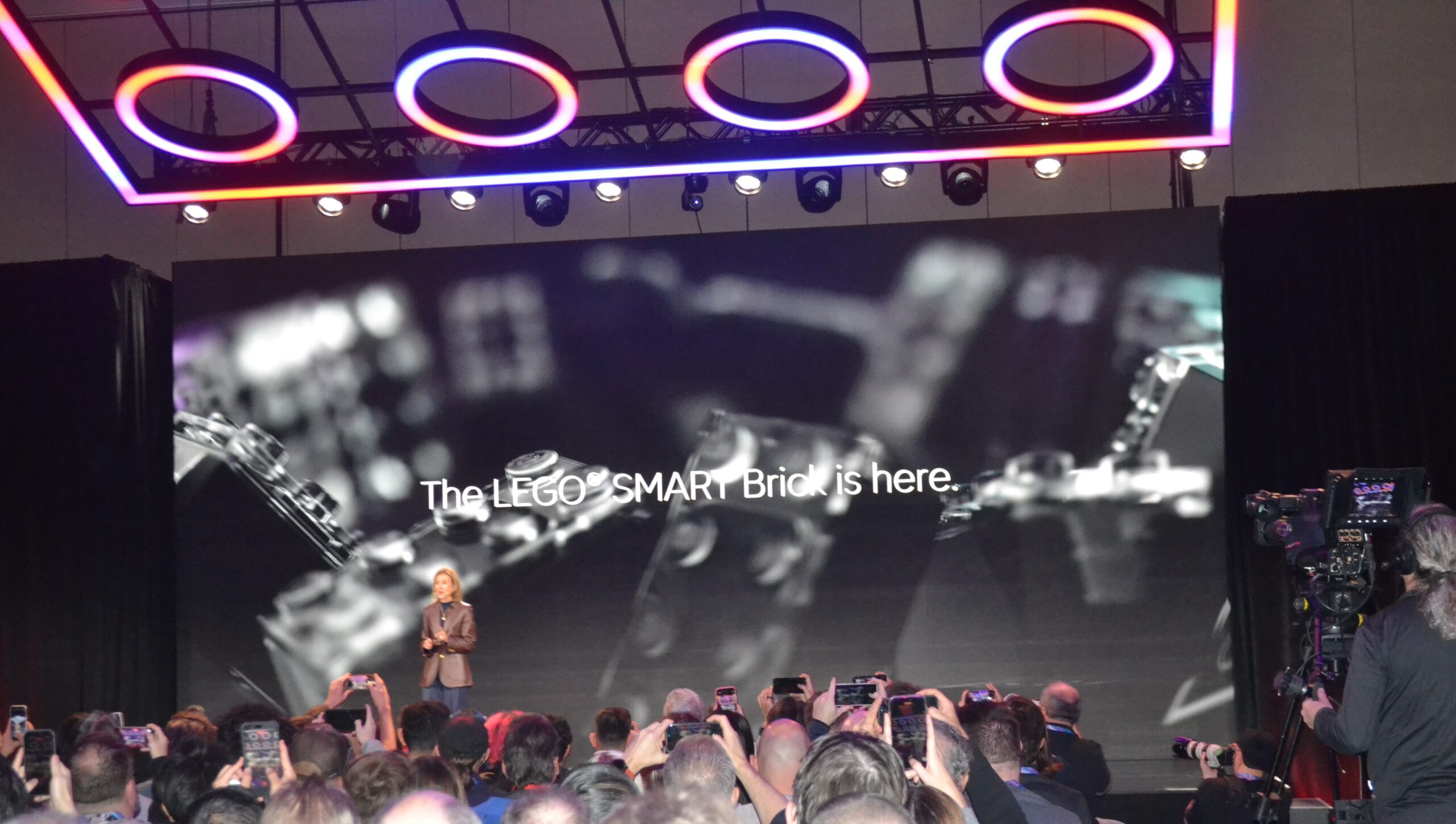
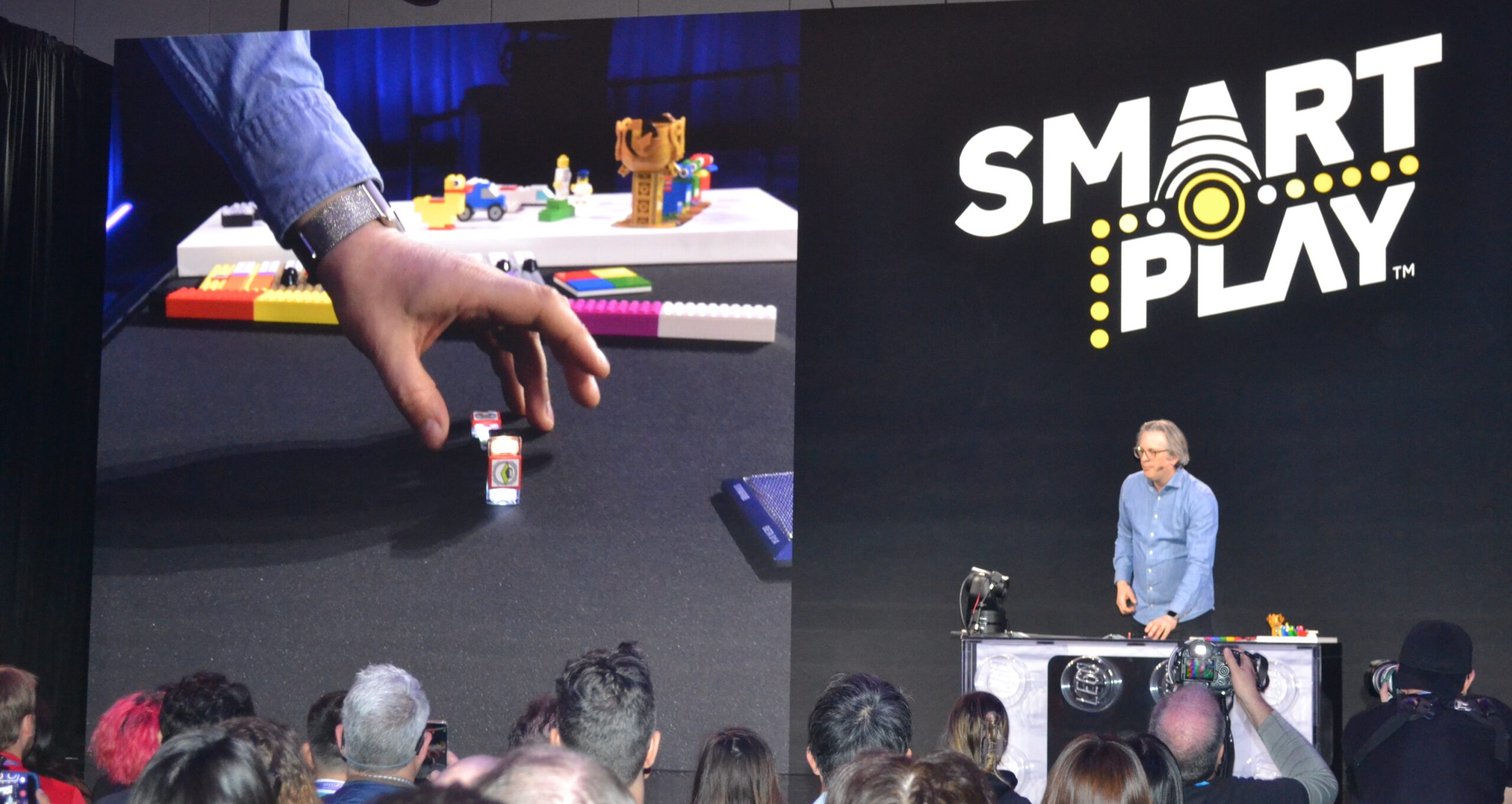
The LEGO Group introduced a major new initiative at CES with the launch of LEGO Smart Play, a platform designed to merge physical LEGO bricks with embedded digital intelligence—without screens, apps, or traditional digital interfaces.
The company described the announcement as its most significant innovation in decades, marking a new chapter in LEGO’s 70-year history of physical play. Executives positioned Smart Play as a foundational platform rather than a single product, signaling a long-term strategy to integrate technology into hands-on creativity while preserving LEGO’s core identity.
A Modern Evolution of a Classic System
LEGO leaders opened the presentation by highlighting the enduring success of the LEGO system of play, which has remained structurally compatible since the interlocking brick was introduced in 1958. With more than 20,000 different elements that fit together, LEGO has maintained a consistent design philosophy centered on creativity, imagination, and open-ended building.
At the same time, the company acknowledged a changing cultural landscape. Today’s children grow up immersed in digital environments, prompting LEGO to explore how interactive technology could be integrated into physical play without replacing it.
Executives said the challenge was to introduce digital intelligence in a way that enhances creativity rather than shifting play toward screens or software-driven experiences.
Technology Designed to Stay Invisible
LEGO Smart Play is built around three core principles: seamless integration of technology into physical play, openness across the LEGO ecosystem, and simplicity in user experience.
Rather than relying on apps or digital interfaces, the system is designed to operate through natural physical interaction. There are no screens, no visible controls, and no learning curve for children. The technology remains embedded in the bricks, responding to how they are used rather than directing how they should be played with.
Inside the Smart Brick
At the center of the platform is the LEGO Smart Brick, a standard-looking brick that contains sensors, processing capabilities, and wireless communication technology. Despite its embedded intelligence, the brick has no screen or power button and functions automatically as part of a build.
According to LEGO, the Smart Brick can detect movement, sound, light, color, distance, orientation, and direction. It can recognize specially designed Smart Tags that define behaviors, identify Smart Minifigures within a model, and communicate wirelessly with other Smart Bricks.
This allows LEGO creations to respond dynamically to physical interaction. Vehicles can detect drivers and track movement, structures can respond to proximity, and entire play environments can interact in real time through decentralized networks of connected bricks.
Modular Intelligence Across Builds
A single Smart Brick can be reused across multiple builds and play scenarios. By changing tags and minifigures, the same brick can take on different roles, functioning as an engine, character, creature, or interactive object depending on how it is configured.
During demonstrations, LEGO showed how one Smart Brick could animate cars, aircraft, animals, and games, generating light, sound, and behavioral responses based solely on physical movement and positioning.
Spatially Aware Play
One of the platform’s distinguishing features is spatial awareness. Without relying on cameras or external tracking systems, Smart Bricks are able to detect distance, orientation, and directional relationships between builds.
This enables interactive play scenarios such as tracking race outcomes, triggering responses based on proximity, and creating game mechanics that operate in three-dimensional physical space.
A Long-Term Platform for Storytelling
LEGO executives emphasized that Smart Play is designed as a scalable platform rather than a single product line. The system is intended to support long-term storytelling, re-playability, collaboration, and evolving narratives across different LEGO themes.
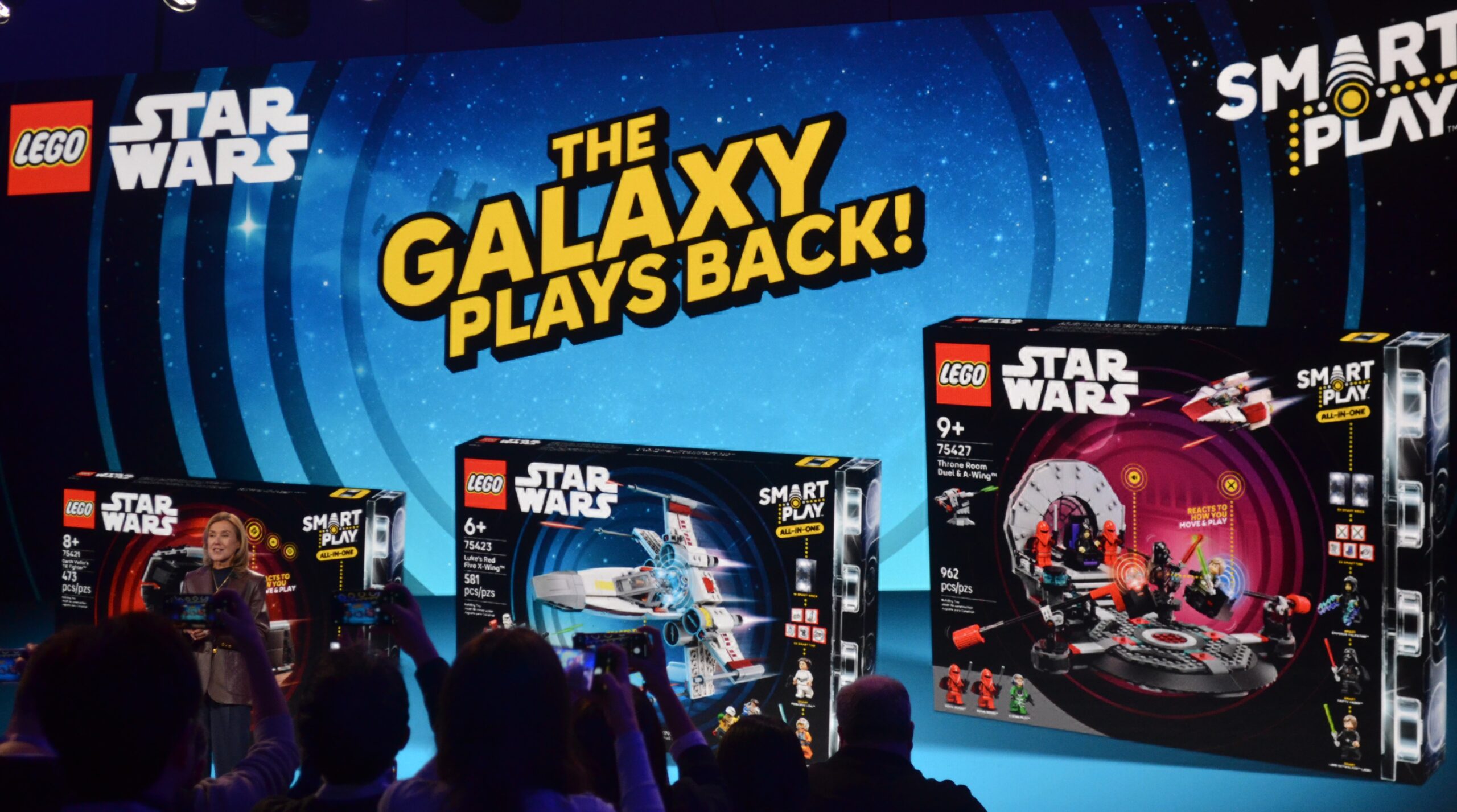
To demonstrate the platform’s potential, LEGO announced its first Smart Play partnership with LEGO Star Wars.
LEGO Star Wars Becomes Interactive
In collaboration with Disney and Lucasfilm, LEGO revealed that Smart Play will be integrated into upcoming LEGO Star Wars sets. After more than 25 years of partnership, the franchise will move beyond static builds to interactive physical play environments.
Characters, vehicles, and locations will respond to movement, proximity, and interaction, allowing children to create dynamic Star Wars experiences without screens or digital displays.
The first LEGO Star Wars Smart Play sets are scheduled to launch in March.
Redefining Physical Play
LEGO Smart Play represents a shift in how physical toys can incorporate advanced technology. Rather than directing behavior through software, the system is designed to respond to play itself, keeping creative control in the hands of children.
Company leaders described the platform as a foundation for future development, positioning Smart Play as the beginning of a broader transformation in physical play design.
At CES, LEGO framed the initiative not as a move toward digital toys, but as a reimagining of physical creativity—one where technology remains invisible, and imagination remains central.
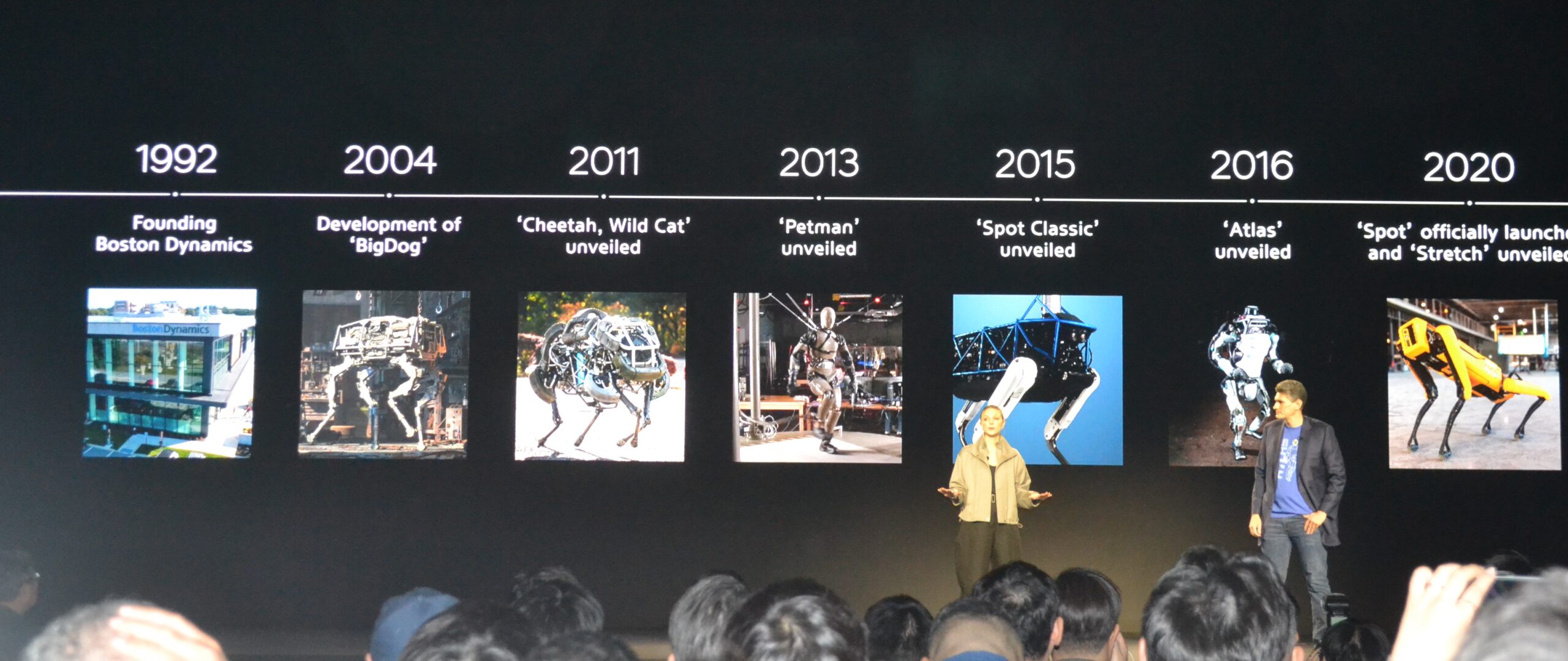
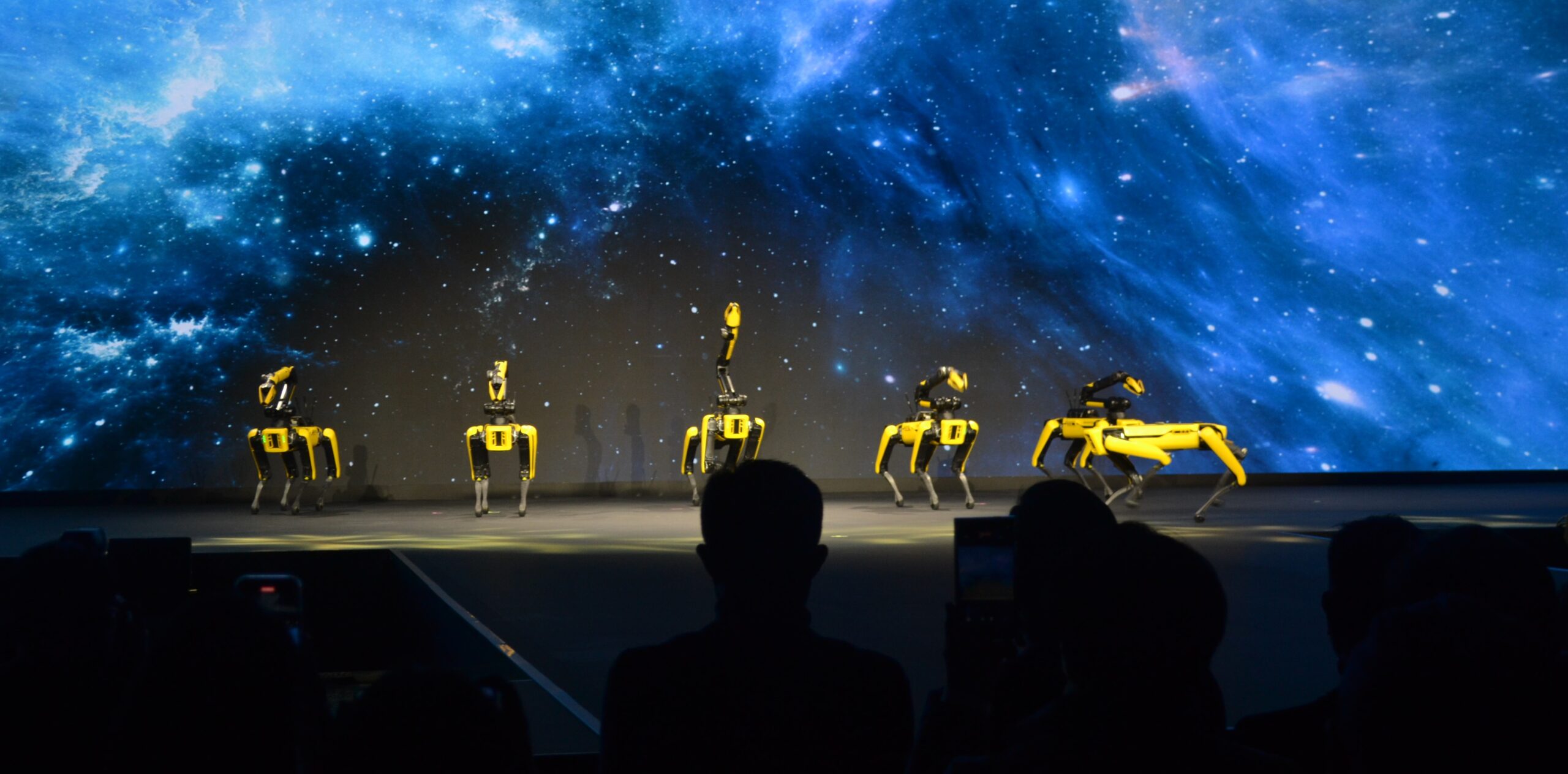
Hyundai Motor Group, Boston Dynamics, and Google DeepMind used this year’s Consumer Electronics Show to present a long-term vision for artificial intelligence and robotics focused on collaboration between humans and machines, rather than automation for its own sake.
The companies framed their message around what they described as human-centered AI robotics—systems designed to support human work, improve safety, and expand productivity, rather than replace human labor. Executives emphasized that robotics is moving beyond spectacle and demonstration toward real-world deployment and practical impact.
From humanoid robots in factories to AI systems that learn through experience, speakers stressed that the next phase of robotics development is about purpose-driven technology.
From Demonstration to Deployment
Boston Dynamics, long known for its high-profile demonstrations of robots that run, jump, and perform complex movements, positioned its work as increasingly focused on industrial and commercial applications.
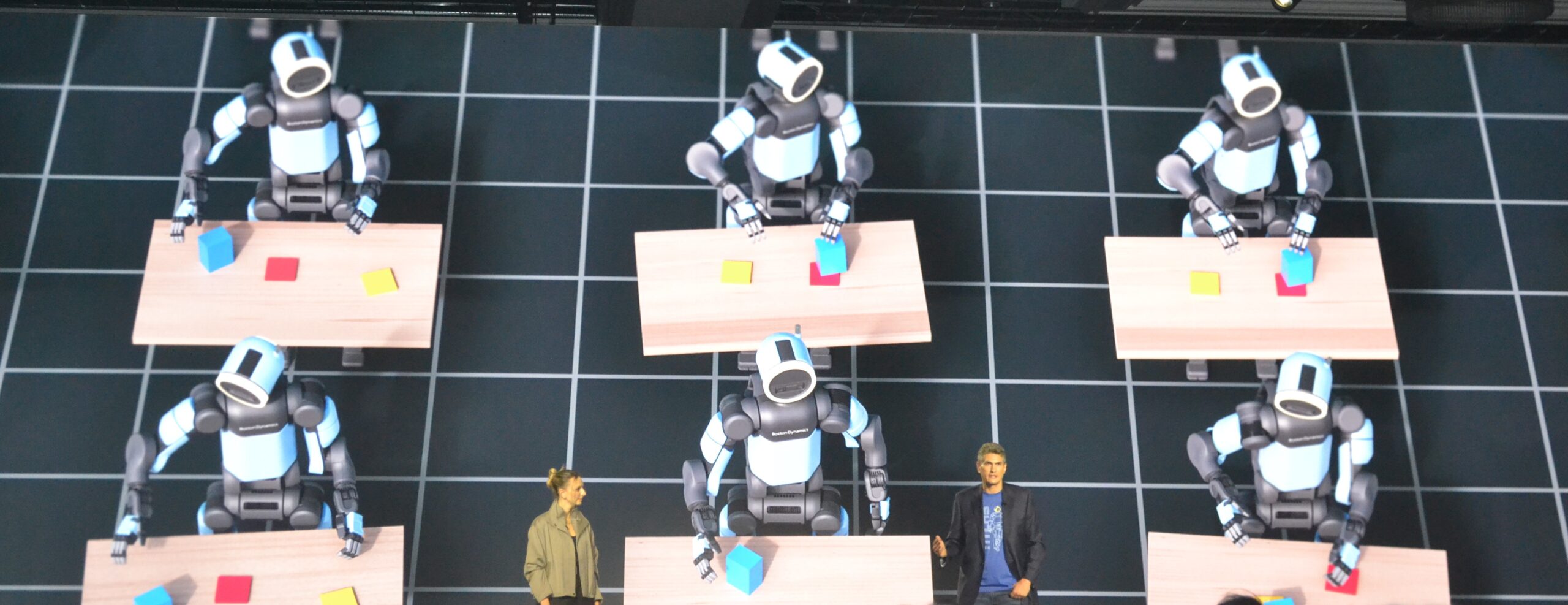
Aya Durbin, Humanoid Application Product Lead and Zachary Jackowski, Vice President, General Manager of Atlas highlighted the shift toward robots designed for hazardous environments, repetitive labor, and physically demanding tasks. The stated goal is to reduce workplace injuries, increase safety, and improve operational efficiency across industries.
Rather than replacing human workers, executives said the company’s strategy is centered on extending human capability and removing people from dangerous or exhausting roles.
Atlas: A General-Purpose Humanoid Platform
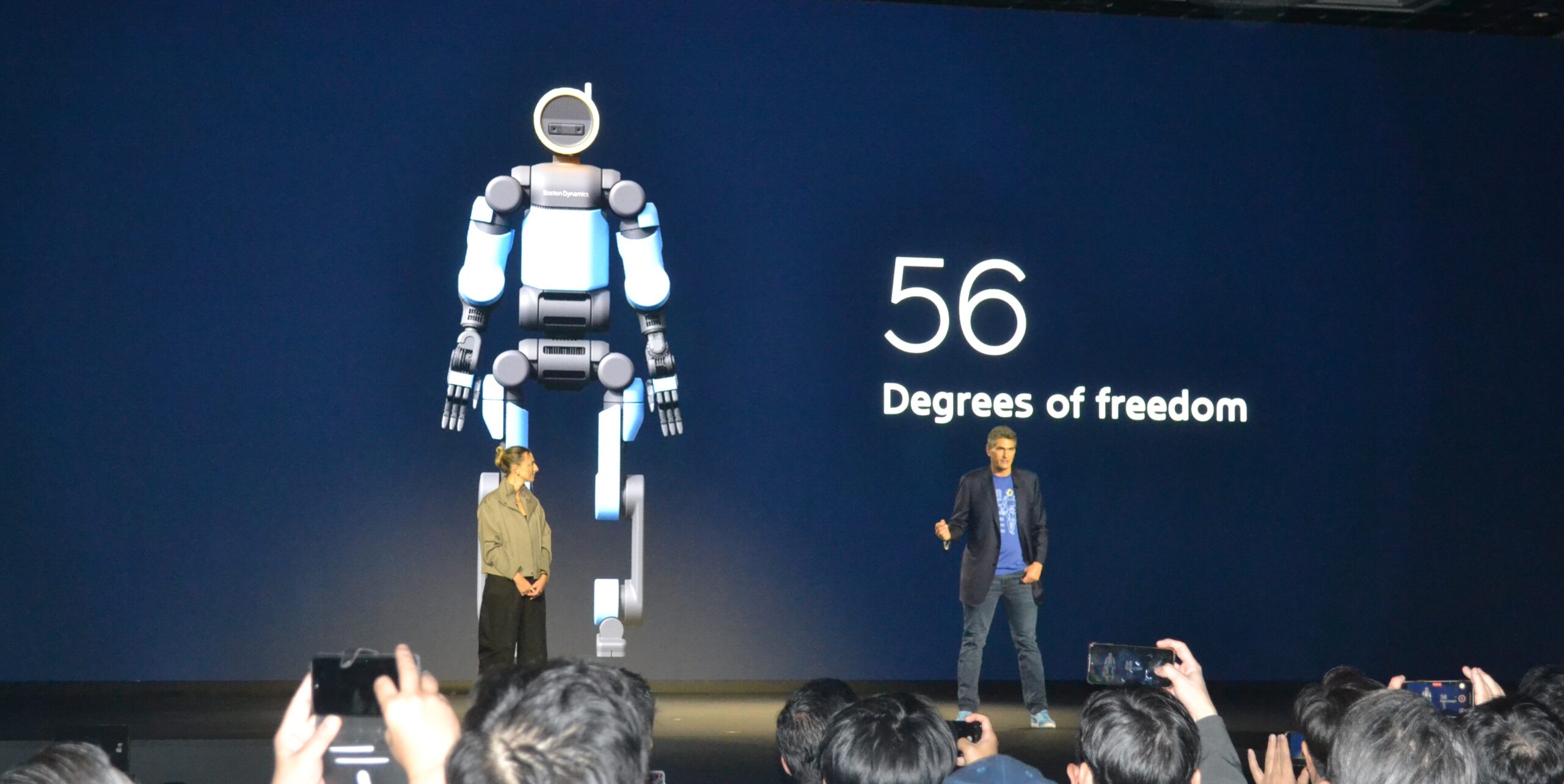
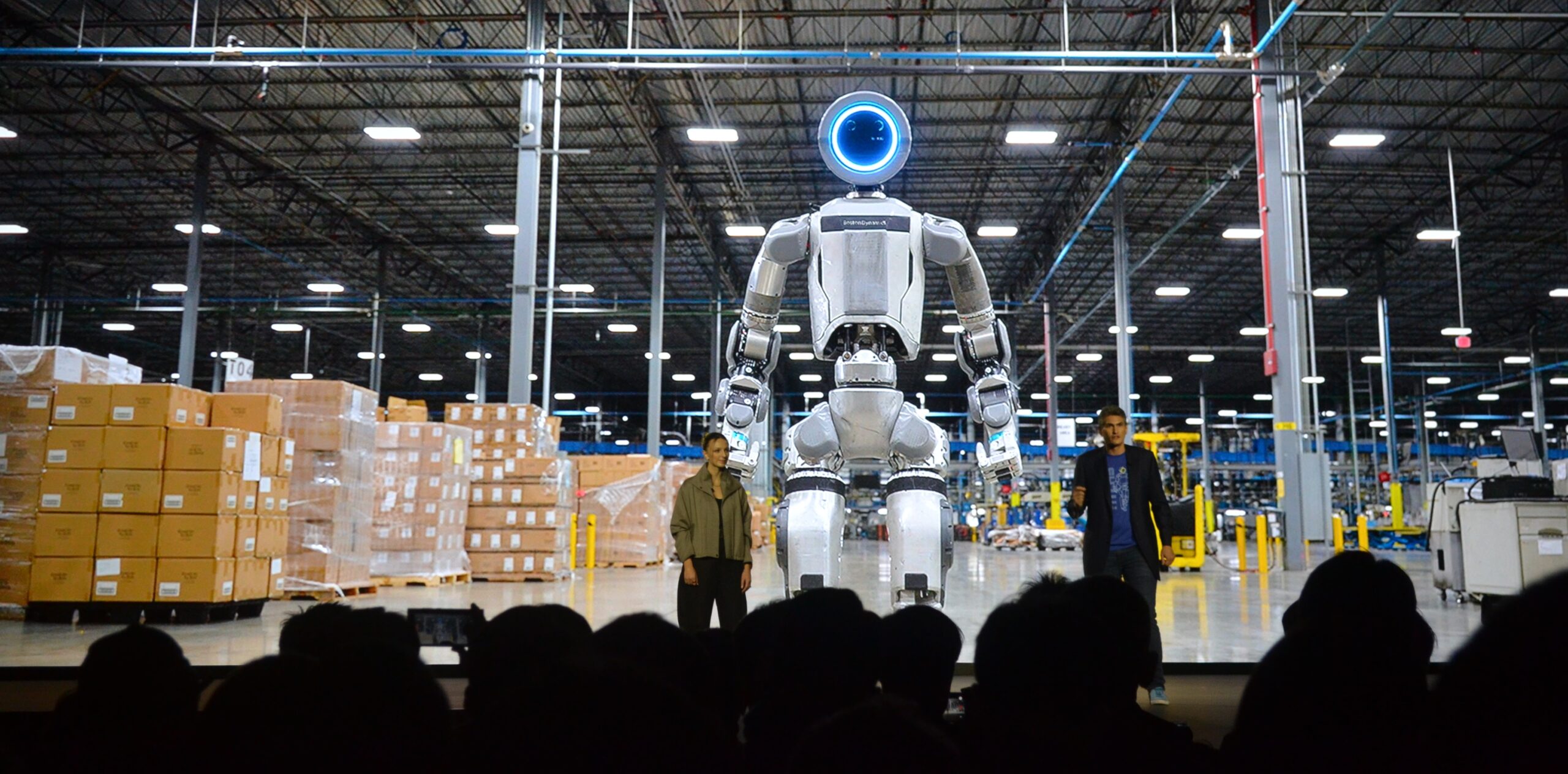
The centerpiece of the presentation was the public unveiling of Atlas, Boston Dynamics’ next-generation humanoid robot.
Unlike traditional industrial robots built for single-task automation, Atlas is being developed as a general-purpose humanoid platform. According to company representatives, the robot is designed to navigate complex environments, manipulate objects with human-like dexterity, and adapt to different tasks as operational needs change.
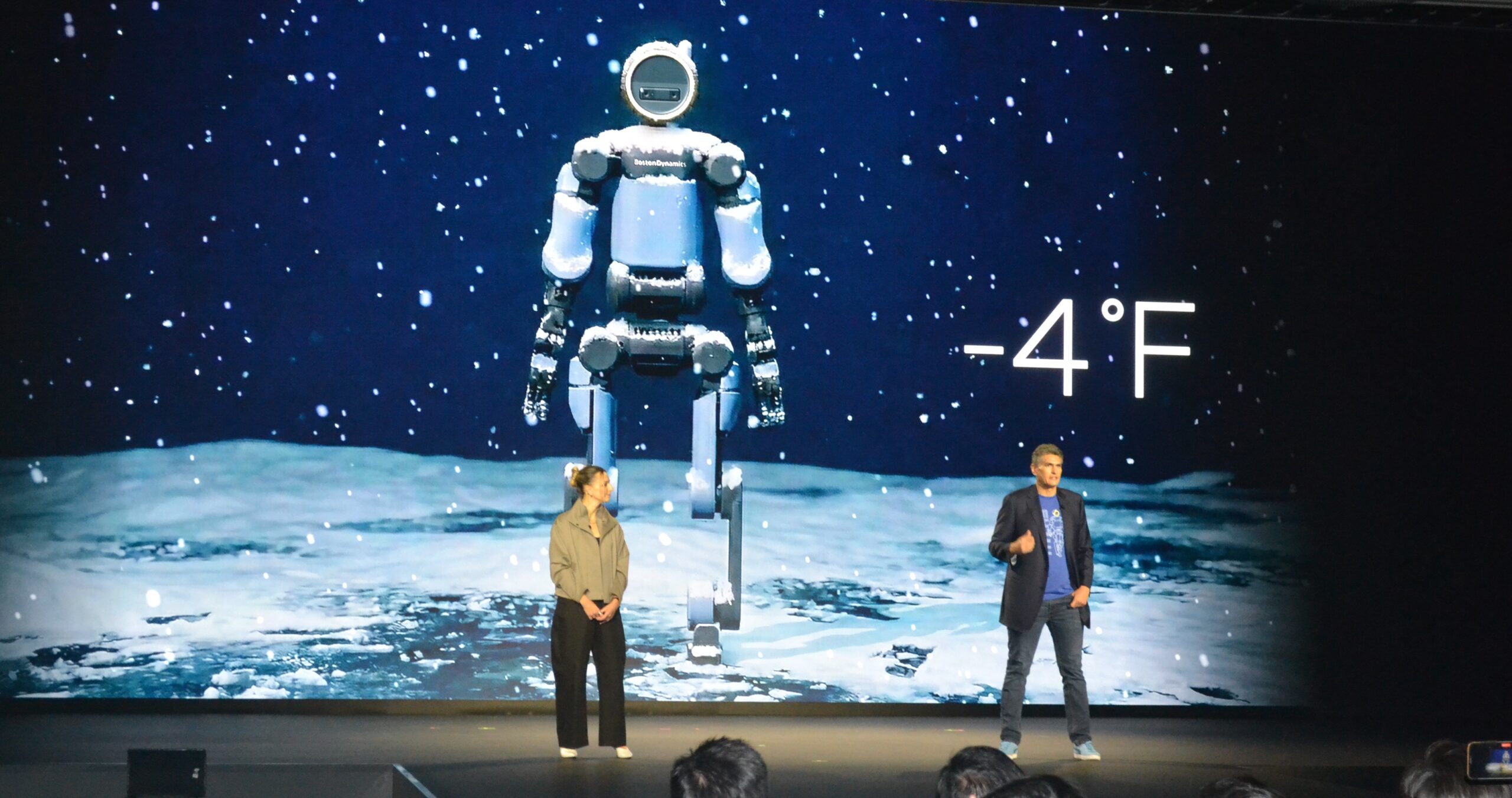
Atlas is engineered for industrial settings and includes capabilities such as heavy lifting, extended reach, autonomous operation, operation in extreme temperatures, and self-managed battery systems. It is also designed to share learned tasks across multiple units through cloud-based intelligence systems, creating what the company described as a networked learning model.
Commercial Robotics in Operation
Boston Dynamics pointed to its existing commercial robots as evidence that this approach is already being deployed at scale.
The quadruped robot Spot is currently used in thousands of facilities across more than 40 countries, where it performs industrial inspection, data collection, and safety monitoring tasks. The warehouse robot Stretch has been deployed in logistics environments to automate truck unloading and material handling, with more than 20 million boxes reportedly processed through customer operations.
Company officials emphasized that these systems are already in commercial use and producing measurable operational outcomes.
Hyundai’s Global Robotics Strategy
Hyundai Motor Group outlined plans to build large-scale infrastructure to support global robotics deployment. The company is developing manufacturing facilities capable of producing tens of thousands of humanoid robots annually, alongside data-driven production systems and AI-enabled factory environments.
Executives described a long-term strategy that extends beyond manufacturing into logistics, construction, energy, infrastructure, and smart city development, with eventual plans for integration into consumer and home environments.
Hyundai’s approach includes service-based robotics models, integrated deployment networks, and AI-powered industrial ecosystems designed to scale robotics adoption across multiple sectors.
Partnership with Google DeepMind
A major announcement at the event was the partnership between Boston Dynamics and Google DeepMind Robotics, bringing together advanced physical robotics and large-scale AI foundation models.
The collaboration aims to develop general-purpose humanoid intelligence systems that combine physical capability with advanced reasoning, language understanding, and adaptive learning.
Rather than relying on pre-programmed task execution, the companies said future robots will be able to learn through observation and experience, generalize skills across environments, and continuously improve performance over time.
Redefining Human–Robot Collaboration
Speakers emphasized that the vision presented at CES is based on collaboration rather than replacement.
Under this model, humans remain responsible for supervision, decision-making, judgment, and ethics, while robots take on physically demanding, repetitive, and hazardous tasks. The goal, according to company leaders, is to improve workplace safety, increase productivity, and allow people to focus on higher-value activities such as problem-solving, leadership, and creative work.
A Broader Shift in Robotics
The companies framed the developments as part of a broader transformation in how robotics is designed and deployed. Rather than isolated automation systems, they described the emergence of integrated human–robot ecosystems built around shared intelligence, learning systems, and scalable infrastructure.
Executives summarized the vision as a model of technological development centered on partnership between humans and machines, rather than competition between them.
Looking Ahead
As AI systems, robotics platforms, and industrial infrastructure continue to converge, industry leaders said the line between digital intelligence and physical systems will continue to blur.
What is emerging, they argued, is a new model of robotics—one where machines are designed not simply to operate autonomously, but to function as collaborators within human systems.
At CES 2026, that future was presented not as a distant concept, but as a roadmap already moving into real-world deployment.
CES 2026 kicked off Sunday, January 4th, with the annual “CTA Tech Trends to Watch” presentation for members of media, hosted by Melissa Harrison, VP communication & marketing, CTA, and Brian Comiskey, senior director, Innovation & Trends, CTA.
Innovation doesn’t happen in isolation. Breakthroughs rarely stay confined to a single sidewalk, industry, or discipline. Instead, progress emerges where technologies intersect—where advances in one field accelerate transformation in another. Because of this interdependence, the most impactful technologies are never just one thing.
Today’s wave of innovation can be understood through three major megatrends: Intelligent Transformation, Longevity, and Engineering Tomorrow. Together, they are redefining how we live, work, and build the future.
1. Intelligent Transformation: Beyond Digital
For the past two decades, digital transformation shaped enterprises and economies. Cloud computing, mobile connectivity, and digital platforms redefined how businesses operate and how consumers engage with the world. This era enabled scale, lowered barriers to entry, and connected billions globally.
Now, we have entered a new phase: intelligent transformation.
Driven by rapid advances in artificial intelligence, intelligent transformation goes beyond digitizing processes. It embeds intelligence directly into systems, devices, and infrastructure—reshaping enterprise operations, workforce roles, and everyday consumer experiences at massive scale.
The Foundations of Intelligence
This transformation rests on three critical pillars:
Trust and Security Modern cybersecurity ensures data integrity, encrypted communication, and resilience against threats. Without trust, intelligent systems cannot scale. Secure infrastructure enables innovation to move faster and farther.
Scalable Cloud Infrastructure Hyperscale platforms allow AI to operate globally and elastically. From startups to multinational enterprises, cloud scalability ensures intelligent capabilities are accessible across industries and geographies.
Computation and Simulation Intelligence begins at the chip level. Advanced processors and simulation technologies transform raw data into actionable insight, enabling faster, smarter decision-making across every sector.
AI at Work and in Industry
AI has moved from experimentation to necessity. Across global markets, awareness and adoption exceed critical thresholds. Workers are already reclaiming hours each week through AI-assisted productivity, signaling a shift toward human–AI collaboration rather than replacement.
Industries such as healthcare, mobility, agriculture, logistics, and manufacturing are adopting industrial AI, embedding intelligence directly into infrastructure and operations. These systems improve productivity, resilience, and scalability—allowing complex industrial environments to function as connected, adaptive ecosystems.
Physical AI and Robotics
The rise of physical AI—robots and autonomous systems—marks another leap forward. Consumer, healthcare, and industrial robots are gaining contextual awareness, enabling them to perform increasingly complex tasks. Autonomous vehicles, warehouse robots, and service robots are learning to navigate real-world environments safely and efficiently.
Extended reality (XR), smart glasses, and voice-driven interfaces further blur the boundary between digital and physical worlds. These technologies enhance human capability across healthcare, logistics, manufacturing, and hospitality—making intelligence tangible and interactive.
2. Longevity: Redefining Quality of Life
While intelligent systems transform productivity, longevity technologies redefine what progress means. The new measure of advancement is no longer just economic growth—but longer, healthier, higher-quality lives.
Precision Health and Personalized Care
Healthcare is shifting from reactive, one-size-fits-all treatment to precision medicine. Advances in genomics, AI-driven diagnostics, and biological modeling enable early detection, predictive insights, and tailored interventions.
Connected wearables, remote diagnostics, and telehealth platforms extend care beyond hospitals, allowing continuous, proactive health management. Individuals increasingly become active participants—executives of their own health—empowered by real-time data and personalized insights.
From Treatment to Prevention
Health technology ecosystems now integrate glucose monitors, digital stethoscopes, cardiovascular sensors, and AI-powered health platforms. These tools reduce strain on healthcare systems while improving outcomes through early intervention and continuous monitoring.
Mental health is also evolving, with AI-driven tools identifying early signals of stress, anxiety, and depression, and providing scalable, accessible support through conversational and behavioral technologies.
Human-Centered Enhancement
Longevity innovation extends beyond health into accessibility and inclusion. Exoskeletons, advanced hearing solutions, neuro-responsive interfaces, and assistive technologies enhance mobility, sensory perception, and quality of life—ensuring progress benefits broader populations.
3. Engineering Tomorrow: Building Sustainable Systems
The third transformation focuses on how technology reshapes the physical world—engineering tomorrow’s infrastructure, mobility, energy, and production systems.
Intelligent Mobility
Vehicles are no longer static machines. They are becoming software-defined platforms with over-the-air updates, personalization, predictive maintenance, and autonomous capabilities. Automakers increasingly collaborate with cloud providers, AI developers, and content platforms to accelerate innovation.
Autonomous driving systems, advanced sensing technologies, and human–machine interfaces are improving safety, accessibility, and efficiency—turning transportation into a connected, intelligent ecosystem.
Smart Industry and Agriculture
AI-powered heavy equipment, autonomous construction systems, and precision agriculture technologies are redefining productivity while reducing environmental impact. Autonomous tractors, predictive analytics, and vertical farming systems enhance food security and sustainability in the face of climate and labor challenges.
Energy and Electrification
Electrification is accelerating across industries. Smart grids, adaptive solar systems, energy storage, and AI-driven demand optimization are transforming how energy is generated, distributed, and consumed. Emerging technologies—including advanced nuclear and alternative energy systems—promise resilient, low-carbon infrastructure for the future.
The Road Ahead
By 2026 and beyond, intelligent transformation will drive autonomous systems, adaptive devices, and deeply personalized experiences. Smartphones, PCs, TVs, vehicles, and wearables are evolving into intelligent platforms that respond dynamically to individual needs.
Together, intelligent transformation, longevity innovation, and engineering tomorrow are converging to solve some of the world’s biggest challenges—improving productivity, extending healthy lifespans, and building resilient, sustainable systems.
Innovation doesn’t occur in isolation. It happens at the intersections—and those intersections are shaping the future now.
Imec closed out 2025 with significant announcements that underscore its growing influence in semiconductor R&D and AI systems design. Between a high-profile debut at Super Computing 2025 and a strong showing at the International Electron Devices Meeting (IEDM), the Belgium-based research center marked the end of the year with momentum across multiple technology fronts.
In November at Super Computing 2025, one of the world’s largest gatherings for high-performance computing, imec unveiled imec.kelis, an analytical performance modeling tool aimed at reshaping how AI datacenters are planned and optimized.
Imec positioned the platform as a response to pressures facing datacenter designers, as AI workloads expand into the trillions of parameters and energy demands climb. According to the organization, imec.kelis offers a faster and more transparent alternative to conventional simulation tools, which are often slow or limited in scope.
Early adopters have already begun exploring the platform, an early sign of commercial interest.
“Imec.kelis is more than a simulator—it’s a strategic enabler for the next generation of AI infrastructure,” said Axel Nackaerts, system scaling lead.
Imec.kelis provides an end-to-end analytical framework that evaluates performance across compute, communication, and memory subsystems. The tool is optimized for large languagemodel (LLM) training and inference, offering predictions validated on widely used systems such as Nvidia’s A100 and H100 GPUs.
The platform draws heavily on imec’s longstanding expertise in hardware-software co-design, system-level modeling, and semiconductor technology road mapping. Imec said the goal is to give system architects the ability to make better-informed decisions at datacenter scale, where design choices directly impact cost, efficiency, and sustainability.
At the beginning of December 2025, imec continued to demonstrate research leadership at the 71st International Electron Devices Meeting (IEDM), presenting 21 papers spanning advanced logic, memory, quantum computing, imaging, and bioelectronics.
With a high-visibility launch in HPC computing and a deep bench of contributions at IEDM, imec concludes 2025 with strengthened leadership in both advanced semiconductor research and the rapidly expanding AI datacenter ecosystem. The organization is positioning itself as a critical contributor to the technologies that will define next-generation computing infrastructure.
Guillaume de Fondaumiere is the Co-CEO of the Quantic Dream Studio based in France, which developed games such as, “Fahrenheit” (2005), “Heavy Rain” (2010), and in collaboration with Sony Computer Entertainment, the PS3 exclusive title, “Beyond: Two Souls”, starring actors Ellen Page and Willem Dafoe (2013).
Today, on the 15th anniversary of “Heavy Rain,” he finds himself reminiscing: “In the mid-2000s when we started production on “Heavy Rain” I was executive producer on the project. I was also responsible for managing relationships with actors, composers, etc. In the weeks leading up to the launch, we decided with Sony, to send the game to several editorial teams. I remember very clearly sending out those codes, one after another. And a few weeks later we started receiving the first reviews. It was a huge relief to realize that the reviewers had understood what we are trying to do. When we hit after six weeks, one million copies I couldn’t help but shed a tear, telling myself “Phew!”. What I’d tell to myself fifteen years ago in the tough moments, because there are always some during a game’s development, is this: “Don’t worry. It’s going to be okay.”
Guillaume de Fondaumiere was also appointed the Chairman of the European Games Developer Federation. During his position, the French government and the European Union agreed to introduce a 20% tax credit for video games studios. He not only fought for many years to support the gaming industry, but had also lobbied for the games industry to be recognized as an art form.
“To me, all games are a form of cultural expression”, he says. “I see no reason why games should be treated differently than any type of literature or any type of movie. I think that more and more video games are becoming artful, and are becoming a form of art that should be recognized next to the others.” In his opinion, games should be placed among institutional forms of art such as, architecture, sculpture, visual arts, music, literature, theater, cinema art and media arts (television, radio and photography).
Media and internet often sell the information; games trigger the violence, players get addicted to them, and at the end, they are merely entertainment for young and immature minds. The stereotype of thinking associate games with either the shooting or the lighthearted entertainment for children. The reasons for such thinking originate from the early years of the gaming industry, which was actually targeted the children. The first games were very simple, they had boosted the simplest instinctive behavior and the release of adrenaline, which is also referred to as hormone 3F – fear, fight, flight.
But since that time has changed almost everything: games, hardware and the players themselves. Today, the old game enthusiasts had grown up and they still want to play games but they expect deeper, artistic and intellectual entertainment. Under such demanding clients there was a dynamic and multidirectional development of games, and palette of emotions has greatly increased. Today, players can incarnate in any characters, make their own choices, stand for duels with hundreds of players from all over the world. Production studios strive for authenticity and put meticulous attention to details.
Every little part is important, and approaching players to reality. There is also a 3D technology that changed the flat images into three-dimensional images. Today’s game has a story, uses the visual graphics and new, advanced forms of interaction with the player. In addition, there is also increased proliferation of the authors in the games industry, artists express themselves creatively and individually. The impact of games on mass culture is unquestionable and its value is growing at a dynamic pace.
So, is art or not?
A precise, unambiguous, and commonly held definition of art does not exist. However, it is known that art acts through aesthetic, ethical or cultural functions. It affects its audience through watching, listening, creating and reflecting. Without a doubt, the video game industry, which is the fastest growing sector of the modern entertainment industry, is a part of modern culture.
P.S. Roger Ebert, the legendary (Pulitzer Prize) film critic, who for 46 years shaped the tastes of American film audiences, remarked, “as long as there is a great movie unseen or a great book unread, I will continue to be unable to find the time to play video games”. He repeated this statement for eight years and once he hit harder “video games can never be art.”. He died in 2013, with no chance for revision of his assessment.