It’s been nearly a year since Will Smith infamously slapped Oscar host Chris Rock live onstage at last year’s Academy Awards telecast after cracking a “G.I. Jane” joke aimed at Smith’s wife, Jada Pinkett Smith. It was indeed a surreal moment as the audience watched Smith laugh initially then turn to his wife who was fuming from the inside, got up from his chair to approach the stage and strike Rock.
Most of the audience thought that it was just “part of the act”, but when Smith returned to his seat and shouted expletives at Rock, they realized it was not.
Though the “teary eyed” and emotional Smith was allowed to return onstage to accept his Best Actor Oscar for “King Richard” after the incident, the Academy of Motion Pictures Sciences (AMPAS) decided a few weeks later that Smith would be barred from attending any Oscar ceremonies for the next ten years.
Months later, Apple TV announced a new movie called “Emancipation” to be released in late Fall starring Will Smith. At first, I thought it was about his documentary regarding his “freedom” from the Academy not having to attend the Oscars for the next ten years. Last weekend, Chris Rock premiered his Netflix special called “Selective Outrage”. “I rooted for Will Smith my whole life,” he said. “The other day, I watched “Emancipation” just so I could watch him getting whipped.”
All kidding aside, it’s a shame that had happened. It was one step forward for diversity, but two steps back. Or is it?
Sure, you can make a case there should have been at least more than two African-American nominees list this year for the acting categories. Viola Davis in “The Woman King” and Danielle Deadwyler in “Till” come to mind. You can also make a case that their directors from those films, Gina Prince Bythewood or even Chinonye Chukwu should have made the list in their category, even in a very competitive field.
Regardless of these omissions, the Academy is seems to be doing a formidable job of accomplishing its goals of diversifying the Academy since the #OscarsSoWhite movement eight years ago. They are clearly doing its best to continue its efforts in representing all groups, not just African-American filmmakers. If you look at this years nominations, it’s clearly diverse.
With four nominations, more Asian performers were recognized by the Academy in 2023 than in any single year in its history. In addition, Malaysian “Everything Everywhere All At Once” star Michelle Yeoh is only the second Asian best actress nominee in 95 years of Oscars history, with a strong chance of becoming the first winner.
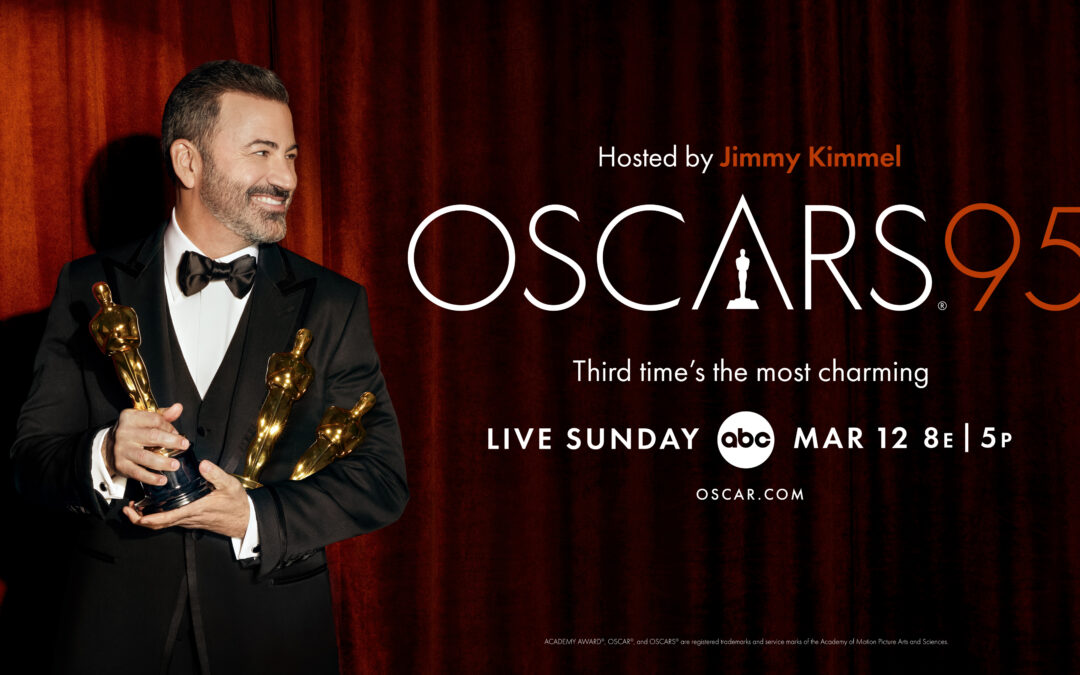
After the embarrassing “Slap Heard Around The World” Oscars telecast like last year, we need a bit of comic relief. You can certainly bet our host for this year’s Oscars, Tonight Show’s own Jimmy Kimmel will prepare a lot of material that should keep us comfortably and uncomfortably laughing during the telecast. I can’t imagine a better host to open up the show and look forward to his monologue.
OSCAR PREDICTIONS
This may be the most difficult year in predicting the Oscars ever, but here are my predictions for the 95th Annual Academy Awards.
BEST PICTURE:
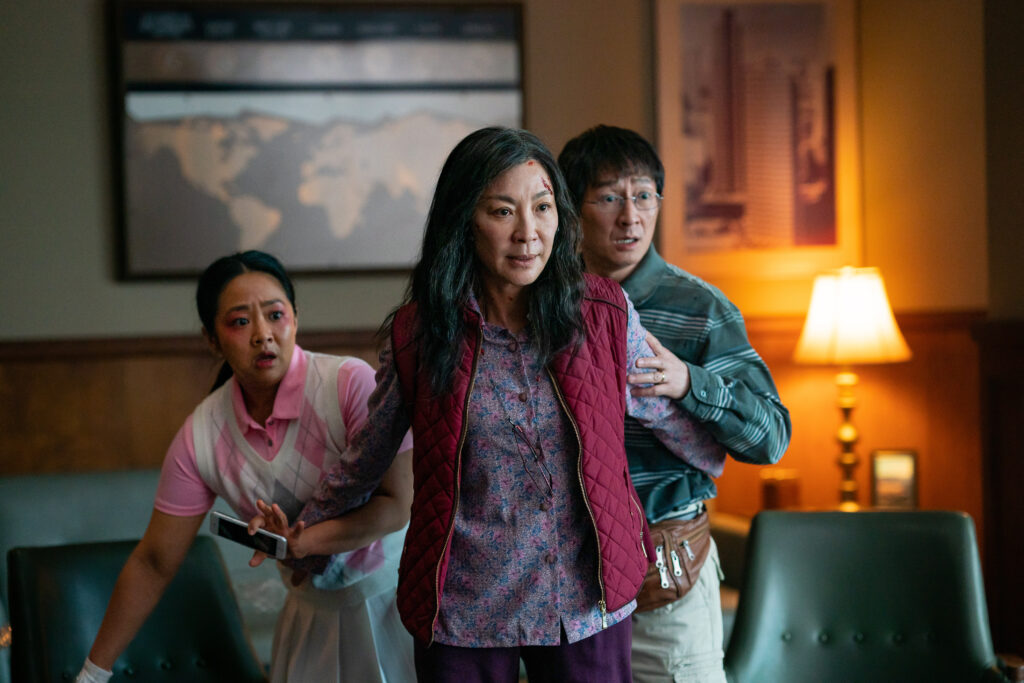
Exactly a year ago, when this “mind bending” independent film “Everything Everywhere All at Once” had it’s World Premiere at the South by Southwest Film Festival on March 11th, 2022. Since that time, the film went on to become A24’s highest grossing film ever. It was re-released three times due to it’s popularity, including a one-night only at IMAX, and its re-release on January 27th thanks to a resurgence of interest for its leading eleven Academy Award nominations. It has won the top prizes from the Director’s Guild, Producer’s Guild, the Writer’s Guild, and won a record-breaking four awards at the Screen Actor’s Guild Awards. Though it lost at the BAFTA’s to “All Quiet on the Western Front”, the British Academy Awards, there is too much momentum for this film to lose at this year’s Oscars.
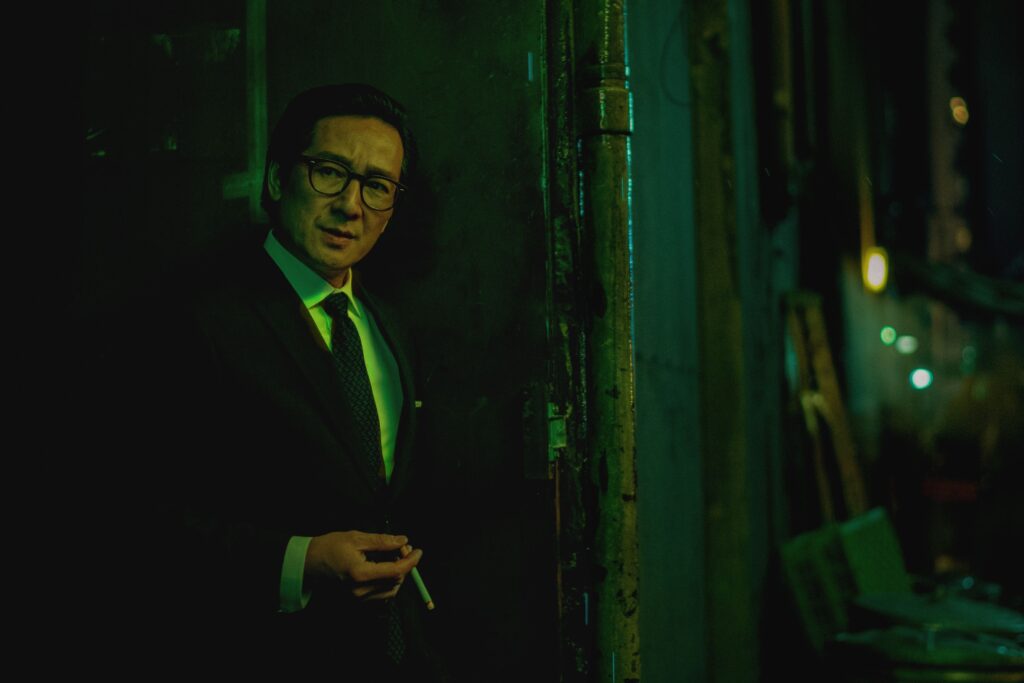
Everything Everywhere All at Once with Oscar nominees, Stephanie Hsu, Michelle Yeoh and Ke Huy Quan.
Photo Credit: Courtesy of A24.
BEST ACTOR:
After watching Brendan Fraser in his heart-wrenching performance in “The Whale” as a 600 pound recluse, I was certain that was getting the Oscar. Fraser just recently won at the SAG awards, so we know at least a majority of actors loved his performance. However, the Academy didn’t embrace “The Whale” as much as they did “Elvis” with its eight nominations. “The Whale” was nominated for three awards, but wasn’t nominated as Best Picture or even screenplay.
I still keep changing my tune on my prediction for Best Actor even as I write, as picking Elvis starts to make more sense. The Academy loves bio-pics, and it’s rare to have an actor be able to portray someone as iconic as Elvis. Jamie Foxx played Ray Charles, Rami Malek played Freddie Mercury, and Renée Zellweger played Judy Garland and they all won the Oscar.
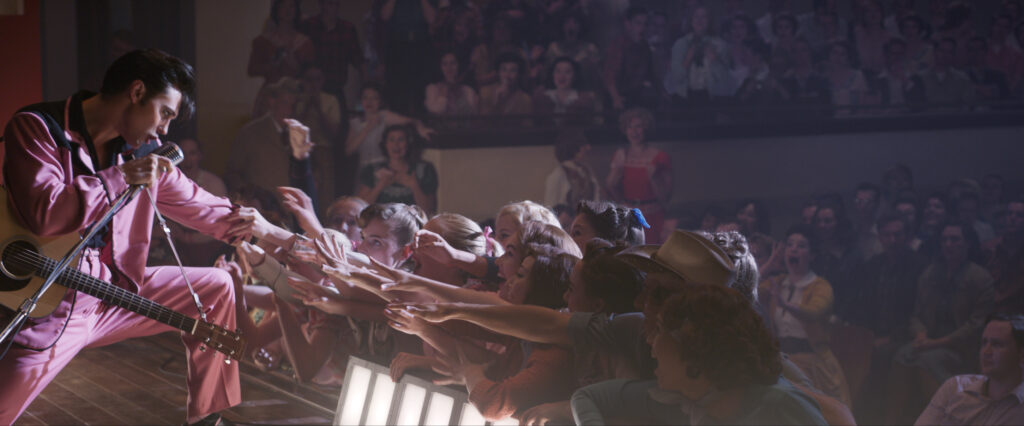
The extreme dedication of Butler for three years of his life is exemplary. As a method actor, he not only acted as Elvis, but embodied himself in his role as “The King”. He looked, sang and danced like him by watching tapes and films of him when production was down during COVID. He needed to be able to discern how Elvis talked and walked during certain periods of his career since they needed to shoot scenes out of sequence. He put posters and photos all over his wall during the shutdown when his co-star Tom Hanks, who played the Colonel caught COVID-19.
Even after the movie was done, he could not let go of Elvis, even as he went about promoting his film. He was Elvis 24/7 and still could not leave the King. He didn’t even see his family for three years because he was so focused on his role. What a hound dog!
This will be a tight race, but I think the “King” will live on.
AUSTIN BUTLER as Elvis in Warner Bros. Pictures’ drama “ELVIS,” a Warner Bros. Pictures release.
Photo Credit: Courtesy of Warner Bros. Pictures
BEST ACTRESS:
Another difficult category to predict is Best Actress, which is really a race between the two-time Oscar winner, Cate Blanchett and Michelle Yeoh. Even on a fair playing field, I probably would have leaned for Cate Blanchett for her performance as Lydia Tár, one of the most extraordinary performances that she has ever done, if not the best.
She has proven she can play just about anything, including Spazzatura, the monkey in “Guillermo Del Toro’s Pinocchio”. If there is a sequel to “Everything Everywhere All at Once”, the Daniels may want her to play a googly eyed rock, and she may get another nomination.
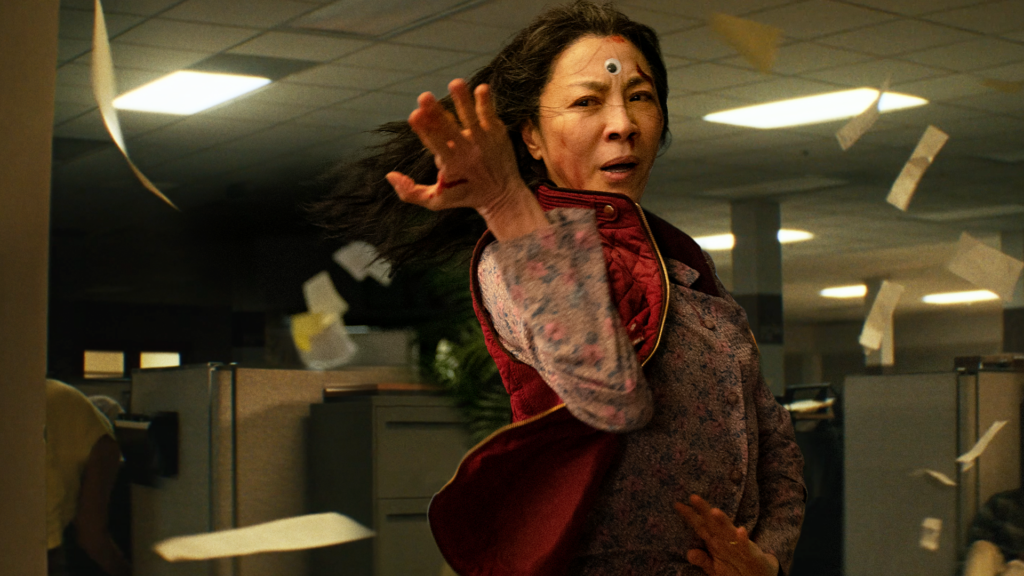
However, Michelle Yeoh, who gets her second Oscar nomination for “Everything Everywhere All at Once” since “Crouching Tiger, Hidden Dragon”, even with her hot dog fingers, can still just beat anyone up against her…and not just the music exit prompters at the Golden Globes. She is well loved not just in Hollywood, but globally, and the Academy would probably want to honor her the award, rather than give Blanchett a third.
She would also be a fitting tribute to honor the first Asian Best Actress Oscar winner as she has made a tremendous contribution to World Cinema during her lifetime. It would be fitting and iconic.
Maybe the U.S. mint she will issue her own coin one day.
Evelyn Wang (Michelle Yeoh) is an average Chinese mother who reluctantly becomes a superhero, jumping alternate worlds and absorbing powers to fight an evil villain. A24
BEST SUPPORTING ACTOR:
When Ke Huy Quan stopped getting roles after being a formidable child star working in movies such as Indiana Jones and the Temple of Doom alongside with Harrison Ford with Steven Spielberg directing, and a cult timeless movie classic called “The Goonies”, Quan believed the best was over. He stopped getting roles and decided to stop acting and work behind the scenes, notably with Wong Kar Wai as an assistant director. Nearly broke, he told his agent that he needed to work and found a role that he really wanted. The real life story of Quan is inspirational to any actor who was once in the spotlight and wants to return to it.
If there is any category that is the “sure thing”, this is it. He has won nearly every “Best Supporting Actor” award, with the exception of the BAFTA, in which Barry Keoghan won for his role in “The Banshees of the Inisherin”. I highly doubt Keoghan will repeat on American turf.
Hollywood loves a comeback story. Ke Huy Quan is the real deal.
Ke Huy Quan in EVERYTHING EVERYWHERE ALL AT ONCE. ALLYSON RIGGS / A24 / COURTESY EVERETT COLLECTION
BEST SUPPORTING ACTRESS:
This could be the category that will be most difficult to predict. Early in the Awards season, Angela Bassett was the frontrunner for “Black Panther – Wakanda Forever”. She won the Golden Globe and Critics Choice Award. However, the momentum shifted. Just recently, Jamie Lee Curtis won the SAG award and Kerry Condon won the BAFTA. I have a feeling that the Academy will split votes between Curtis and Bassett more in recognition for their life work as veteran actors and the Academy would still like to honor “The Banshees of the Inisherin” as an Oscar winner. This is the only possible category that it could potentially win. Condon most likely will take the award, and deservedly so.
One real mystery remains, however. Now that Will Smith is barred from the Oscars, who will present the Best Actress award to this years recipient?
MLS Entertainment’s Oscar Predictions:
Best Picture: “Everything Everywhere All at Once” Best Actor: Austin Butler, “Elvis” Best Actress: Michelle Yeoh, “Everything Everywhere All at Once” Best Supporting Actor: Ke Huy Quan “Everything Everywhere All at Once” Best Supporting Actress: Kerry Condon “The Banshees of Inisherin” Best Director: Daniel Kwan and Daniel Scheinert, “Everything Everywhere All at Once” Best Adapted Screenplay: Sarah Polley “Women Talking ” Best Original Screenplay: Daniel Kwan and Daniel Scheinert, “Everything Everywhere All at Once” Best Cinematography: “All Quiet on the Western Front” Best Costume Design: “Elvis” Best Film Editing: “Everything Everywhere All at Once” Best Makeup and Hairstyling: “The Whale” Best Music (Original Score): “All Quiet on the Western Front” Best Music (Original Song): “Naatu Naatu” Best Production Design: “All Quiet on the Western Front” Best Sound: “Top Gun Maverick” Best Visual Effects: “Avatar: The Way of Water” Best Animated Feature Film: “Guillermo Del Toro’s Pinocchio” Best Foreign Language Film: “All Quiet on the Western Front” Best Documentary (Feature): “Navalny” Best Documentary (Short Subject): “Elephant Whisperers” Best Short Film (Animated): “The Boy, the Mole, the Fox and the Horse” Best Short Film (Live Action): “An Irish Goodbye”
originally published on https://wordpress.com/post/mlsentertainment.wordpress.com/8262
On Cyber Monday, one of the oldest grocery retailers in America, Albertsons, started selling and delivering tangible items in the metaverse. Metaverse, a platform for augmented reality, enables users to build interactive experience that combine the virtual and real worlds.
Metaverse is very popular in online video games, like Fortnite by Epic Games, and offers immersive digital gaming and social space that is an example of a real-life metaverse-like environment.
As the other retailers, fashion brands and restaurants have been experimenting with connecting the metaverse to real life shopping, Albertsons is the first in the grocery space.
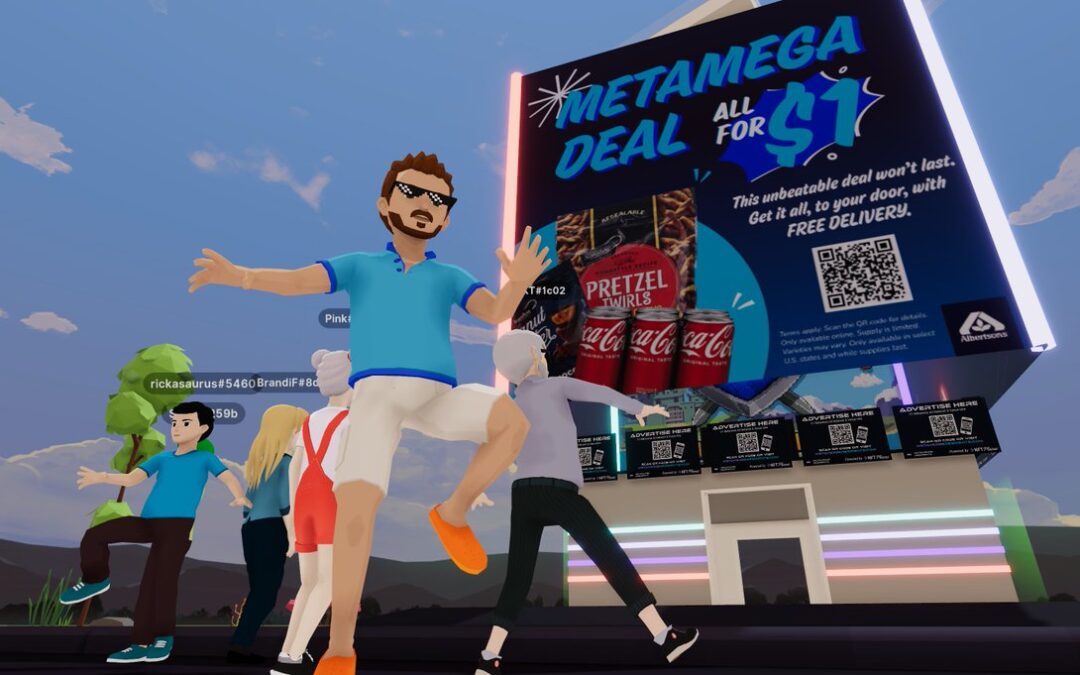
Its pilot program, called the “Meta Mega Deal”, was launched on Decentraland, a 3D virtual browser-based platform. Albertsons offered Signature Select pretzels, peanut butter cups and a six-pack of mini coke as a bundle, all for $1 with free delivery. Users of Decentraland simply scan a QR code, pay by credit card and get items delivered in 45 minutes.
Albertsons, who oversees more than a dozen grocery store brands including Safeway, Vons, Jewel-Osco and Acme will closely analyze the Meta Mega Deal pilot program to understand the on-line interactive behaviors of its younger customers.
Metaverse was announced to be the next big thing at CES 2023. According to McKinsey & Company it is predicted that by 2030, the metaverse may generate up to $5 trillion in sales as an alternative to physical brick-and-mortar store shopping.
One of the big differences in the Metaverse shopping vs traditional on-line shopping is the buyer is not simply looking at an on-line catalog of static photos of items. It is an interactive experience that presents a real-life view of actually being in a location and uses either the actions of the on-screen avatar or a simple QR code to enable the e-commerce activity.
I vividly remember the first time becoming totally immersed with an “Arthouse film” It was in 1992, in a little dinky hole-in-the-wall cinema in San Francisco. I sat there completely mesmerized watching, and as far as I can tell, a “near-perfect” movie, as every component of it’s filmmaking was simply superior in every aspect. The movie was “Howards End”.
The tiny theater consisted of less than fifty uncomfortable seats, but that didn’t matter much, as I was glued to how the the story moved along with Emma Thompson’s nuanced performance as Margaret Schlegel, a character I would never forget, along with the masterly Sir Anthony Hopkins.
The adapted screenplay written by Ruth Prawer Jhabvala of Merchant/Ivory fame resonated with me, that I inspired to seek out the original writings by the author himself, E.M. Forster. When everyone else was collecting Batman memorabilia, I was collecting anything “Howard’s End”.
The film went on the following year to win three Academy Awards, including Best Actress for Thompson. It also happened to be the very first Sony Pictures Classics movie ever released.
Thank you Sony Pictures Classics for not only for introducing me to “Howard’s End”, which was absolutely my “Best Picture” favorite from that year, but also to the countless movies that were released in the last three decades.
Over the years of festival going, I would flip through the programs as an active movie festival goer, always looking for thought provoking films, both domestic and international. If I see the name “Sony Pictures Classics” as the distributor, then I knew right off that it was going to be a high quality film.
I still can’t believe it’s been thirty years.
To commemorate, Sony Pictures Classics just released since their 30th Anniversary 4K UHD set and it’s a beautiful package. It is the perfect gift for that someone who not only collects 4K UHD movies, but who appreciates finely designed packaging.
One of my gripes of buying physical media is that more than 90% of the time, you just get an amaray case along with the paper insert and Blu-ray. I used to love collecting Digi books Blu-Rays in my collection. Here, you have a 24-page booklet, featuring an all-new essay from renowned film critic David Thomson about the history of Sony Pictures Classics, along with information about each of the included films and an introduction from SPC co-presidents Tom Bernard and Michael Barker.
This 11 movie box set includes iconic award-winning masterpieces from world-renowned filmmakers, unforgettable performances from global luminaries, and fan-favorite stories that have resonated across the years: ORLANDO, THE CELLULOID CLOSET, THE CITY OF LOST CHILDREN, RUN LOLA RUN, SLC PUNK, CROUCHING TIGER, HIDDEN DRAGON, THE DEVIL’S BACKBONE, VOLVER, SYNECDOCHE, NEW YORK, STILL ALICE and CALL ME BY YOUR NAME. Each film is presented in 4K resolution with Dolby Vision High Dynamic Range.
Notably, ten out of the eleven titles have never been released on 4K. (Only Crouching Tiger, Hidden Dragon was released in 4K) Also, the set includes hours of archival special features across the eleven films, plus a few newly added materials, rounding out this set.
It would be a wonderful present for the holidays, even if it’s just for yourself.
ORLANDO
Synopsis: Tilda Swinton and Billy Zane star in this hip, sexy and wickedly funny look at an English nobleman who defies the laws of nature and comes back to life as an English noblewoman.
Special Features and Technical Specs:
4K RESTORATION OF THE FILM
DOLBY VISION/HDR PRESENTATION OF THE FILM
English 2-Channel Surround DTS-HD Master Audio
Audio Commentary with Director Sally Potter and Actress Tilda Swinton
Select Scenes Commentary
Orlando Goes to Russia
Orlando in Uzbekistan
Jimmy Was an Angel
Venice Film Festival Press Conference
An Interview with Sally Potter
Theatrical Trailer
Optional English SDH subtitles for the main feature
THE CELLULOID CLOSET
Synopsis: Narrated by Lily Tomlin, this exuberant, eye-opening movie serves up a dazzling hundred-year history of gay men and women on the silver screen.
Special Features and Technical Specs:
4K RESTORATION OF THE FILM
DOLBY VISION/HDR PRESENTATION OF THE FILM
English 2-Channel Surround DTS-HD Master Audio
Audio Commentary with Filmmakers Rob Epstein, Jeffrey Friedman, Lily Tomlin, producer Howard Rosenman, and editor Arnold Glassman
Additional Commentary with Author Vito Russo
Collection of Outtakes
Interview with Vito Russo
Theatrical Trailer
Optional English SDH subtitles for the main feature
THE CITY OF LOST CHILDREN
Synopsis: From Jean-Pierre Jeunet, the director of AMELIE and DELICATESSEN, comes a fantastically twisted fairy tale chock-full of curious characters, spectacular stunts and unforgettable visuals.
Special Features and Technical Specs:
4K RESTORATION OF THE FILM
DOLBY VISION/HDR PRESENTATION OF THE FILM
French 2-Channel Surround DTS-HD Master Audio
NEW Audio Commentary with Director Jean-Pierre Jeunet
Audio Commentary with Director Jean-Pierre Jeunet and Actor Ron Perlman
Making-Of Featurette
“Les Archives de Jean-Pierre Jeunet”
Interview With Costume Designer Jean-Paul Gaultier
Theatrical Teasers & Trailer
Optional English subtitles for the main feature
RUN LOLA RUN
Synopsis: A thrilling post-MTV, roller-coaster ride! Time is running out for Lola (Franka Potente). She’s just received a frantic phone call from her boyfriend, Manni (Moritz Bleibtreu), who’s lost a small fortune belonging to his mobster boss. If Lola doesn’t replace the money in twenty minutes, Manni will surely suffer severe consequences.
Special Features and Technical Specs:
4K RESTORATION OF THE FILM
DOLBY VISION/HDR PRESENTATION OF THE FILM
German DTS-HD Master Audio 5.1
NEW Audio Commentary with Director Tom Tykwer and Editor Mathilde Bonnefoy
NEW, Making-Of Featurette
Audio Commentary with Director Tom Tykwer and Actor Franka Potente
Still Running Featurette
Believe” Music Video
Theatrical Trailer
Optional English subtitles for the main feature
SLC PUNK
Synopsis: It’s 1985 and Stevo is that rare animal: a punk rocker in the Mormon stronghold of Salt Lake City, Utah. He just graduated from college with honors and now his life is a nutty roller coaster ride of rock shows, stealing cars, beating up rednecks and non-stop partying with his buddy, Heroin Bob, and his girlfriend. But with the scene getting lame and Stevo going nowhere fast, he has to put his punk ideals to the test.
Special Features and Technical Specs:
4K RESTORATION OF THE FILM
DOLBY VISION/HDR PRESENTATION OF THE FILM
English DTS-HD Master Audio 5.1
NEW Revisiting SLC PUNK – a new interview with Director James Merendino
Audio Commentary with Director James Merendino and Actors Matthew Lillard & Michael Goorjian
Comic Book Gallery
Theatrical Trailer
Optional English SDH subtitles for the main feature
CROUCHING TIGER, HIDDEN DRAGON
Synopsis: An epic set against the breathtaking landscapes of ancient China, Crouching Tiger, Hidden Dragon combines the exhilarating martial arts choreography by Yuen Wo-Ping (The Matrix) with the sensitivity and classical storytelling of an Ang Lee film. The result is something truly unexpected: romantic, emotionally powerful entertainment.
Special Features and Technical Specs:
4K RESTORATION OF THE FILM
DOLBY VISION/HDR PRESENTATION OF THE FILM
Mandarin Dolbv Atmos and DTS-HD Master Audio 5.1
Audio Commentary with Director Ang Lee and Writer / Producer James Schamus
Audio Commentary with Cinematographer Peter Pau
Introduction by Director Ang Lee
7 Deleted Scenes (in 4K HDR)
Crouching Tiger, Hidden Dragon – A Retrospective
The Making of Crouching Tiger, Hidden Dragon
English “A Love Before Time” Music Video
Mandarin “A Love Before Time” Music Video
A Conversation with Michelle Yeoh
Photo Gallery
Theatrical Trailer
Optional English subtitles for the main feature
THE DEVIL’S BACKBONE
Synopsis: His father killed in the brutal fighting of the Spanish Civil War, ten-year-old Carlos is sent to live at the desolate Santa Lucia School, now a makeshift shelter for war orphans. Soon after his arrival, Carlos has a series of seemingly supernatural encounters: strange shadows, voices and, most frightening of all, the apparition of a brutalized young boy. Turns out that Carlos is not alone in seeing these strange phenomena, many other children have experienced the “One Who Sighs,” as the entity has come to be called.
Special Features and Technical Specs:
4K RESTORATION OF THE FILM
DOLBY VISION/HDR PRESENTATION OF THE FILM
Spanish DTS-HD Master Audio 5.1
Audio Commentary with Director Guillermo del Toro
Audio Commentary with Director Guillermo del Toro and Cinematographer Guillermo Navarro
Guillermo del Toro Introduction
Director’s Thumbnails Track
Director’s Notebook
Que es un fantasma? Featurette
4 Deleted Scenes with Director Commentary
Sketch, Storyboard, Screen – 6 Scenes
Making-Of Featurette
Summoning Spirits Featurette
Theatrical Trailer
Optional English subtitles for the main feature
VOLVER
Academy Award-winner Pedro Almodóvar (2003, Best Original Screenplay, Talk to Her) comes VOLVER, a comedic and compassionate tribute to women and their resilience in the face of life’s most outrageous tribulations. A luminous Penélope Cruz leads an ensemble of gifted actresses, including Carmen Maura (Women on the Verge of a Nervous Breakdown). Raimunda (Cruz) and her sister Sole lost their parents in a tragic fire years ago…or did they? Superstitious villagers claim that the girls’ departed mother, Irene (Maura), has been seen wandering around their Aunt Paula’s home. When Irene appears to Sole, she explains that she has returned to set right her daughters’ troubled lives and reveal shocking secrets that will impact everyone!
Special Features and Technical Specs:
4K RESTORATION OF THE FILM
DOLBY VISION/HDR PRESENTATION OF THE FILM
Spanish DTS-HD Master Audio 5.1
Audio Commentary: Director Pedro Almodóvar and Actor Penélope Cruz
Making of Volver Featurette
Interview With Pedro Almodóvar
Interview with Penélope Cruz
Interview With Carmen Maura
Tribute to Penélope Cruz
Theatrical Trailer
Optional English subtitles for the main feature
SYNECDOCHE, NEW YORK
Synopsis: From Charlie Kaufman comes a visual and philosophic adventure. Theater director Caden Cotard (Philip Seymour Hoffman) is mounting a new play. His life catering to suburban blue-hairs at the local regional theater in Schenectady, New York is looking bleak. His wife Adele (Catherine Keener) has left him to pursue her painting in Berlin, taking their young daughter Olive with her. His therapist, Madeleine Gravis (Hope Davis), is better at plugging her best-seller than she is at counseling him. A new relationship with the alluringly candid Hazel (Samantha Morton) has prematurely run aground. And a mysterious condition is systematically shutting down each of his autonomic functions, one by one. Worried about the transience of his life, he leaves his home behind. He gathers an ensemble cast into a warehouse in New York City, hoping to create a work of brutal honesty. He directs them in a celebration of the mundane, instructing each to live out their constructed lives in a growing mockup of the city outside.
Special Features and Technical Specs:
4K RESTORATION OF THE FILM
DOLBY VISION/HDR PRESENTATION OF THE FILM
English DTS-HD Master Audio 5.1
The Story of Caden Cotard Featurette
NFTS/Script Factory Masterclass
Infectious Diseases in Cattle Roundtable
In and Around Synecdoche, New York Featurette
Theatrical Trailer
Optional English SDH subtitles for the main feature
STILL ALICE
Synopsis: Alice Howland (Julianne Moore), happily married with three grown children, is a renowned linguistics professor who starts to forget words. When she receives a diagnosis of Early-Onset Alzheimer’s disease, Alice and her family find their bonds thoroughly tested. Her struggle stay connected to who she once was is frightening, heartbreaking, and inspiring. Also starring Alec Baldwin, Kristen Stewart, Kate Bosworth and Hunter Parrish.
Special Features and Technical Specs:
4K RESTORATION OF THE FILM
DOLBY VISION/HDR PRESENTATION OF THE FILM
English DTS-HD Master Audio 5.1
3 Deleted Scenes
Directing Alice Featurette
Finding Alice Featurette
Interview with Composer Ilan Eshkeri
Theatrical Trailer
Optional English SDH subtitles for the main feature
CALL ME BY YOUR NAME
Synopsis: Amid the summer splendor of 1980’s Italy, Elio and Oliver discover the heady beauty of awakening desire that will alter their lives forever.
Special Features and Technical Specs:
4K RESTORATION OF THE FILM
DOLBY VISION/HDR PRESENTATION OF THE FILM
English DTS-HD Master Audio 5.1
Audio Commentary with Actors Timothée Chalamet and Michael Stuhlbarg
Snapshots of Italy: The Making of Call Me by Your Name Featurette
In Conversation with Armie Hammer, Timothée Chalamet, Michael Stuhlbarg, and Luca Guadagnino Featurette
“Mystery of Love” Music Video by Sufjan Stevens
Theatrical Trailer
Optional English SDH subtitles for the main feature
The retail revenue from consumer electronics sales in the United States is expected to reach close to 505 billion U.S. dollars by the end of 2022, recording a growth rate of almost three percent – predicts Statista, a leading provider of market and consumer data.
The market continues to grow at a rapid pace as a major contributor in enriching people’s lives. It becomes most noticeable during the months of November and December, when consumer spending drives the holiday season compromising of about 40% of their annual revenue for most of the retailers during the year.
During the pandemic (COVID-19), that disrupted growth in several sectors, the consumer electronics market was resilient. With people spending a lot more time at home, increased demand for greater comfort and security through smart devices and appliances drove growth in the sector.
The consumer electronics market often appears to reach its saturation levels with proliferation rates at maximum, but there are always innovative products that act as critical drivers of growth in this sector. Today’s electronic devices are not only more technologically advanced than years ago, but also cheaper, more widely available, and more diverse.
According to Statista leading consumer tech product sales in US will be a smartphone. This largest electronics sector showed no sign to slow down. In 2021 reached a revenue 481 billion U.S. dollars and will continue to grow with 500 billion expected by 2026. In 2021, the television segment of the CE market reached a sales volume of 544 million units. Given the constant development of modern technologies, high-resolution TVs, such as 8K are becoming popular, while smart TVs with integrated internet features have already taken the world. Great consumer enthusiasm over the last years earns also wearable devices, which include fitness trackers and smart watches. The overall wearable market is projected to ship around 490 million units by 2023, an increase of approximately 80% compare to 2020. Strongly growing is also gaming consoles and VR/AR headsets. In contrast, digital cameras are undergoing a sustained market decline.
Welcome to the era of technology and Happy Holidays!
Electrification trends are shaping the future of mobility. At 2022 LA Auto Show that took place at Los Angeles Convention Center in the late November most of the press conferences were focus on electric cars, most talks were about electric cars and almost every auto manufacture present hybrid or fully electric vehicle of its own.
In a gasoline driven world, the latest electric vehicles are changing the landscape of the automotive industry. The negative environmental consequences of using gasoline can’t be ignored any longer. With the continuing high prices of gasoline that drivers face each time they fill up their automobile tanks at the gas station, consumers have an attitude like “it is what it is”. However, with the EV’s that have been introduced, they now have another viable option. Drivers will save not only on fuel costs but also will never have to pay any additional money for oil changes and smog check, not mention to be in fashion – environmentally friendly and concern about next generation future.
The EV’s are now presenting a new reason to get them into homes, providing power when the electrical grid goes down. Ford introduced the F-150 Lightning to their 2023 lineup which can power your home for up to 3 days automatically when it is connected to the Ford Charge Station Pro home charging unit.
These are great reasons to make a transition immediately to the electric cars, however is the automobile industry there? Gasoline, with all of its problems that it causes to the environment, is a very efficient way to store energy. It is definitely more efficient than an electric battery. In addition, plug-in electric’s also need a massive charging infrastructure and we already have a century’s worth of gas stations and other fueling infrastructures built. In conclusion, drivers’ expectations for electric cars presently do not compete the same way as the traditional gasoline cars do.
But there is no way back. The industry is heading to full electric models with powerful and smart chargers. Electrify America, that is an electric DC fast charging station network in the US, announced more than 791 charging locations (plus 90 coming soon) and over 3,531 individual charging units as of September 2022. The largest public fast charging network has been building out a convenient, reliable, customer-centric network of electric vehicles chargers nationwide – at workplaces, in communities, and on highways.
Disney Original Documentary’s Mija follows Doris Muñoz and Jacks Haupt, two daughters ofimmigrants from Mexico, navigating their careers in the music industry. A moving love letter to immigrants and their children, this intimate debut feature by Isabel Castro captures the emotional and complex stories of Doris and Jacks for whom “making it” isn’t just a dream, it’s a necessity.
A DISNEY FIRST
It’s been a quite a musical journey for 27 year millennial old Doris Muñoz, the subject and protagonist of the latest Disney documentary feature film “Mija”, who appeared at a recent screening at the Roxie Theater in San Francisco along with the films Emmy-nominated director, Isabel Castro, who is also credited as the Director of Photography.
“Mija”, which literally translates to “my darling little daughter” in Spanish, tells the story of Muñoz pursuing her dreams of “making it” in the music industry while trying to sponsor her undocumented immigrant parents to gain legal status in the U.S. enabling them to reunite the entire family together. Her brother was deported back to Mexico six years ago.
“Mija” has the distinct honor of being the first “Disney Original Documentary”, which is “committed to pushing the boundaries in non-fiction storytelling by embracing new creative voices, approaches and styles in cinema”. The film is a sensible first choice as it fits that criteria with the Latino community, an ethnic group whose voice rarely gets heard in the media. On so many different levels, the film takes the audience out on an emotional rollercoaster, especially exposing the racial and cultural barriers of living in this country without having the benefit of being treated as a first-class American citizen.
The film had its premiere at Sundance in January, its theatrical run in August, and will be streaming on Disney Plus starting September 16th.
PERSONAL STORYTELLING
In contrast to her journalistic immigration documentaries that she directed for various media outlets, Castro was given more creative control and was able to shape the narrative storytelling in “Mija” that had limited her so much in the past. “As a teenager, I felt like there was a shortage of stories about what it meant to come of age as an immigrant or as the child of immigrants in the United States. I wanted to tell the kind of story I craved myself, as a Mexican immigrant, when I was figuring out my identity, family, and community.” Castro exclaims.
It’s her most personal film to date, which included and total cooperation and trust from with her subject, Doris Muñoz, along with her entire family and her musical cliental, even through the pandemic, which actually heightened their relationship even more.
“When I met Isabel, we clicked in a way that felt like we’ve known each other for such a long time. And that’s my gut feeling immediately checked out. I was like, already cool, like I could trust her with this, and I think that”, Munoz explained. “I didn’t have Big Sisters growing up and I felt like Isabel kind of really like became a part of our family. Her being a part of such intimate moments. And I felt like I had a big sister all of a sudden, you know, and I, I think quite transparent online.”
MUSIC AS A CAREER CHOICE
The film begins with Muñoz, buying party supplies at a local store in San Bernardino, which we later find out is for her own 26th birthday party that she plans to throw for herself. She explains that she is the “birthday queen” as we are shown footage of early family home videos from when she was a baby to where she is now. Lovingly raised alongside her brother by her immigrant parents and extremely proud of their Latina heritage, we see her singing at home, in church, and even playing the saxophone and the violin in high school. Through these clips, it becomes obvious that music was going to be her chosen path.
After graduating USC with a degree in music theater, Muñoz questions her unorthodox career choice of being a music manager. We see her trying to persuade her supportive but unconvinced parents that she is heading in the right direction career-wise to financially support herself. At the same time, we feel the conflict and tension in her voice as she tries to reason with her parents on the phone, as she now has to make critical adult decisions on her own that will shape her life and eventually her family from this point on.
A CAREER IN MUSIC MANAGEMENT
It soon pays off for Muñoz, as she began to reach out to other Latino artists using social media, such as Twitter and YouTube. She gets her big break with becoming the music manager for Cuco, a young teenage Chicano singer-songwriter music artist from Hawthorne, California. Within a year, Muñoz helped Cuco playing backyard BBQ shows to major music festivals, such as Coachella and Lollapalooza, eventually becoming an international sensation.
In one memorable scene, Cuco mesmerizes his Latino audience, who are also singing along to his lyrics as he seductively performs to them. The camera perfectly captures the mood with its colors magically blending its universe and adding to the ethereal quality of the moment, as well as showing us the power and intensity of those of the artist and audience that are reserved usually only to the musical elite.
From that point on, Muñoz never looked back as her career flourished with a new lifestyle that she never imagined; five star hotels, restaurants, travel all around the world, but most of all, financial independence…all for something she loved doing.
After Cuco and Doris parted ways, due to the pandemic that forced cancelling tours, she decided to create her own company, named “Mija Management”. She reached out to Jacks Haupt for who she also saw on social media. Like Muñoz, she was also an immigrant who wanted nothing more than to succeed as an artist with no turning back. Even with Muñoz being six years her senior, the two became like-sisters, with both having the same guilt of being the only U.S. citizen in their own family.
Just as the importance in a relationship between a documentary subject and the documentary director is to the film, the same could be said between the artist and the music manager when it comes to music. It’s all about gaining trust. Just like Muñoz has a trusting relationship with her family, she also does with the artists that she manages. With her growing reputation and success as a music manager, musical talent now pursues her instead of it being the other way around.
Though she had the talent to be a singer herself when she attended USC, Muñoz preferred not to be in the spotlight but to be behind the scenes. It wasn’t until she had the opportunity to sing with Ed Sheeran, who asked her onstage to sing along to his hit single “Lego House” at a radio event during her sophomore year in college, that she ever did consider to become a singer and launch a solo career.
As soon as she started posting videos of herself performing on YouTube, they went viral. Even her musical heroes responded and gave her much encouragement and praise. Even more amazing is that it hasn’t even been yet a year since Muñoz decided to change career paths from being a music manager to a singer. It was a life transformation for her.
“It’s the best decision I’ve ever made. It was like when I finally made the decision, it felt like my angels, my ancestors, my guide, take everyone who’s been rooting for me up and around me”, Munoz continued, “they made the way, and like every door has been opening since”.
Now she is going by the stage name, Doris Anahí, she has her music on all the streaming platforms and already has a few Vevo music videos playing on YouTube. There will also be a soundtrack available for “Mija’, as well.
FINAL THOUGHTS
When asked during a Q&A at the Roxie Theater in San Francisco about her future plans, Castro answered, “I don’t know. I’ll give you a medium answer ’cause I can stay up here for two hours. Kind of unpacking my existential crisis.” Castro paused. “I’m constantly just navigating the different challenges that come along with storytelling spaces. I think I moved out of journalism to try to, you know, go into documentary. And now I’m kind of thinking about fiction”, Castro concluded. “I’m a mess”, as the audience roared into laughter.
With the overly enthusiastic audience and ovation at the end of the film, I believe we will all greatly anticipate and embrace her next film project, whatever it may be documentary or fiction.
Since the advent of online gaming during the 80’s and 90’s, you were only considered a serious online gamer, if you had a top-of-the line gaming PC, such as an Alienware that contained the utmost highest performance components, along with the latest graphics card and a ultimate high performance CPU that had an outlandish ton of memory that most people couldn’t imagine. Expect to pay at least $3000 for a good entry level Alienware gaming computer. It’s just all part of the “game” to stay competitive online.
Today, some extreme gamers will shell out well over $40,000 for a PC, such as for the 8 Pack OrionX2 PC built by Overclockers UK, which is really two systems in one. Processing power comes from the 18-core i9-7980XE that’s overclocked to at least 4.6GHz, and it’s paired with 128GB of overclocked memory and three Nvidia Turing graphics cards. Call it a personal obsession or an expensive habit.
Most of us don’t have an extra $40,000 to spend on a gaming PC. For the average Joe, it’s just really all about upgrading their graphics card into their existing PC’s which will still hopefully be able to accommodate it with its minimum requirements for the CPU.
Just about every two years, Nvidia releases a line of new graphic cards, so to stay competitive in the online gaming world, it’s not unusual to buy a new graphic card every time a product announcement is made when launched. That’s the very least you should do to stay competitive.
When Nvidia’s flagship RTX 3080 GPU came out last year in September, only a fortunate few were able to get hold of one before they were out of stock due to to the huge demand. A few weeks later, the RTX 3090 which cost nearly twice as much as the RTX3080, sold out in minutes at retailers everywhere.
The main reason is because individuals or companies will gobble up all of the supply and sell them nearly double on Amazon or eBay, as third party sellers. You will see them listed on eBay for double the list price, as the $1499 list RTX 3080 GPU’s are selling at $2800, where as the $699 list price of the RTX 2080 is selling for around $1500 to $1700.
Nvidia CEO Jensen Huang addresses the crowd at the 2018 GTC conference. Photo by Marcus Siu.
The third party sellers really made a huge profit knowing that Crypto miners have the money to buy them out. It is as though suddenly, GPU’s have become more used for speculative investment purposes rather than just a commodity. Gamers are on the losing end.
There was not much manufacturers could do to prevent this. According to Nvidia’s CEO, Jensen Huang, he expects this problem to continue well into late 2022, extending his original projection from 2021.
In February, 2020, Nvidia did come up with an alternative solution to help alleviate the huge demand for their GPU’s for gamers; they launched their cloud based gaming platform, GeForce Now. Similar to what Microsoft had done in the cloud with their Office365 software that used to sell in brick and mortar stores, Nvidia has been doing something similar with their cloud based streaming subscription service.
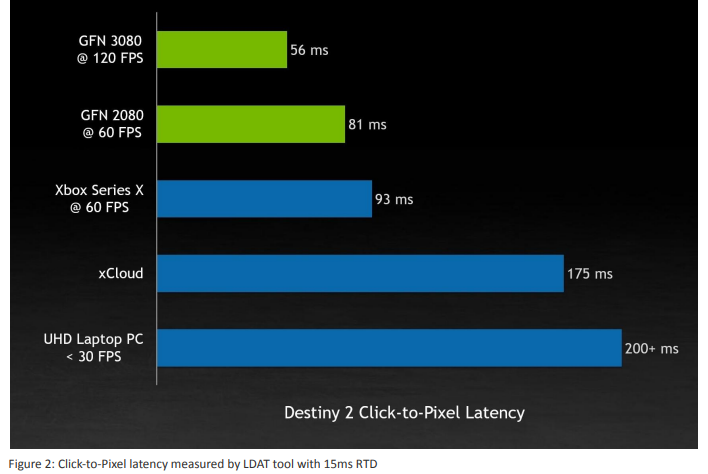
Subscribers are basically “utilizing and leasing” their Nvidia hardware and software to gamers into the cloud. It’s as though they have exclusive rights and access to the world’s greatest supercomputer, called the SuperPod, giving gamers their own high-performance cloud gaming rig that streams and renders through the cloud directly onto their personal device but with a much lower latency and much higher frame rates compared to what they could ever receive from any high-end laptops and PC’s.
For example, the recently announced GeForce Now RTX 3080 memberships can stream up to 1440p at 120 FPS gaming on PC and Mac, with ultra-low latency that rivals local gaming. It can also stream 4K HDR at 60 FPS on SHIELD TV, with ultra-low latency that rivals many local gaming experiences.
As Cloud gaming is ever increasing in popularity, Nvidia’s gamer population has been growing at a very rapid pace. Currently there is a Nvidia priority membership that is $49.99 for a six-month membership. The priority membership uses the RTX 2080 or GTX 1080-powered servers. Members will definitely be motivated to upgrade into the RTX 3080 membership plan for the extra $50.
With GeForce Now available, gamers will no longer need to spend a fortune to buy personal computers or continuously upgrade their GPU’s. Now it’s more of an even playing field for online gamers now that high end computers are no longer required and may be a thing of the past; at least for gaming. The Cloud gaming market has completely changed the way utilize our hardware (and software).
Today, demand for high performance graphic cards have never been greater due to the massive demand far outstripping the supply due to the crypto miners and the pandemic. Regardless of the reason, it’s nice to know that gamers don’t have to be buying a $40,000 to play competitively in the cloud.
Originally published on https://mlsentertainment.wordpress.com/2021/10/30/high-end-gaming-laptops-and-pcs-may-be-a-thing-of-the-past/
Whether you’re a recreational or an avid bicyclist, one of the most crucial items to bring along with you on a medium to long range trip is a good bike light. As the sun sets and it’s just about time to return home after spending a day with friends, you suddenly realize that you may have to ride home in the dark. Visibility and safety becomes the primary concern, especially alongside the fast-paced traffic as you need to see and also be seen.
As you start your journey back, you realize your bike lights aren’t as bright as they should be and you blame it on the possibility of weak batteries, so you park by the side of the road to change them. You reach into your back pack and fumble for your screwdriver and extra batteries in the pitch darkness, but since you weren’t sure you brought them in the first place, you start cursing at the starry night above.
This has been a typical scenario if my life before I started using solar powered products.
Sometimes, it’s actually not the batteries fault because of the ever changing lighting conditions on the roads. Cyclists always want their lights as bright as possible, but with most bike lights, it is not possible unless you bring a battery tester with you to ensure the battery is holding up properly.
I would always find myself consuming countless conventional batteries because I would simply forget to turn off the bike light after each use and would later discover that the batteries were completely drained. Oops.
I also tried going the rechargeable route, but they were not up to par with the conventional batteries since they never held a constant charge. The lights would flicker inconsistently due to the rechargeable batteries lower voltage compared to those of the conventional ones.
To a cyclist, the inconvenience of changing batteries on a bike light is an irritable experience equivalent to that of a person driving a car who has to pull off to the side of the road due to a flat tire.
Luckily, the latest MPOWERD Luci Bike Lights solves these problems, thanks to solar.
INTRODUCING MPOWERD LUCI BIKE LIGHTS
There have been some gnarly looking solar bike lights on the market, so it’s refreshing to see the stylish MPOWERD’s Luci bike lights as another option. It has a minimalist design and weighs a mere two ounces for the front light and 1.2 ounces for the tail light. It almost looks like it was designed to look like an iPod accessory, even though it’s not.
It has a very sleek and stylish bezel, and is very easy to use. Besides being portable and adjustable, it is also waterproof. Even if you get drenched in the pouring rain, be assured that you won’t have to worry about the light ever malfunctioning while pedaling away frantically.
There is a power button on both headlight and tail light. As soon as you turn it on, it defaults to the low light mode. Each time you push the button, it advances to medium, high, and then to a rapid flashing mode that is guaranteed to get everyone’s attention.
The MPOWERD Luci bike light needs bright sunlight for about eight hours to fully charge its 750 mAh lithium-ion battery through its solar panels. If it’s not quite sunny enough or if time is a factor, you can plug and charge it through it’s port through using the micros USB cable that comes with the product. Of course, you can also use a power bank, if you have one laying around.
The front light features a battery indicator to indicate if it’s running low on its battery. Green means it has more than 56% to 100% battery power, yellow means it has 11 to 55% left, and red means you have 0 to 10% left. There is a peace of mind knowing that the brightness will be constant at all times, regardless of which of the three different settings are being used.
Luckily, it is quite versatile, so you can take it with you anywhere you go, inside or out. The headlight stands at about an 80% angle, so it can reflect against a mirror or wall making it a perfect light source. It’s like having an extra wall lamp and perfect to use as emergency backup situations, as well.
IT’S A SNAP – NO TOOLS NOT REQUIRED
The MPOWERD Luci bike light comes in a nicely designed package containing two small post-it sized boxes, each about an inch in height. One box contains the headlight, mount, and a grey silicon strap. The other contains the taillight, mount and two yellow straps.
The mounts have industrial strength magnets that are attach and detach to the bike. It’s tempting to carry them in the original package, but it is best to keep them in a zippered jacket, pant pocket, or even in a small compartment of a backpack instead for easy access.
The setup is a piece of cake, though some bikes may be better equipped to mount these lights depending on the location of where the lights can be mounted. Since, both headlight and tail lights snaps via magnets into the fixed mounts, it would be preferred if the location spots on the bike were made of steel or of any type of magnetic properties.
For example, if the handlebars have exposed steel on it, then the headlight will clamp magnetically onto the handlebar…and it will stay 100% secure without needing the straps.
However, if your handlebar is not made of steel or does not have magnetic properties, such as my old ten-speed touring bike which is made of aluminum alloy, which is also covered with grip tape, then the straps included in the box are certainly required in order to mount the headlight. The Lucid bike strap helps keep the headlight secure and stable and also keeps the light from rattling, though it is certainly not as secure compared with the magnetic snaps.
The taillight installation is quite simple. All that is required is that your seat is raised up at least three inches to free up the exposed steel on the seat post giving it a perfect mount that would be secured with its industrial magnet strength bond.
In my case, however, I decided I didn’t want to raise my bike seat another inch due to personal seating posture preferences. I switched and mounted the tail light to the rear steel post frame of the bike, along with the silicon straps, even though the smaller frames that support the rear wheels slightly obstructed the tail light, but is still very visible for everyone to see in the dark.
In the olden days, I used a screwdriver, pliers and a wrench to mount my bike light. Most of the time, I would completely ruin the bike’s design and scratch the bikes paint and logo just trying to attach the metal clamp around the frame of the bike.
Luckily, this is no longer the case, as the new silicon straps that the Luci bike light made of flexible silicon is harmless to the frame. Better yet, I no longer need to use or carry tools.
THE LOWDOWN
The headlight contains 10 cool white LED bulbs and rates 100 lumens. It lasts over 15 hours, after 8 hours of charging in the sun, which I happily confirmed. The tail light is rated at 40 lumens and lasts about three hours, so you may have to recharge it if you plan to ride longer.
One very useful feature of the Luci bike light is that you can also magnetically mount the tail light to the front headlight to charge it up.
At 100 lumens, I was pleasantly surprised how much light it could generate. Initially, I really didn’t expect to be able to see every nook and cranny on the road. I did feel relatively safe, even on unlit paths, just as long as I wasn’t speeding too much. It provided ample brightness, though, it might be tough to see sudden potholes that you may not see fifty feet ahead if you are going too fast.
If you are mainly biking on unlit roads and trying to win Olympic medals, then you may wish to consider brighter bike lights that have at least 500 to around 1000 lumens.
CONCLUSION
The MPOWERD Luci bike light is perfect for the casual biker who needs to see and be seen at night, especially in the city. It’s perfect for riding during the day with a full charge and then at night for a good couple of hours with the option of using the USB charger.
These bike lights require very little maintenance as you can just leave them outdoors attached to the bike and let the sun do all the work charging the batteries without even having to think about it.
With the ease and convenience of installing it and removing it, you probably never have to worry about having your light stolen ever again unless, of course, if you forget to remove them yourself. It’s portability and versatility make it a great light for biking or just as another light source, even in emergency situations.
It would have been nice if MPOWERD would have included a few extra silicon straps along in the package. I can easily imagine myself carelessly losing one or two of them one day and it sure wouldn’t paint a pretty picture of me attempting to strap the lights using something else, such as Velcro or duct tape out of pure desperation. Perhaps, in order to avoid this, I may just need to run to the nearest Office Depot or Staples to buy a small binder ring to keep them all together.
From the makers of the LUCI lanterns, The MPOWERD Luci bike light is yet another winning new addition to the company’s lineup. How can you not love a company whose mission is to improve lives with transformative, thoughtfully designed, clean technology whose innovative products give people the power of self-reliance and help create a positive environmental impact around the world?
With their products, including the Luci bike light, not only will you help by saving the planet by not having to buy batteries and disposing of them, but you will rarely have to worry about being in the dark ever again…
In 2007, before the days of “apps” and “streaming” was even heard of, I received a special red envelope from Netflix in my mailbox that was going to change everyone’s watching habits forever. These envelopes were reserved for a select few DVD based Netflix subscribers which was the only option initially there was at the time.
The label on the envelope read “Instant Streaming Disc” for PS3.
When Netflix made the announcement to their subscribers that they would soon be able to watch hundreds of movies from their PlayStation 3 console on to their TV sets, it seemed almost incompressible. After I installed the disc, I found myself panning through the menu for what seemed like to be an endless supply of movies that I had the option to watch. After carefully choosing one to my liking, I was blown away at how good the actual video quality was.
From that point on, I realized Netflix’s streaming was going to be the official game changer for not just the DVD rental industry, but the entire movie industry as a whole. It changed the way we watched movies at home; by being able to watch almost any movie at any time.
Fifteen years since that monumental moment, it seems that Netflix may just utilize the magic of the Sony PlayStation yet again, but this time for a different kind of purpose. One that the Sony PlayStation utilizes quite well – games.
In addition to their original films, animation and unscripted TV, Netflix will be offering another new content: gaming.
The great news, at least in the short term, is that there will be no additional cost for the new gaming content for the subscribers, though once everyone gets hooked into it, just like the way video streaming did when it first came out, I imagine they might repeat themselves and charge a bit extra for it later down the line once it is widely embraced by it’s audience.
Recently announced on a letter to shareholders this month, Netflix said that will initially focus gaming on mobile devices. So, I assume Netflix will develop some new Android and iOS apps to install onto smart-phones, tablets, and laptops, in order for subscribers to get a taste of what’s to come for gamers. Look for this to be done by the end of the year.
Though, it really wasn’t their intention to get into the gaming business even just a few years ago, Netflix has completely changed their tone. Perhaps it could have been due to the fact that many studios were pulling their big blockbuster movies out of Netflix so they could put them in their own streaming channels, like Disney Plus and HBO Max.
I am sure they had lost a chunk of their 18 to 34 year old audience, since all the Marvel and Star Wars movies had disappeared from the Netflix catalogue. It will be any of them will return just for the games.
STRANGER THINGSHAPPENED
Netflix’s phenomenal Stranger Things, became an overnight sensation since it debuted in 2016. According to Symphony Technology Group, within the first 35 days of release, Stranger Things averaged ratings around 14.07 million adults between the ages 18–49 in the United States. Within its first month, the third season was watched by 64 million households, setting a new record for the most-watched original Netflix series.
The series is the most followed TV show on social media app “TV Time’s” history, with over 5 million followers.
Stranger Things is Netflix’s most prized franchise after having aired four seasons. All types of merchandise could be found at just about any major retail outlet. Books, comics, novels, clothing, toys, games, and even video games. You name it.
INTERACTIVE FILMS AND MOBILE GAMING
In 2017, Netflix started to produce their series of “interactive” films, such as “Black Mirror Bandersnatch”. Their “choose your own adventure” movie has up to ten to twelve different endings based on the viewer’s choices presented at a certain “choice point”. Though there are very few decision-making choices compared to an actual video game, it still made it somewhat, in a way, a “game”, since it is interactive.
The following year, Netflix partnered with Telltale Games and introduced their first interactive game, Minecraft: Story Mode, which through basic controls on a television remote, was comparable to the existing catalogue of narrative stories rom Netflix.
Telltale Games also had the exclusive rights to produce a video game adaptation of Stranger Things, but unfortunately, the company collapsed before production even started.
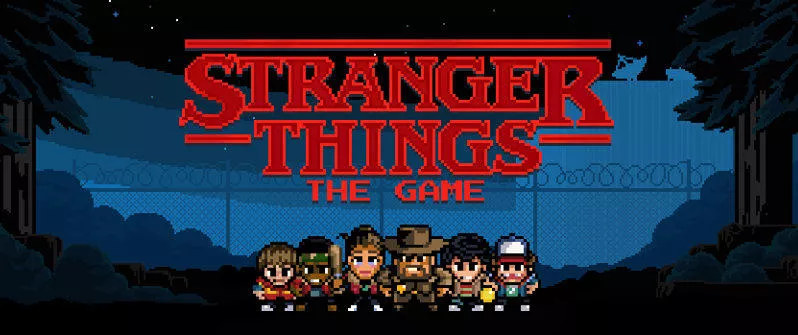
In spite of this, Netflix partnered with BonusXP and developed the first mobile game for Stranger Things on the Android and iOS operating systems, which styled the 80’s look of The Legend of Zelda, the iconic 16-bit Nintendo game that was also about exploration and discovery. The free touchscreen game was downloaded over 3 million times it’s first week in 2017.
The following year, in 2018, when Season Two of Stranger Things came out, the game was updated and also became compatible with the Amazon Fire tablet with an option of using a controller through its port, which was a step in the right direction for serious gamers.
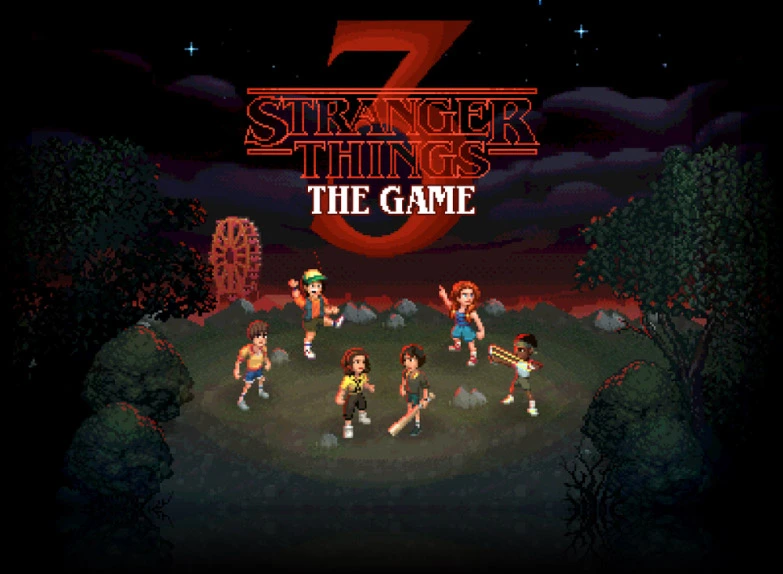
When BonusXP released Stranger Things3: The Game in 2019, the tie-in for the third season, it was the first time that Stranger Things supported multiple platforms a such as personal computers, Nintendo Switch, PlayStation 4, and Xbox One.
The debut of Netflix’s “Stranger Things” in 2017 became a phenomenal franchise that games was just a natural path for its world-wide popularity. Courtesy of BonusXP
I can imagine an updated Stranger Things 5 release, just in time for Christmas that could launch their introduction of gaming to their subscribers.
Even though they are still the major leader of all “over-the-top” streaming services with 204 million subscribers (and still growing), Netflix’s market share has been decreasing each quarter to rivals such as Disney Plus, HBO Plus, Hulu, Amazon Prime and so on. Their competition is starting to take a bigger chunk of the revenue pie.
In 2020, Netflix had a market share of 36.2% of the U.S. television industry’s revenue, down from 44.4% in 2019. By 2022, its share is expected to be down to 28.4%, and almost even with Disney’s slice of the U.S. streaming market.
Perhaps, it just seems natural for Netflix at this stage as a delivery content provider to transition into gaming after experimenting with interactive films.
Unlike Apple Arcade and Google Stadia whom haven’t exactly bowled the public over with their gaming platforms, Netflix has a much better chance to be successful with their existing 204 million subscriber base global platform, along with the endless quantity of intellectual property coming from Hollywood movies. Mobile gaming has the possibility to be more creative than ever.
They also have a great strategic partnership with Sony. I believe game developers from all walks of life would want to work for Netflix, which is one of the most trusted and reputable companies in America to work for, as well. It was ranked #115 in Forbes 500 this year.
For better or worse, there will be some very exciting times as well as more stranger days ahead for the streaming giant. We’ll see if gaming will help fuel the future growth for Netflix. It will be a wait and see.
originally published on https://mlsentertainment.wordpress.com/2021/07/31/the-evolution-and-future-of-netflix-gaming-stranger-things-to-come/
Foundry have been developing creative software for the Digital Design, Media and Entertainment industries for over 20 years. Foundry products are used to create breathtaking visual effects sequences on a wide range of feature films, video-on-demand, television and commercials. The company partners with others players in that field to solve complex visualization challenges and turn incredible ideas into reality. Senior Director Christy Anzelmo talks about the current products and new virtual Production Pipeline. The interview can be found on TL Network coverage.
With the COVID-19 Pandemic looming above us during the past year, the major awards season has been rather anemic with its shows having to rely almost exclusively on virtual technology. It would have been just as enjoyable and appropriate for viewers to watch the shows on their six inch smart-phones instead of on their ultra HD television sets.
This year’s venue will be primarily at the Union Station in Los Angeles, where they will be able to treat this as a film production shoot, rather than an event. The event will be like watching a movie. It will even be shot at 24 frames per second just like film, rather than the 30 frames per second that TV normally is shot at. There may be some “simulcast” feeds and “pre-recorded” performances for best songs, but certainly no Zoom.
It will be virtually “non-virtual” with live presenters and audience, as well. It promises to pay tribute to the golden days of Hollywood when the ceremony was just as a small intimate gathering at the Roosevelt Hotel back in 1929. Winners will be able to give their long glorious acceptance speeches to a live audience, without masks. In other words, everyone that you see on camera will be totally mask-less.
And no, we are not at a “Make America Great Again” political rally.
Prior and close to the event, all attendees will be required to be tested for COVID three separate times before entering the historic venue along with its multiple hubs around the globe. When they are not in front of the camera, everyone must wear their mask. So you can assume when the commercial rolls, they will all be practicing safety and distancing guidelines.
The membership of the Academy Awards has gone through some major changes recently. Thanks to the, #OscarsSoWhite” movement which started two years ago causing an uproar that all of the twenty acting category nominees were all white. In addition, there wasn’t enough women being represented in the Academy.
Since then, AMPAS (Academy of Motion Picture Sciences) recruited filmmakers all around the globe to diversify its members by doubling the number of women and people of color. By looking at this years nominees, it sure looks like they have certainly accomplished this task.
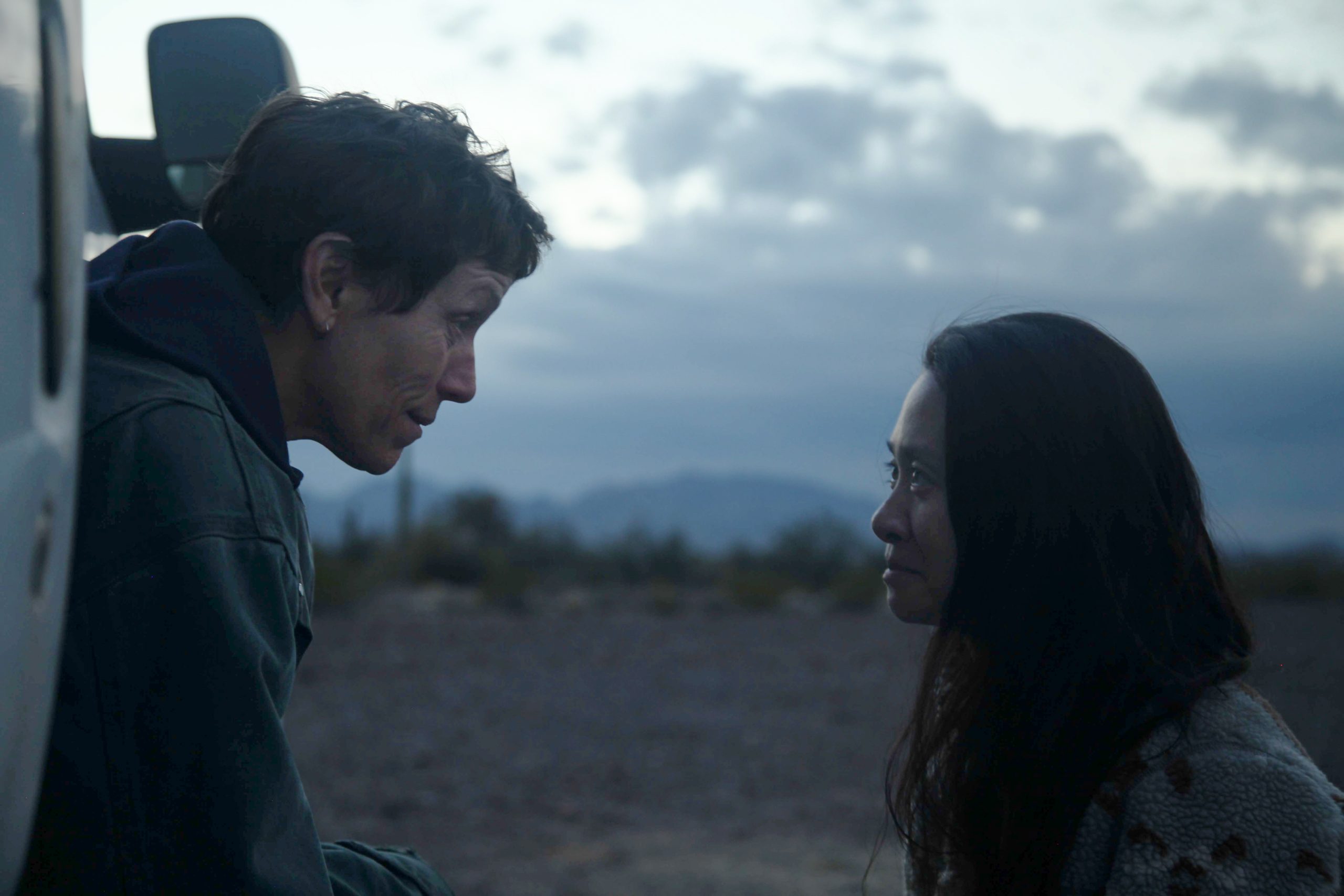
Seventy women received a total 76 nominations, a record for a given year. Chloé Zhao, (editor, writer, director, producer of “Nomadland”) is the first woman to receive four nominations in a single year. Emerald Fennell, (writer, director, and producer of “Promising Young Woman”), becomes the third woman with three nominations in a single year, joining Sofia Coppola and Fran Walsh, who both accomplished that feat in 2003.
Not only has there never been as many diverse nominations in a given year, but this may be the year that the all or the majority of Oscar winners will be of color, if my predictions are correct. Also, for the first time in history and a major leap for #OscarsSoWhite, an Asian woman, a woman who is not white, will most likely win for Best Director.
BEST PICTURE: The Academy Award for the “Best Picture” category is based on the ranking system; an instant-runoff voting or preferential treatment rather than the typical plurality voting that is done in all the other categories. That means even if a movie garners the most first place votes, it can still lose if it places lower on all of the other voters lists. Such a likely example might have happened a few years ago when the heavily favored “La La Land”, with its record 14 tie-breaking nominations lost to the critically acclaimed, “Moonlight”.
This year is no exception, as the rules for the Best Picture category can be a somewhat unpredictable. “Nomadland” is the front-runner as it won most of the awards during the year, including every single Best Director Award for Chloé Zhao. This will be only the second time a woman has won the Best Director prize since Kathryn Bigelow won for “The Hurt Locker”. It will be the first time an Asian woman has ever won the award, as well.
Considering how diversified the Oscars has gotten to be over the years, don’t be too surprised if the highly regarded Korean film, “Minari” pulls off a surprise upset. It has all the necessary major nominations to win votes across the board, but because Korea’s “Parasite” was last year’s big winner, it would put it at a disadvantage in the voting.
MA RAINEY’S BLACK BOTTOM (2020) Chadwick Boseman as Levee. Cr. David Lee/NETFLIX
BEST ACTOR: Critics and filmmakers alike are so enamored by Chadwick Boseman performance in “Ma Rainey’s Black Bottom” that they were thinking it would be inconceivable that anyone else could possibly win this category, even before the Oscar campaign season officially started. When you see his first scene in the movie and you immediately think the studio will use that scene as his “Oscar Clip”, only to discover these scenes gets better and better throughout the movie, especially when he is sharing the screen with the incomparable Viola Davis.
If there is any competition against him who can possibly upset him, it’s Sir Anthony Hopkins, who recently won the BAFTA (British Academy Awards) for Best Actor. However, it probably won’t happen here in the U.S. where many actors were very blessed to have had worked alongside his brilliance before he tragically died. He has virtually won every single award he was nominated for in here in this country.
Andra Day stars in THE UNITED STATES VS. BILLIE HOLIDAY from Paramount Pictures. Photo Credit: Takashi Seida.
BEST ACTRESS: Now that there are more films being made about strong and independent women, the scripts have never been better. Whether it would be musical bio-pics, featuring Billie Holliday or Ma Rainey, or just about “everyday” strong liberated women, it will be very difficult to choose a winner, as we haven’t had this many powerhouse performances ever in a given year for actresses.
Andra Day might have the edge over Davis, since she not only embodied the role of her character like Davis did, but unlike Davis, she actually sang throughout the movie. Within a short amount of time with the help of her dialect/singing coach, she recreated Billie Holiday’s unique vocal style. She even took up smoking and drinking which helped put the “gravel” into her voice, creating the nuance that Holiday had in her singing.
Votes will definitely be split across the board between musical icons, strong and promising young, women, Oscar winners and Oscar nominees who haven’t won, and so on. Sometimes, I feel they should just split the award among all five of the nominees when all of the performances are so outstanding.
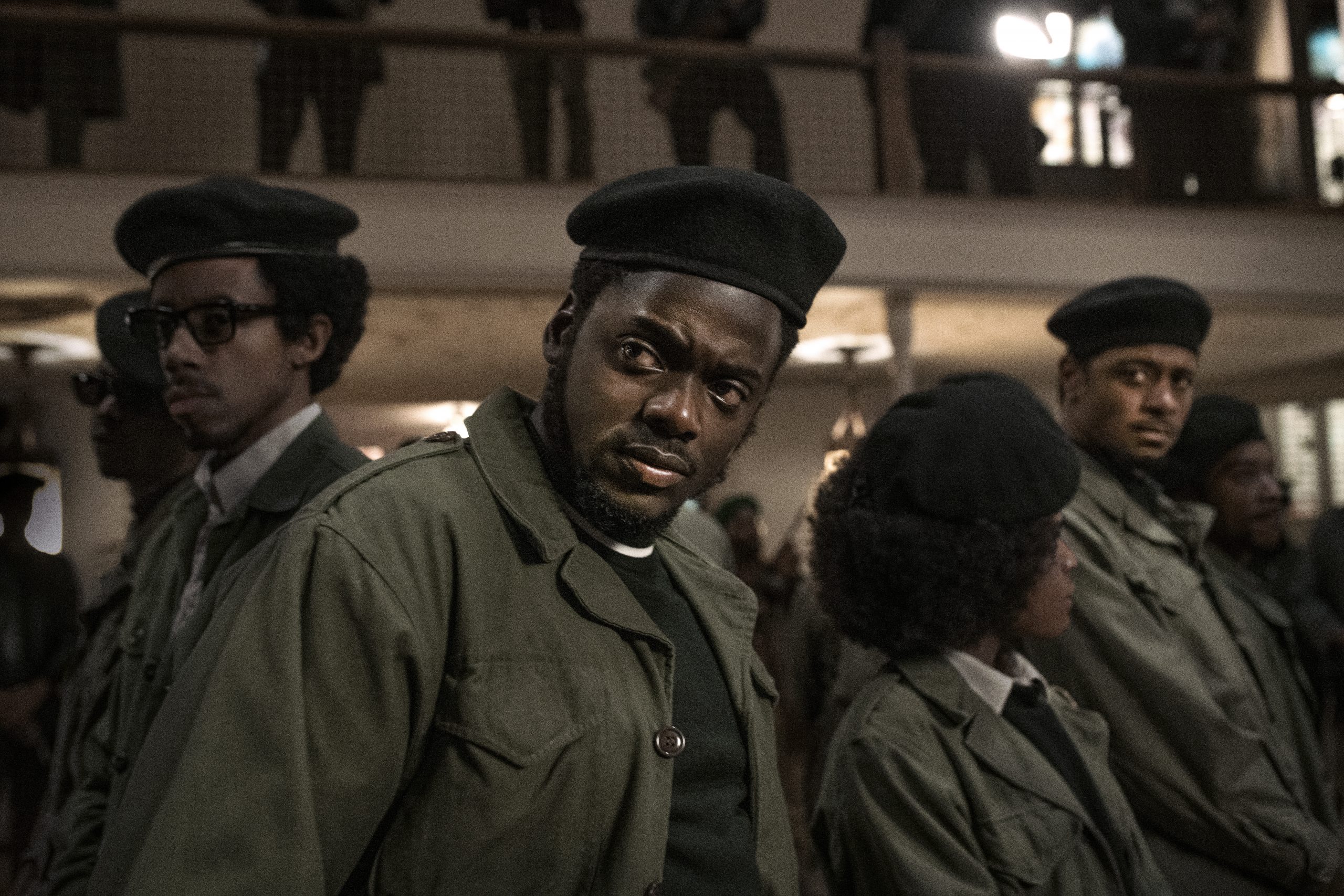
(L-r) DARRELL BRITT-GIBSON as Bobby Rush, DANIEL KALUUYA as Chairman Fred Hampton and LAKEITH STANFIELD as Bill O’Neal in Warner Bros. Pictures’ “JUDAS AND THE BLACK MESSIAH,” a Warner Bros. Pictures release. Photo Credit: Glen Wilson
BEST SUPPORTING ACTOR: If there is another “sure” bet in any acting category, it will be for Daniel Kaluuya taking home the statuette for Best Supporting Actor, portraying Black Panther revolutionary, Fred Hampton in “Judas and the Black Messiah”. Many filmgoers were quite surprised that he is actually British, as most remember his Actor nominated performance as Chris Robinson in Jordan Peele’s thriller, “Get Out”, which earned him a Best Actor nomination in 2017. Kaluuya went on to sweep all the major awards during the year, so it will be no surprise for him to win.
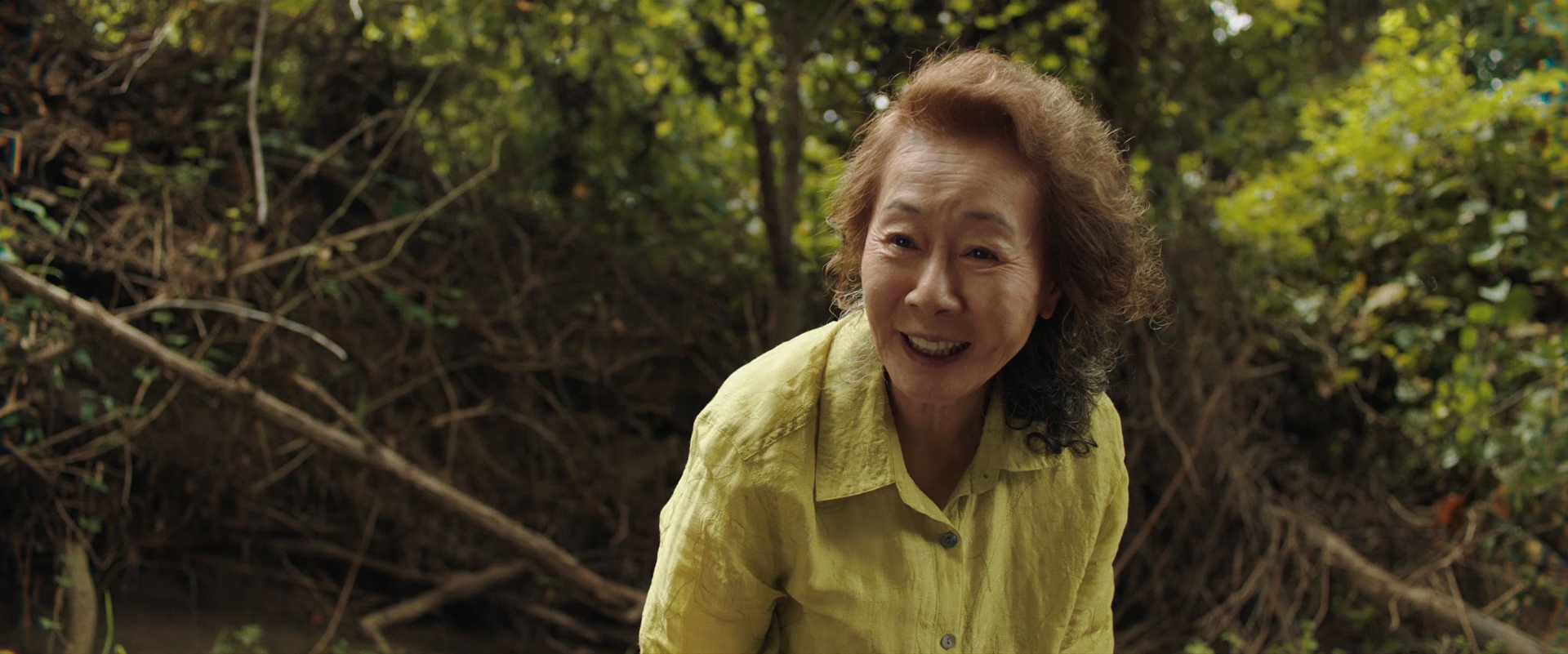
Minari_ Yuh-jung Youn Credit: Courtesy of A24
BEST SUPPORTING ACTRESS: You would think Glenn Close would have an Oscar by now with her eight nomination during her forty year career in film, but her film “Hillbilly Elegy” didn’t garner much support from the Academy voters. Since Yuh-Jung Youn took home the SAG and BAFTA and virtually everything else she was nominated for “Minari”, this should be history in the making for her to be the first Korean actress to win the Academy Award for acting and the second Asian actress since Miyoshi Umeki for “Sayonara” in 1958.
MLS Entertainment’s Oscar Predictions:
Best Picture: “Nomadland” Best Actor: Chadwick Boseman, “Ma Rainey’s Black Bottom” Best Actress: Andra O’Day, “The United States vs. Billie Holiday” Best Supporting Actor: Daniel Kaluuya, “Judas and the Black Messiah” Best Supporting Actress: Yuh-Jung Youn, “Minari” Best Director: Chloé Zhao, “Nomadland” Best Adapted Screenplay: “ Nomadland ” Best Original Screenplay: “ Promising Young Woman” Best Cinematography: “Nomadland” Best Costume Design: “Ma Rainey’s Black Bottom” Best Film Editing: “Trial of the Chicago 7” Best Makeup and Hairstyling: “Ma Rainey’s Black Bottom” Best Music (Original Score): “Soul” Best Music (Original Song): “Speak Now” from “One Night in Miami” Best Production Design: “Mank” Best Sound: “Sound of Metal” Best Visual Effects: “Tenet” Best Animated Feature Film: “Soul” Best Foreign Language Film: “Another Round” Best Documentary (Feature): “My Octopus Teacher” Best Documentary (Short Subject): ”A Love Song for Latasha” Best Short Film (Animated): “If Anything Happens I Love You” Best Short Film (Live Action): “Two Distant Strangers”