Artificial intelligence is impacting the music industry at a rapid pace, offering tools for impromptu creation, production, and even performance. Along with text, images, and videos, generative AI can also produce music, assist with songwriting and production, and even replicate voices in a matter of seconds. Deep learning is based through its training data, which through its underlying patterns and structures is used to produce new data based on the input, which often comes in the form of natural language prompts.
There are numerous websites that use this technique, such as Suni, AIVA, Udio just to name a few, that can generate a complete song with music and lyrics in a certain style, mood, instrumentation, genre, and vocal style with just a brief description and a click of a button. These prompts can be entered directly or created using external tools like ChatGPT, which generates the lyrics.
For example, the user can enter into the Suni song description field “a song in the style of classical music about a ballet dancer struggling to find success in her career”. In just seconds with a click on the “create” button, the user will be able to hear a complete song that sounds like it was written by a semi-professional songwriter, with fairly decent lyrics.
Now, anyone can create music…well at least generate it.
Will the listening music public start listening to music produced entirely by A.I. instead of the real music we know and love?
The answer is many of them already are without really knowing it.
A.I.’s “The Velvet Sundown”
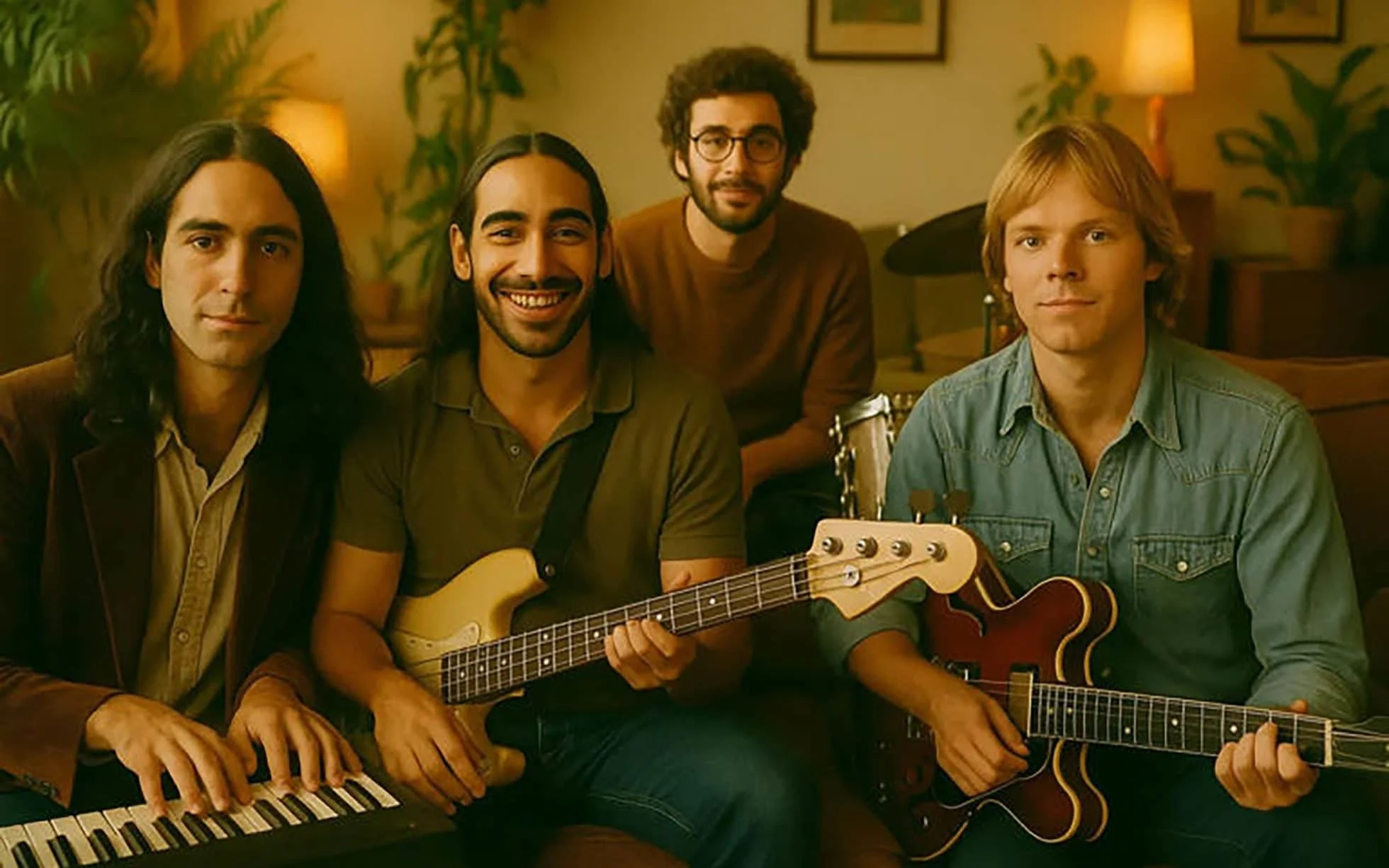
For example, last June, “The Velvet Sundown” (named after “The Velvet Underground”) came out of nowhere and released its first albums on Amazon Music, Apple Music, Spotify as well as other music streaming services: “Floating on Echoes” on June 5, “Dust and Silence” on June 20, and then another on July 14th called “Paper Sun Rebellion”. At their peak, they had well over 900,000 monthly listeners on the streaming platform with their opening track “Dust on the Wind”, (not to be confused with the iconic Kansas song) played over 2.7 million times.
However, there were soon allegations on the bands social media pages that the band was A.I. generated. There was no evidence that this band ever existed. There were no tours, interviews, group websites or any clues whatsoever online. Even many listeners commented that The Velvet Sundown’s music was “soulless” and was missing the “human element”.
The “band” denied all allegations on its X account, claiming it was “absolutely crazy that so-called ‘journalists’ keep pushing the lazy, baseless theory that the Velvet Sundown is ‘AI-generated’ with zero evidence.… This is not a joke. This is our music, written in long, sweaty nights in a cramped bungalow in California with real instruments, real minds and real soul.”
Just a week later, the apparent hoaxer, using the name Andrew Frelon, admitted that he impersonated the band on X and falsely claimed to be a spokesperson for the band in interactions with the media, including a phone interview with Rolling Stone magazine. Frelon finally admitted that the band was 100% A.I. generated using the Suni platform for all the “band”.
“It’s marketing. It’s trolling. People before, they didn’t care about what we did, and now suddenly, we’re talking to Rolling Stone, so it’s like, ‘Is that wrong?’” Frelon questioned.
As with the Spotify subscriber numbers since the “bands” breaking news, over 500,000 subscribers removed their names from the “bands” playlists, a drop of 55% from its peak, as it continues to drop quickly on a daily basis.
The bands Spotify bio eventually changed their description:
“All characters, stories, music, voices and lyrics are original creations generated with the assistance of artificial intelligence tools employed as creative instruments. Any resemblance to actual places, events or persons – living or deceased – is purely coincidental and unintentional. Not quite human. Not quite machine. The Velvet Sundown lives somewhere in between.”
The real issue is its sudden emergence of its popularity and a growing concern about the future of art, culture and authenticity in the era of advanced generative artificial intelligence. It’s both astounding and appalling that music from A.I. can amass and defraud so many listeners in a relatively short amount of time.
“Personally, I’m interested in art hoaxes,” Frelon continues. “The Leeds 13, a group of art students in the U.K., made, like, fake photos of themselves spending scholarship money at a beach or something like that, and it became a huge scandal. I think that stuff’s really interesting.… We live in a world now where things that are fake have sometimes even more impact than things that are real. And that’s messed up, but that’s the reality that we face now. So it’s like, ‘Should we ignore that reality? Should we ignore these things that kind of exist on a continuum of real versus fake or kind of a blend between the two? Or should we dive into it and just let it be the emerging native language of the internet?’”
In another similar hoax “project” from decades ago, one can’t forget the infamous story of the pop group Milli Vanilli and it’s producer Frank Farian, who may have pulled the biggest hoax in popular music history: selling over 7 million albums and 30 million singles, and winning a Grammy for “Best New Artist” by deceiving the public with a pair of lip-synching performance artists who did not sing one note on their records.
Even with the regret and humiliation that Milli Vanilli producer Frank Farian went through, at least their end product was “real music” that used professional musicians and was produced in a recording studio. That takes real talent.
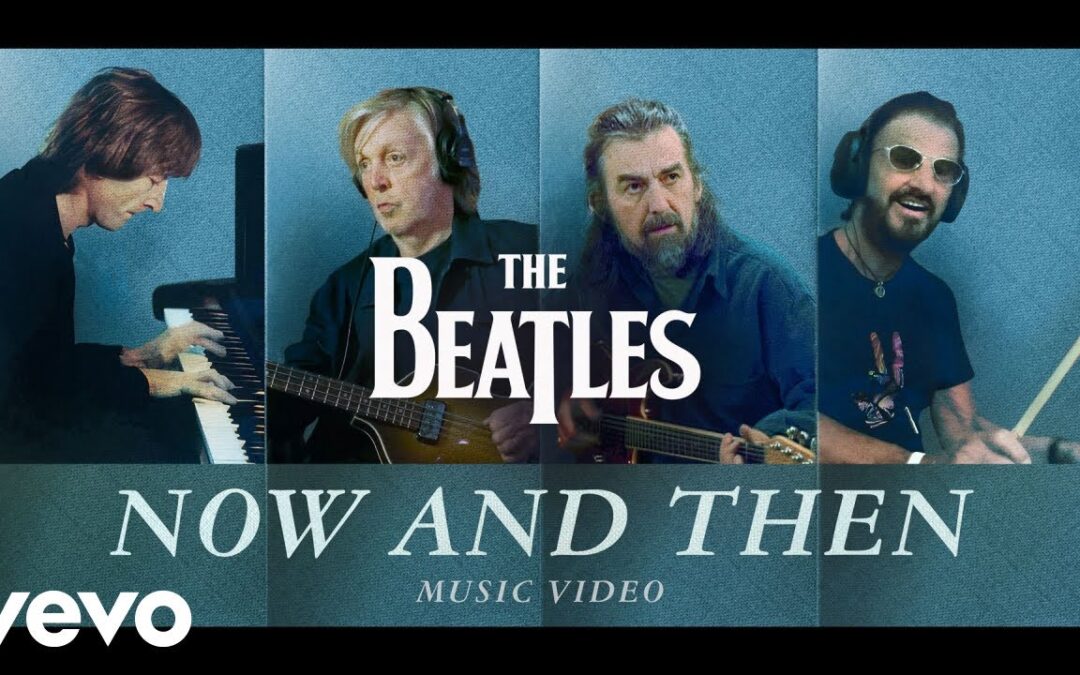
In a notable moment for the music industry, an A.I.-assisted Beatles song, “Now and Then,” won the Grammy for Best Rock Performance in 2025. It was the first time an AI-assisted song received one.I-assisted song received one.
You can credit director Peter Jackson and his production team who worked on the 2021 “The Beatles – Get Back” documentary. They developed an A.I. tool (MAL) for the film and discovered that they could use it to extract John Lennon’s voice from a demo cassette tape recorded in 1974 that originally had Lennon’s piano and vocal on it. They were able to isolate the tracks mixed into a 2 track master and later combined the original 1995 guitar tracks that George Harrison recorded from their “Now and Then” recording session along with McCartney and Starr, who decided to re-record their tracks in 2023 for a true authentic Beatles recording.
Currently, unless you have access to Peter Jacksons MAL A.I. tool, it appears the only way to tell if the music is A.I. generated is if you have software such as Apple’s Logic Pro track splitter and finding “artifacts” from the inputted music files, as music producer Rick Beato calls it.
Also, the music streaming app Deezer, also uses its own tool to identify AI-generated content and declared that 100% of The Velvet Sundown’s tracks were created using A.I. Deezer labels that content on its site, ensuring that AI-generated music does not appear on its recommended playlists and that royalties are maximized for human artists.
Unlike generative A.I., there is nothing fake with the Fab Four latest song, “Now and Then”… it’s just real music with real musicians with a little help from A.I. and their friends; producers Peter Jackson, Giles Martin and George Martin with all of the original Beatles back together again.
“Imagine” that.
Originally published on https://mlsentertainment.com/2025/08/31/milli-vanilli-or-the-velvet-sundown-discerning-real-music-in-the-a-i-era/
Over the past decade, data centers have served as the digital backbone of modern life—warehouses of servers designed to store information, host applications, and deliver content across the internet. But the rise of large-scale artificial intelligence has fundamentally changed what these facilities need to do. Traditional data centers are evolving into AI factories highly specialized, compute-intensive environments designed to train and run AI models at unprecedented scale. This transformation is reshaping architecture, operations, energy consumption, and economics across the tech ecosystem.
NVIDIA held its main GTC (GPU Technology Conference) in San Jose, California, from March 17-21, 2025, focusing heavily on transforming data centers into AI factories with Blackwell Ultra and Reuben architectures, plus AI-powered robotics. Yes, the data centers are no longer in fashion. The AI factories is the word that is describing the transformation what has been happening in technology world.
GTC 2025 solidified NVIDIA’s vision for an AI-driven future, emphasizing massive AI factories, a reinvented computing stack, and the practical application of AI across all industries – from healthcare, life science to manufacture robotics, autonomous vehicles, computer graphics, even video games. Jensen Huang found himself reminiscing on Video games that started Nvidia company in 1983 running the first application and the journey where Nvidia is now.
Key NVIDIA GTC 2025 Themes & Announcements:
AI Factories & Infrastructure: Shift to full-stack accelerated computing, with Blackwell Ultra boosting reasoning workloads and Reuben architecture offering massive performance gains (900x scale-up flops).
Software & Platforms: Introduction of Nvidia Dynamo, an OS for AI factories, and platforms for connecting millions of GPUs.
Physical AI & Robotics: Reality of AI in robotics, logistics, and manufacturing, with demos of self-driving cars and digital humans.
Industry Focus: Deep dives into healthcare (drug discovery), telecommunications (AI-RAN), and public sector AI.
Geopolitics & Sovereign AI: Initiatives for nations to control their own AI infrastructure.
“It’s becoming a giant industry and it’s crushing it and it’s growing exponentially. After A.I., it’s the fastest growing tech sector…” – Ori Inbar, CEO and Co-Founder of AWE
The Augmented World Expo USA 2024, had its 15th anniversary this month, sharing the latest in AR, XR and spatial computing innovations. It’s the longest running and largest event focused on Augmented Reality and Virtual Reality (XR) in the world. The annual three day event outgrew the Santa Clara Convention Center where the annual event took place for its first fourteen years, relocating to its new home in Long Beach Convention Center, attracting more than 6,000 attendees, 300 exhibitors and 575 speakers.
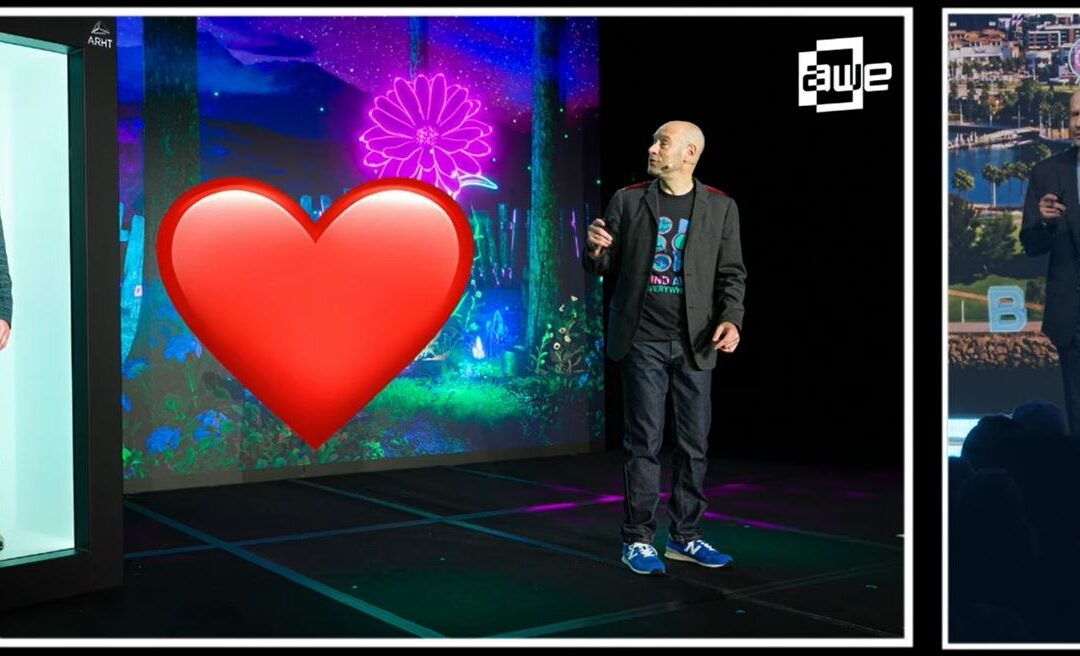
CEO and Co-founder, Ori Inbar, for the first time in its AWE opening keynote history, entered through the convention floor onto the stage wearing a XR headset (Vision Pro) headset, showing all types of mixed reality and face filters that was shown from his headset directly onto the screen entertaining his AWE audience.
LEARNING FROM XR’S PAST TO CREATE THE FUTURE
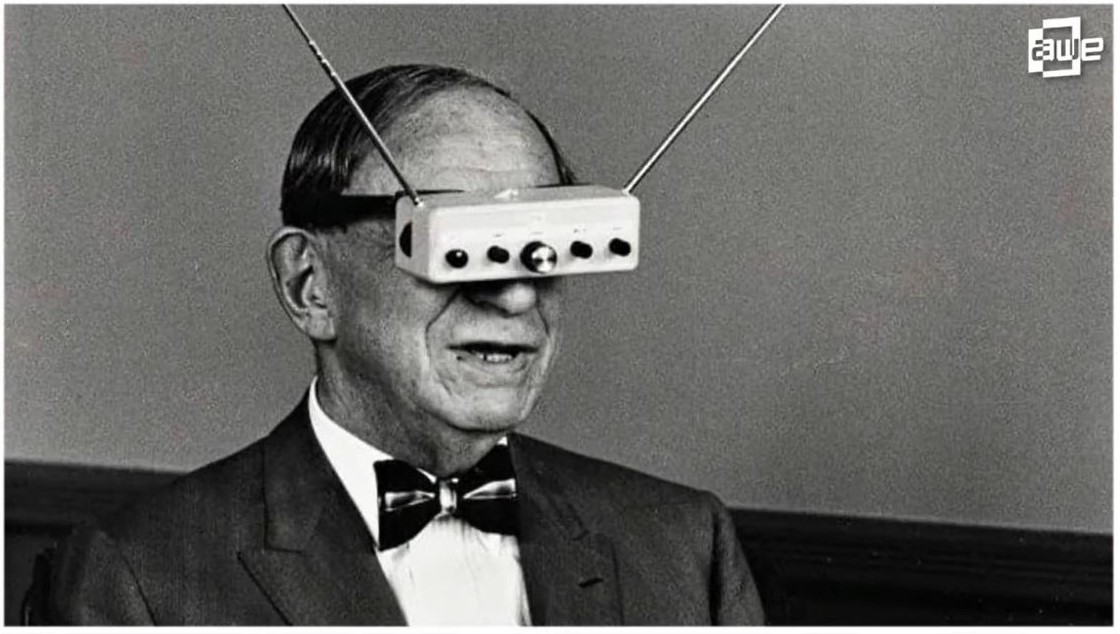
During his keynote, he summarized the state of XR and went through a brief XR history lesson from the beginnings from 1963, with a photo of Hugo Gernsback, the father of science fiction, wearing a type of headworn device that looks like a transister radio with two antennas on it, then five years later, in 1968 with a photo of the first working demo of a head-mounted display created by Ivan Sadland, along with the first keyboard mouse and 2D screen.
Hugo Gernsback, the father of science fiction, wearing a type of headworn device in 1963. Courtesy of AWE.
“If we want spatial computing to one day replace 2D computing we all have to become history buffs”, Inbar stresses to the crowd.
For those who unfamiliar with what “spatial computing” means, Wikipedia defines it as follows:
Spatial computing is any of various human–computer interaction techniques that are perceived by users as taking place in the real world, in and around their natural bodies and physical environments, instead of constrained to and perceptually behind computer screens.
For me the essense of spatial computing is very simple and I quote Ivan (Sadland), “The image of an object changes in the same way the real object changes with similar motions of the head”. Inbar continues, “Head computing imitating real life…that’s a concept I would bet my career on…because humans are biologically spatial and so should computing.”
In conjunction to its annual Auggie Awards, AWE had its inauguration and induction ceremony celebrating the first 101 members of the of the XR Hall of fame—a new platform dedicated to honoring the pioneers whose monumental contributions have shaped and propelled the XR industry forward, including Palmer Luckey, the founder of Oculus VR and designer of the Oculus Rift . It also featured an XR museum showcassing over 80 vintage AR and VR devices, including the Gernsback headworn device.
THE FUTURE OF XR INDUSTRY: THE TIME IS NOW
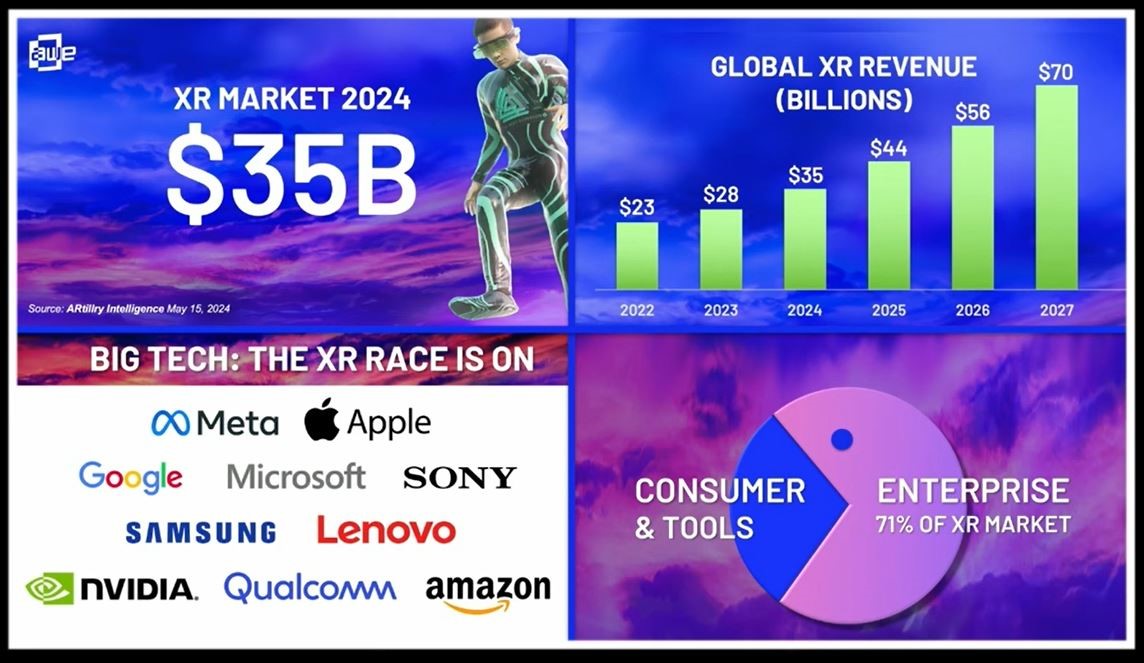
According to ARtillery Intelligence, a research and analyst firm for the business of spatial computing, the XRP market today this year is a $35 billion market. In 2027, it’s expected to double to $70 billion. “It’s becoming a giant industry and it’s crushing it and it’s growing exponentially. After AI, it’s the fastest growing tech sector.” says Inbar.
“Big Tech are all in a tight race to lead the market and it’s rearranging. Each player is retrenching in it to its strengths: software, hardware, operating system, infrastructure…doubling down or opening up and partnering, partnering, partnering. This is good for the market and it’s great for customers.”
According to Inbar, AR penetration has been stagnant around the 30%, but active usage is on the rise and VR adoption is growing where it really matters with the new generation; one in four teenagers are playing in VR.
Almost every single Fortune 1000 company has adopted XR. Enterprise revenue is now over 70% of the XR market. Fortune 1000 companies made its presence at AWE this week. All are participating in AWE’s new enterprise focus program which is ironically called “Focus” with custom export tours, roundtables, networking and really getting business done”, according to Inbar.
“Investments are picking up. Anderson Horwitz, probably the most influential VC in the world is bullish about XR.”, Inbar says. The partner at the firm recently posted this: “We believe AR/VR is among the most underrated markets today”. “Quest has a similar sales trajectory to the iPhone…the time is now” …
“On the Quest store, more than 40 developers have earned over $10 million each”, Inbar continued “amd what’s attractive about XR is that the most popular experiences on the Quest store did it with small teams and no funding.” He cites “Gorilla Tag”, “Penguin Paradise”, and “NoClip” were built with no funding and with one or two people. In addition, games are no longer developed exclusively for XR. Many iOS and Android developers are shifting to spatial with an estimate of over 2 million XR developers in the world.
As an attendee who has been going to the AWE conferences since the very beginnings, never did I have any doubt that VR, AR, MR, XR didn’t have a future. I’m really looking forward to another fifteen years that XR has to offer.
As I was shifting through the RSA Conference 2024 program guide, with it’s impressive comprehensive five day agenda, there was an enormous amount of activities going on to easily fill anyone’s calendar as an attendee for the week. 33 keynote presentations given on two stages in the West and South Stages at the Moscone Center, 650 speakers across 425 sessions, the Expo floors in the South and North Halls had over 600 exhibitors.
As I glanced into the program’s “keynote” section, I noticed one that immediately caught my eye entitled “A Conversation with Actor, Comedian, and Writer, Jason Sudeikis, hosted by RSAC Chairman, Hugh Thompson. It read…
BELIEVE. The Ted Lasso Way has put smiles on the faces of millions worldwide, and maybe made us all a little kinder. A little more focused on teamwork and collaboration. A little more aware of the power of community, and the importance of mental health needs. And a lot more aware of the impact of an inspiring leader. Join this keynote as Jason Sudeikis shares insights, laughs, and inspiration.
As a huge fan of the show, I was curious to know how much knowledge the four-time Emmy Award Winner Jason Sudeikis had in the Cybersecurity field. As I entered Moscone West Hall and tried to find a seat, I discovered that most of the capacity crowd also probably wanted to know, as well.
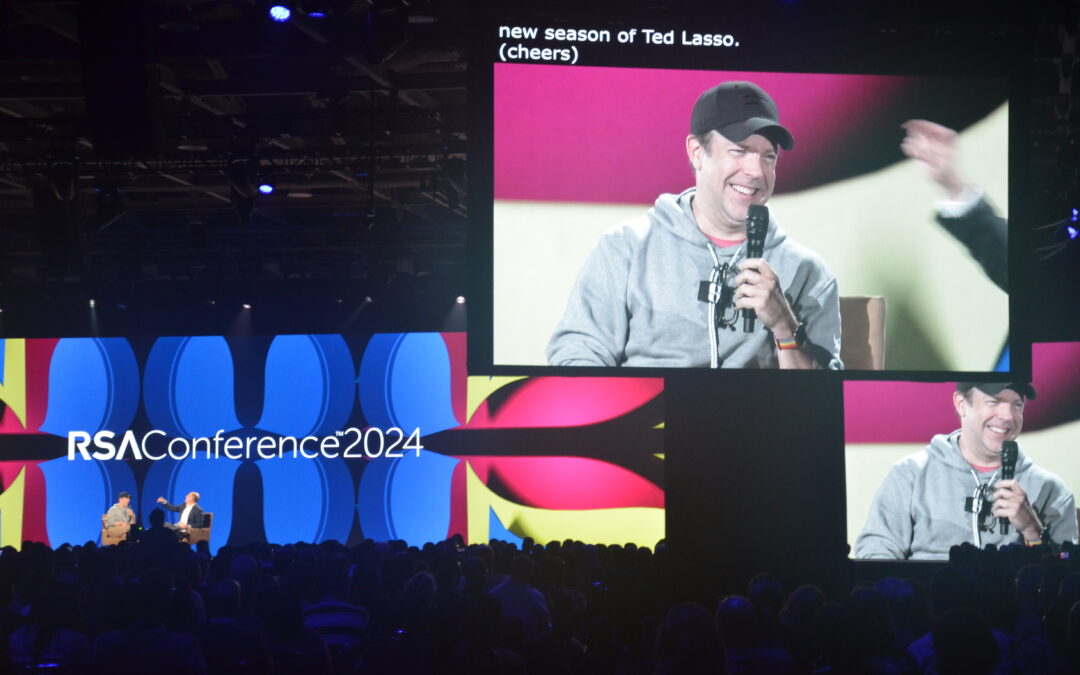
The Executive chair of RSAC and host Hugh Thompson introduced Sudeikis to the much appreciative crowd at Moscone West, and immediately asked Sudeikis what inspired him to be an actor and performer.
“I saw Beverly Hills Cop when I was nine years old… it was very motivational to me and I knew that’s what I wanted … to be a black cop from Detroit.”, Sudeikis replied.
From that moment on, you knew it was going to be a fun-filled afternoon with plenty of laughs with the always very playful Thompson, as host.
BE CURIOUS – NOT JUDGEMENTAL
In a few minutes after the introduction, the lights were further darkened to show a clip from the episode, “Diamond Dogs”, from Season One/Episode 8 of Ted Lasso. They played the infamous darts scene that contained the famous Lasso quote “Be curious, not judgmental”, which perhaps may be one of the most representative quotes based on Ted Lasso’s character reportoire, that easily can be applied practically everywhere in so many different situations. Thompson asked Sudeikis what he wanted people to take away from that scene.
“I just wanted to be cheering for the good guys…like the fact that people have taken and used that in commencement speeches… and I think even some political speeches”, Sudeikis explained...“I’m not sure what politics exactly…that monologue spilled out of me in 1/2 hour… I’m sure everybody has versions of this I know people speak about it a lot in the arts…”
Hopefully, to many of the conference attendees, they can bring this idea of “be curious, not judgemental”, when dealing with others. They should never “judge” whether someone has the means to effect change by contribution, but rather be “curious” having the power to apply and transform change for the better. With the advent of A.I. already now being a major force in Cybersecurity technology, it helps to not be judgemental.
A conversation with Actor, Comedian and Writer, Jason Sudeikis hosted by Hugh Thompson at the RSAConference2024. Photo by Marcus Siu
ALL ABOUT NETWORKING:
At the very beginning of the RSA conference, Thompson encouraged all attendees in the audience to go out an meet new people in the giant RSAC community where people could learn and feed off each other. He presented a hypothetical scenario in the “mean streets” of San Francisco during lunchtime to Sudeikis to the audience: If he was in line at a taco truck stand and would want to connect with a person right next to him, what would be his top five “icebreakers”?
Though Sudeikis didn’t come up with five all together, he and the audience certainly did have alot fun listening to his brainstorming answers.
“Well, I think I’d go “rub bellies” and ask what taco you getting?” “Have you been to this taco truck before?” “You know where the hot spots are?” Or if they are wearing a badge maybe ask them something about that…the big laminates…I don’t know what information is on there but” Sudeikis continued, “I don’t speak “curious”, to know… I mean this is “Playground 101″, I’d ask them their name OK?”
In the middle of Sudeikis’ rant, Thompson asked if tapping a person was okay…
“I think tapping someone might feel a little aggressive. (audience laughs) It depends on the line…if it’s proper like the way like Germans line up, like right behind each other and very rigid (audience laughs) …but if it’s a little “loosey-goosey” and I don’t know, you know, then maybe, yeah”.
Sudeikis then playfully voice acts out two characters in line.
“I apologize for my own hunger because of my tummy.”
“Sorry to hear that…oh, I didn’t hear your stomach.”
“Oh, OK, well it was actually my butt.”
The audience roared with laughter.
“So much of this stuff though is really just about hitting the playing TV Upbeat like your kids… you hit the balloon over to them and you see if they hit it back.“
“Number five would be, “have you seen anything on television that you’ve enjoyed recently?” as Sudeikis glances into the crowd and says “They are all looking for recommendations, and they can always go on “Rotten Tomatoes” but let me ask you perfect strangers.”, Sudeikis explained.
“This is great…which would be great if the answer was “Perfect Strangers”?”
THE ADMINISTER OF LAUGHTER
When Thompson asked Sudeikis, what role humor plays when battling, stress, depression, or burnout, Sudeikis credits his ten year experience on Saturday Night Live, which he was a both a writer and featured performer, as well as various TV projects, shows, and movies.
He highly credited his grandmother during his upbringing, Loretta Wendt, (also mother of Actor George Wendt) who was a volunteer at the Little Company of Mary Hospital in the Southside of Chicago, for teaching him how important humor was to healing.
“It’s always really moving and compelling to me what good medicine laughter is and being an administer of such things or at least a vessel, these projects has always really knocked my socks off and it was something about my grandmother, Loretta Wendt, she worked it, did a lot of work “, Sudeikis continued, “A big part of it was all about how important humor was to healing and I do believe that in between laughter, sleeping and crying are the three best medicines that you’re not going to give any money to a pharmaceutical company. There’s a fourth one too, the love and appreciation and execution of the arts…”
Of course, Thompson couldn’t resist pitching his own “brilliant” idea to Sudeikis for kicking the Emyy Award show into the next level by introducing a new character into the series and possibly leading up to the season finale for Ted Lasso. The concept of a mildly bald, suave, (but not to suave) cybersecurity character from some exotic background like Jamaica or the Carribean, who stalks down a hacker somehow didn’t quite make a very convincing pitch, even with Thompson’s impressive background in the Cybersecurity field.
“Would anyone believe that a character like that really existed…as a person?”, Sudeikis questioned.
So it became pretty obvious after the interview was over that the very delightful Jason Sudeikis didn’t have much to say about the very latest in cybersecurity trends at the RSA Conference, but to give him some due credit, his alter ego Ted Lasso certainly didn’t know much about European soccer (futbal) in his first season, either…and look what can happen. In any case, it couldn’t have been a more fun-filled entertaining afternoon for the RSA conference attendees.
20 DAYS IN MARIUPOL
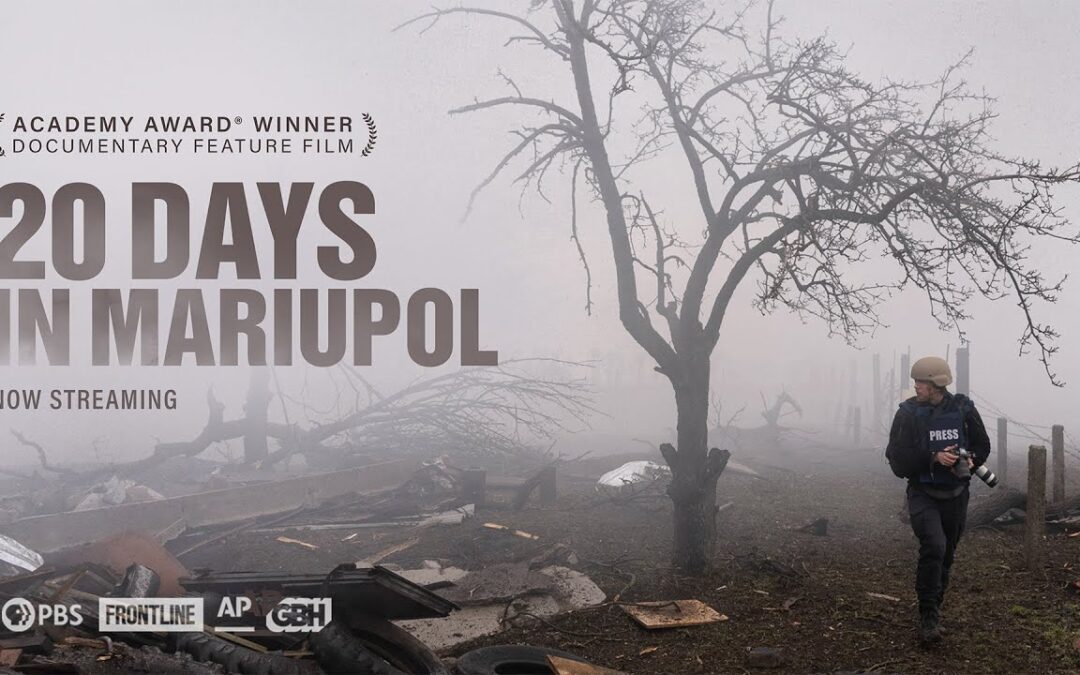
directed, produced and filmed by MSTYSLAV CHERNOV. Courtesy of PBS
When watching the evening news every night on television with its almost repetitive nature of headlines covering yet another senseless mass killing somewhere in the U.S, I often hear criticism from others claiming there is hardly any media coverage in other parts of the world whose acts are even more tragic and horrific.
This is true, especially in those countries that do not represent human rights and whose brutal leaders do not want the “truth” to be exposed, especially when they are hiding possible war crimes. Such is the case in Ukraine, with the Russian invasion of the city of Mariupol.
The public takes it for granted that media covers just about everything with the utmost detail in the free world, but in reality, they have very little knowledge of what types of obstacles that journalists are up against in many corners of the world. Media certainly has its limitations with communications and can possibly spread misinformation or even disinformation that follows a propaganda agenda.
This is why director Mstyslav Chernov made “20 Days of Mariupol”.
“20 Days of Mariupol” is one of those rare films that shows the challenges that war-journalists have to face. Chernov, who also produced and shot the film, gives us a humanistic, yet non-sympathetic first person perspective of the ongoing crisis span during the first twenty days of the Russia-Ukraine war that your nightly news cannot possibly summarize, even if they had all of the footage sent to them on a timely basis each night for the broadcast.
Chernov had forty minutes of his footage published on television, but still had a good thirty hours of unused footage that would be used for the source of his documentary, which won the Audience Award for World Cinema Documentary at the Sundance Film Festival nearly a year ago.
“I wanted to do more with that because the scale was so huge and you can’t really show that with news pieces”, Chernov continues, “We live in age of not just misinformation but misinterpretation…to persist that misinterpretation we need much more context for better understanding in the audience.”
“That’s where documentary films are becoming to be so important that they they give more than just one or two minute news pieces which can be overwhelming, but still you see them and you forget”, Cerno explained. “I kept meeting people who escaped from Mariupol who carried this city within them, but the city was did not exist anymore, so the city was just there in in their hearts. Making this film was also a way to to preserve it as it was being bombed and destroyed, but still existed. It was the way to preserve Mariupol in history, as well”.
20 DAYS IN MARIUPOL directed, produced and filmed by MSTYSLAV CHERNOV. Courtesy of PBS
Along with Chernov, the film documents his AP (Associated Press) team of Ukrainian journalists trapped in the besieged city of Mariupol as they struggle to continue their work documenting atrocities of the Russian invasion. As the only international reporters who remain in the city, they capture what later become defining images of the war: dying children, mass graves, the bombing of a maternity hospital, and more.
The film also draws on Chernov’s daily news dispatches and personal footage of his own country at war. It offers a vivid, harrowing account of civilians caught in the siege, as well as a window into what it’s like to report from a conflict zone, and the impact of such journalism around the globe.
Chernov also serves as the narrator of the film and in spite of its subject matter, he does so in a calm fashionable manner. This was done after he realized he was imposing his emotions to the audience on the first take. His team agreed that his narration should sound like he would in a normal conversation, regardless of what was on screen. His narration reminds me of how Werner Herzog would narrate as an effective storyteller in his films, and it worked extremely well for this documentary.
Chernov initially emerged in 2008 as a fine arts photographer shooting in as many as forty different countries and winning awards all around the world. In 2013, he became the President of the Ukrainian Association of Professional Photographers (UAPF) and eventually started documentary multi-format (photo/video/text) working in journalism for the Associated Press, as well as being a war correspondent covering international conflicts and novelist known for his coverage of the Revolution of Dignity, War in Donbas, the downing of flight MH17, Syrian civil war, and the Battle of Mosul in Iraq.
He recently received the Pulitzer Prize for his work, shared with Evgeniy Maloletka, Vasilisa Stepanenko, and Lori Hinnant, for the Ukraine coverage. In addition, “20 Days of Mariupol” had just been selected last week as one of the fifteen shortlisted films to be elgible for the Academy Award for Documentary Feature film, as well as being shortlisted for International Feature film representing the country of Ukraine.
Unlike most documentaries, it is free to stream and accessible to everyone on YouTube above. It is also available on the PBS app. and is also available on DVD. Regardless of its bleak nature, this is essential viewing for everyone.
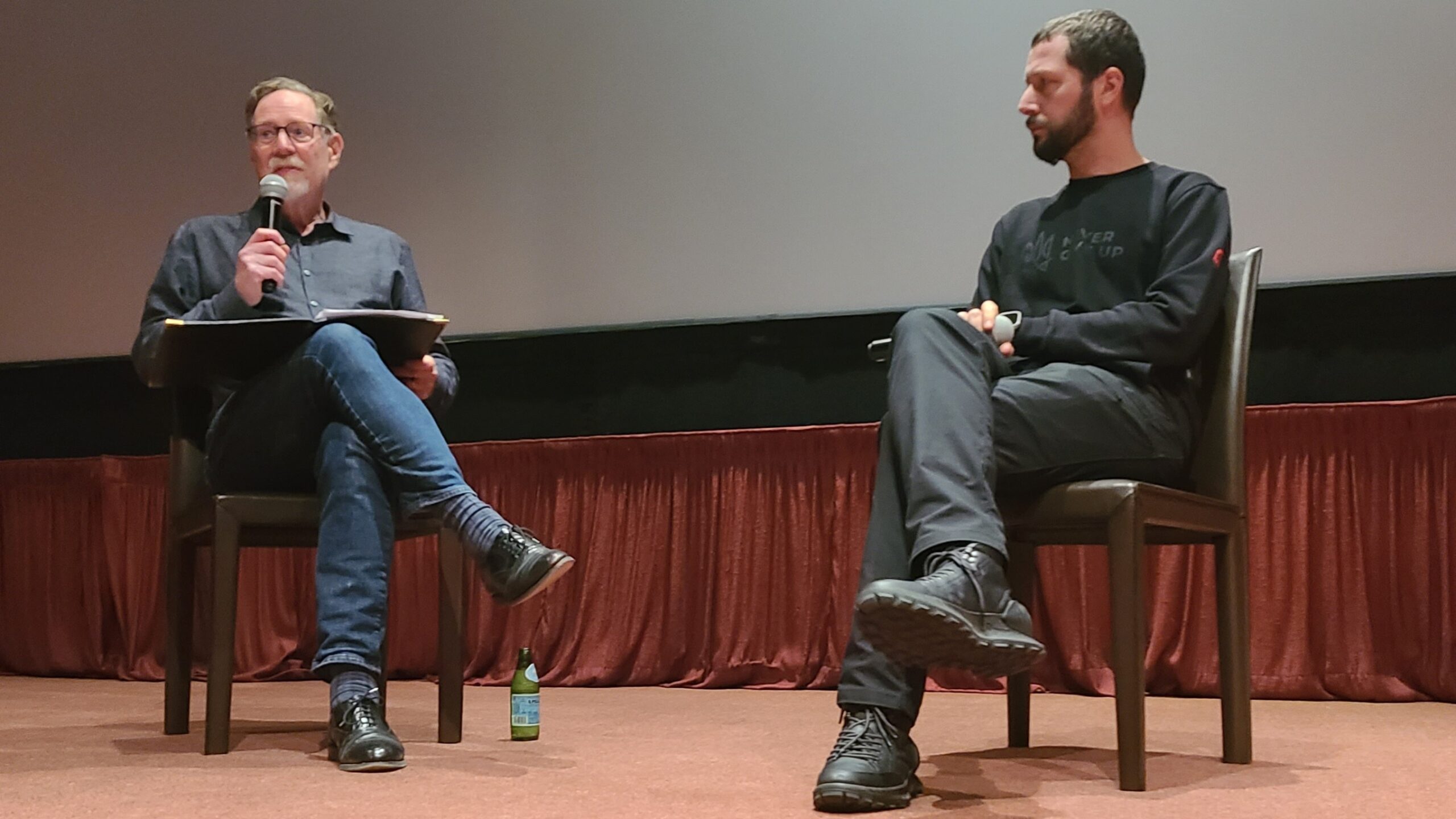
(L-R) Rick Goldsmith interviews Director Mstyslav Chernov at a screening of “20 Days of Mariupol” in San Francisco. Photo by Marcus Siu.
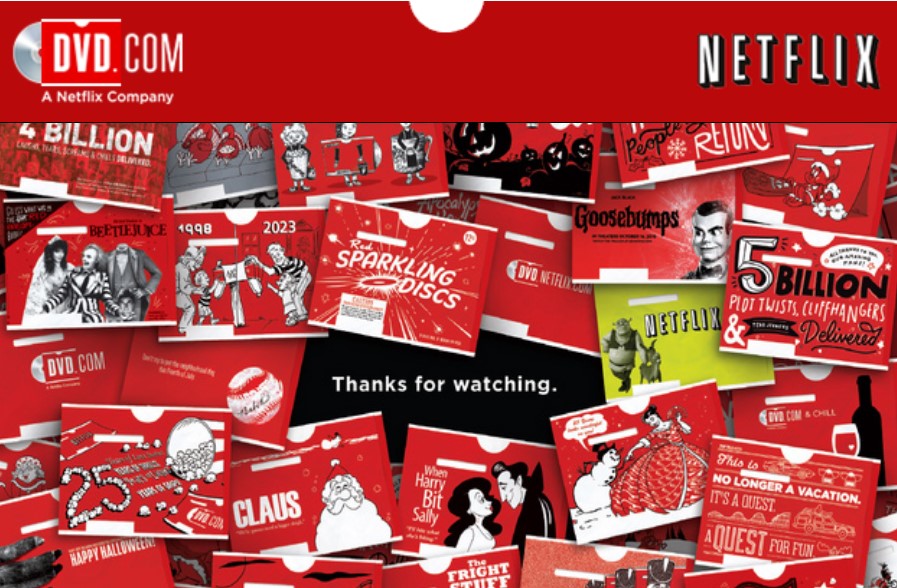
September 29th marks a very sad day for the remaining one million loyal Netflix DVD subscribers including myself. Unfortunately, but not surprisingly, the company announced earlier this year to pull the plug and close its DVD rental operations.
Needless to say, the DVD rental business for the company had been dwindling down ever since its streaming services became the primary choice for its subscribers all over the world and disrupted the video and movie industry.
To give you an idea, Netflix’s DVD revenue totaled $60 million for the first six months of 2023. In comparison, Netflix’s streaming revenue in the United States for the same period reached $6.5 billion. In 2022, the DVD business generated $145.7 million, down 20% year-over-year, which represented just 0.5% of its total revenue. That’s just half of one percent!
In their early beginnings in 1998, they couldn’t have chosen a more opportune time to get into the DVD rental business. DVD’s were at the beginning of their popularity. It also was the perfect format to ship and mail off to millions of customers due to its light weight and size. They wouldn’t have been very profitable during the days of VHS and Beta. Could you imagine Netflix stuffings bulky VHS or Beta tapes in the mail to make it in the video rental business to try to make a profit?
Instead of wasting time and gas and driving back and forth to rent and return the movies to brick and mortar video stores, customers only had to deal with their mailboxes with Netflix. They also had the luxury of returning it anytime, without any late fee to any mailbox. To many customers who are habitually late in returning their DVD rentals, it was a blessing.
Netflix was the primary reason why Blockbuster Video went out of business in 2010, along with the many independent mom and pop video stores that was virtually in nearly every neighborhood.
Nowadays, it’s unfathomable to even think that people actually made special trips back and forth to a video store just to rent and return a video.
As a Netflix subscriber, I had two gripes. There was no way to filter down movie titles that were only available in blu-ray when searching thru their inventory. The other issue that I had was trying to figure out what version of the movie that I would get if there was a title that had been released multiple times, I wouldn’t be able to tell which version of the movie I would get. Customer service was useless with those issues.
But, overall, I will miss this wonderful service.
Netflix not only changed our lives forever with the good old “red envelope” rental subscription for a good ten to fifteen years, but also with the introduction of their streaming services in 2007 it changed the world and the way we watched movies.
But is that a good thing?
Sure there are lots of great popular shows that are currently streaming on Netflix, but unfortunately the number of streaming titles in their catalog are very limited and cannot compete with the number of titles in the Netflix DVD catalog. Netflix streams about 4,000 titles at any given time, but during the peak of DVD rentals ten years ago, there were as many as 100,000 titles to choose from when DVD rental subscription peaked with over 20 million subscribers before streaming was even an option.
With their former DVD subscription, it was great to be able to search their vast inventory ranging from not just blockbuster feature films, but TV shows, documentaries, foreign films, and even music performances and videos. In addition, I loved being able to watch the extras and bonus features that were included on the DVD’s.
After mailing over five billion DVD’s and Blu-ray’s envelopes since 1998, Netflix has come to the end of an era for DVD rentals, but it certainly has been a great twenty five year run for Netflix and its appreciative customers, such as myself. It was a major part of my life.
In the future, I hope Netflix will realize that there is a demand for their own titles that should be released to home media. I do see some hope as “The Irishman” did get a release on the Criterion label, but would love to see more Netflix releases, such as “Squid Game” get a release, as well.
If they decide against releasing their movies to retail, they could at least compromise and have more special supplements streamable, like they did for “The Irishman”, with a Q&A session. I still want to know how certain movies were made along with a behind the scenes featurette, and watch interviews and commentaries with the filmmakers.
Now with my Netflix DVD subscription coming to an end, I may be forced to change my viewing habits and subscribe to their streaming services, but I know I will absolutely miss seeing Netflix’s red envelope in my mailbox every few days.