Many of the conference centers today charge for travelling computer cases on wheels and some have even have changed their rules so drastically that they totally prohibit them on the expo floor.
With the Moshi backpack, this is no longer an issue. The Moshi backpack is extremely handy because it opens from the side which makes it easy to use when it is still on your back.
Without the camera insert inside the Moshi backpack, it is very spacious for carrying conference materials, lights and batteries. It has special dome top flap which is good for safekeeping eyeglasses, microphones or other items that can be easily smashed. The inside of the dome has a zipper pouch which is good for extra batteries and memory cards.
The back of the backpack is padded and has air vents, so it comfortable and does not get hot when it is being used all day. The bag inside has several zipper pockets that are useful for cables, business cards, pens and accessories. The bag also features a full-size bag pocket on the back that holds papers, badges and other materials that are needed for doing full-day camera and studio production.
Finally, what makes a Moshi backpack a camera backpack is that it features a full-size tripod pocket which allows you to carry all your equipment in one location.
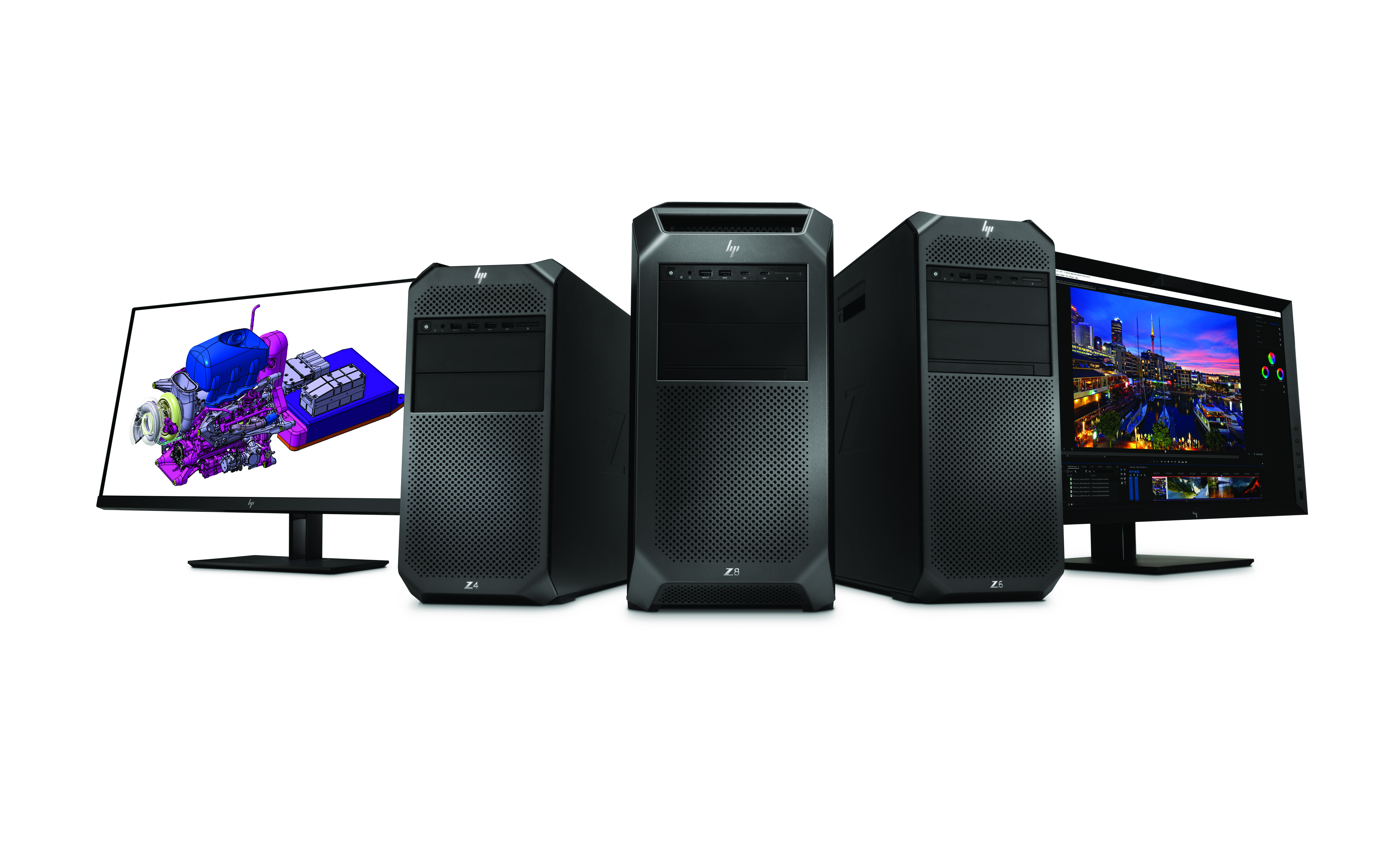
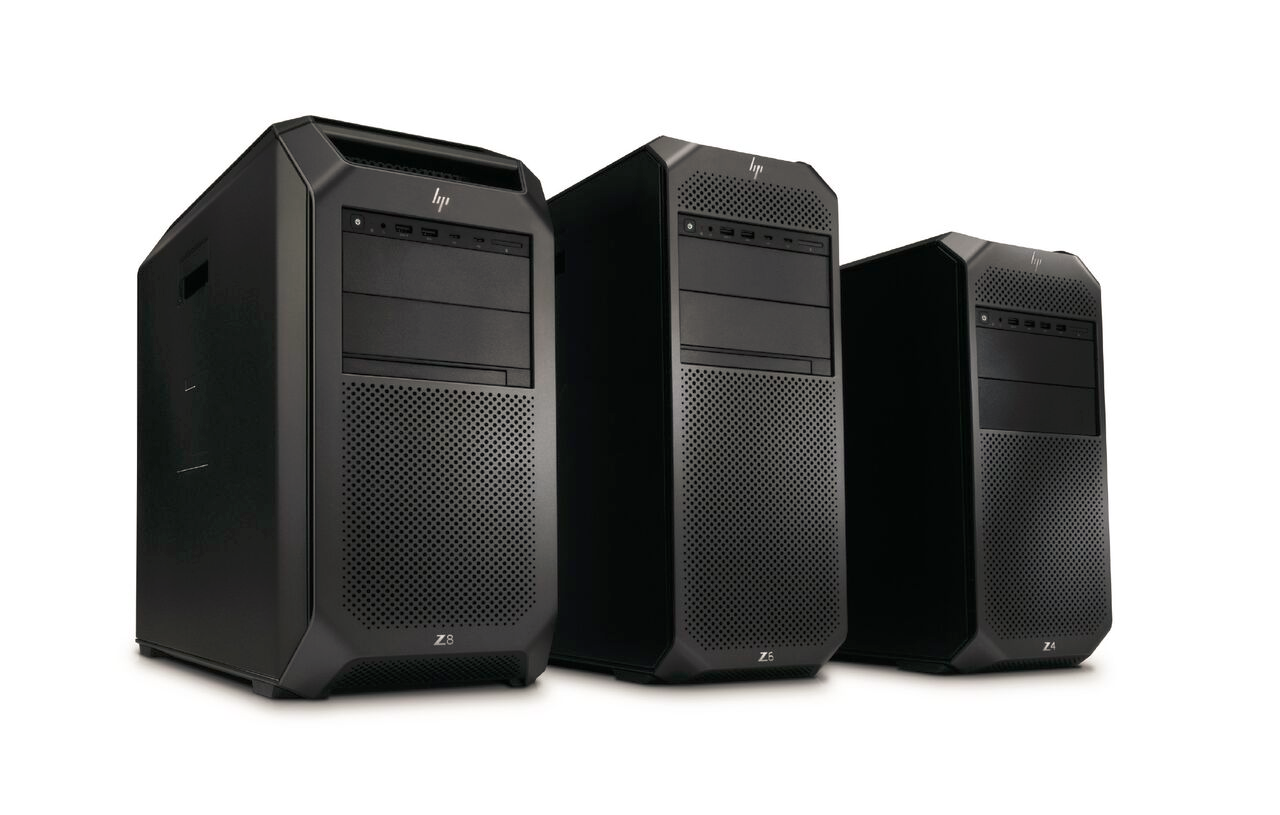
September 2017 – The workstations are making their ways through to the creative community. At this point, it’s no surprise that HP updates their Z8, Z6 and Z4 workstation with advances design including reliability and capacity.
The new designs have been implemented to support the increased performance of the units. Higher power with up to an 1700W power supply, a dual processor configuration supporting up 56 CPU cores, more storage with up to 48TB built in, support for up to 3 Nvidia Quadro P6000 series GPUs and now, 3TB of RAM spread over 24 memory slots, and dual 10GBe network interfaces. This high performance configuration requires a focus on airflow and cooling, and the new designs support that.
The HP workstations are being targeted to higher end applications such as machine learning, virtual reality, and advanced (4K and 8K). As the content created needs a high level security the new machines are maintaining it and security measures such as HP Sure Start Gen3, TMP2.0, Secure Authentication and HP SecureErase are all part of the product line.
In the era of electronic presentations and global collaboration via video conferencing the office environment has been changing rapidly and need more better suitable tools. Not that long ago the laser pointer was broadly used by the presenters but had some flows. The main one was – it could not be seen by other parties in shared video calls or on conference room flat screen monitors. Now this problem is solved. Logitech has introduced a new presenter tool named Spotlight that has advanced pointer system that’s better than a laser. Spotlight not only is better by putting the highlighting function into the image created by the computer before it gets to the display, but also more stylish and more functional.
Magnify Capability in New Logitech Spotlight Presenter
Stylish – three buttons and one large one in the 3 different colors bodies – gold, black and silver. Functional – It has a long range of 30 meters (100 feet) so a presenter can walk freely in the room while giving a presentation. It has 3D cursor to play videos and open links. It manages time by giving vibration alerts. It charges fast! Only 1 minute for 3 hours of presentation. When is fully charged a battery last up to 3 months.
The functions are programmable and can be customized to a user needs.
The details: it supports slides and presentations integrated with AV, slides can be send forward and back and control with the gestures; a volume can be raise on embedded media. Spotlight runs on both Windows and Mac for programs including Powerpoint, PDF, Google Slide and more. It operates by the Bluetooth connectivity or 2.4GHz USB wireless connection. A presentation is enable by a software that is new on the market. The software has three modes if item focus on the screen. Spotlight – circular highlight on the screen while the rest of a picture dims; Magnifier – that changes the spotlight to magnifier to show the details of the image; and the third mode that changes the circle area of the magnifier to an outline circle.
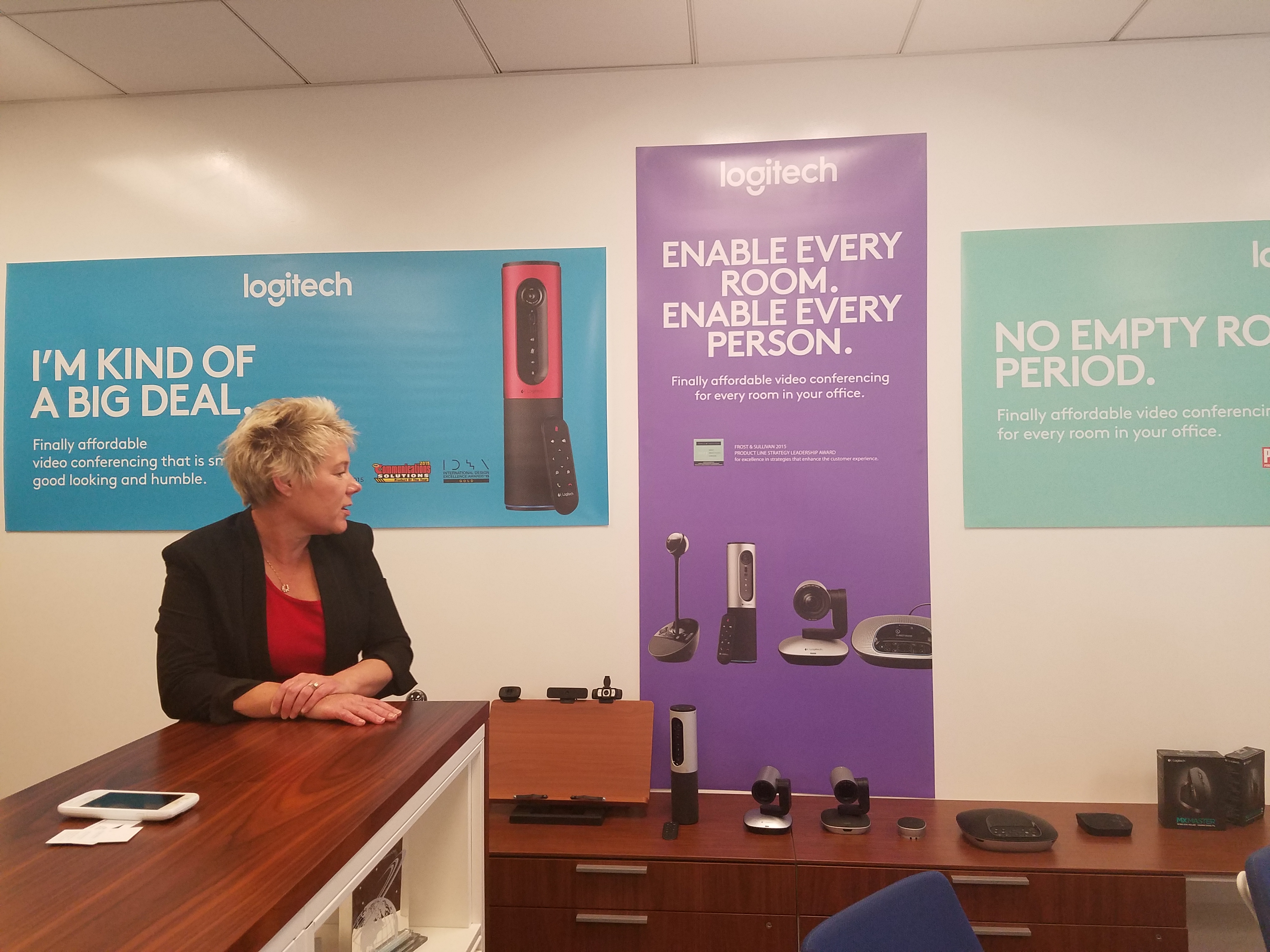
December, Logitech – Logitech SmartDock is secure meeting room console designed for Skype for Business. It can transform your meeting with a rich, collaborative experience. At Video Collaboration Press Briefing that took place November 21, 2016 at Logitech Headquarters in Newark, Joan Vandermate walked us through the details of the LogitechSmartDock and presented the functionality of the unit that was just shipped to the market.
The full interview and product demo can seen below:
October, SMPTE – At the first day of Centennial SMPTE ATC conference three speakers: Paul Debevec, Co-Chairman of Science and Technology Council, George Joblove, Co-Chairman and Jack Holm, Co-Author of Science and Technology Council SSL Project Committee presented the challenges and issues in color rendering using the solid state lighting (SSL) along with a solution – a Cinematographic Spectral Similarity Index. The new color index is based upon the similarity of a luminaire’s spectrum to a reference spectrum that eliminates the need for any assumption of the specific observer or camera spectral sensitivity.
The Academy of Motion Picture Arts and Sciences’ Science and Technology Council has investigated the issue the last few years. The AMPAS project was presented at SMPTE Tech Conference in 2009 (“State of Solid State Lighting”), at NAB conference in 2011 (“Chromatic Chaos: Implications of Newly Introduced Forms of Stagelight”) and again at SMPTE in 2013 (“Color Predictor Tool”). “The Experiment” conducted in 2010 showed that luminaire spectral power distribution affects skin tone, makeup, costumes, props, and sets. It showed differences in color for 4 different sources despite all of them being at the same color temperature.
The characteristics of Spectral Similarity Index (SSI) that is a solution for that issue are following:
it defines how close a test spectrum is to a reference spectrum (e.g. tungsten),
does not assume a spectral sensitivity for the camera/film/eye,
single value representing quality of curve fit,
index is easy to understand
easy to include on luminaire/lamp packaging and literature.
The presenters explained the technical aspects of SSI but the final message is that the index yields a confidence factor, where a high score implies predictable color rendition for cinematography, and a moderate score implies possible color rendition challenges. The look of the image and the color of the things on the large screen for cinema, and now with the addition of HDR (high dynamic range) and WCG (wide color gamut) being available on home television screens, means color rendition for projects is once again at the forefront of the content creators vision.
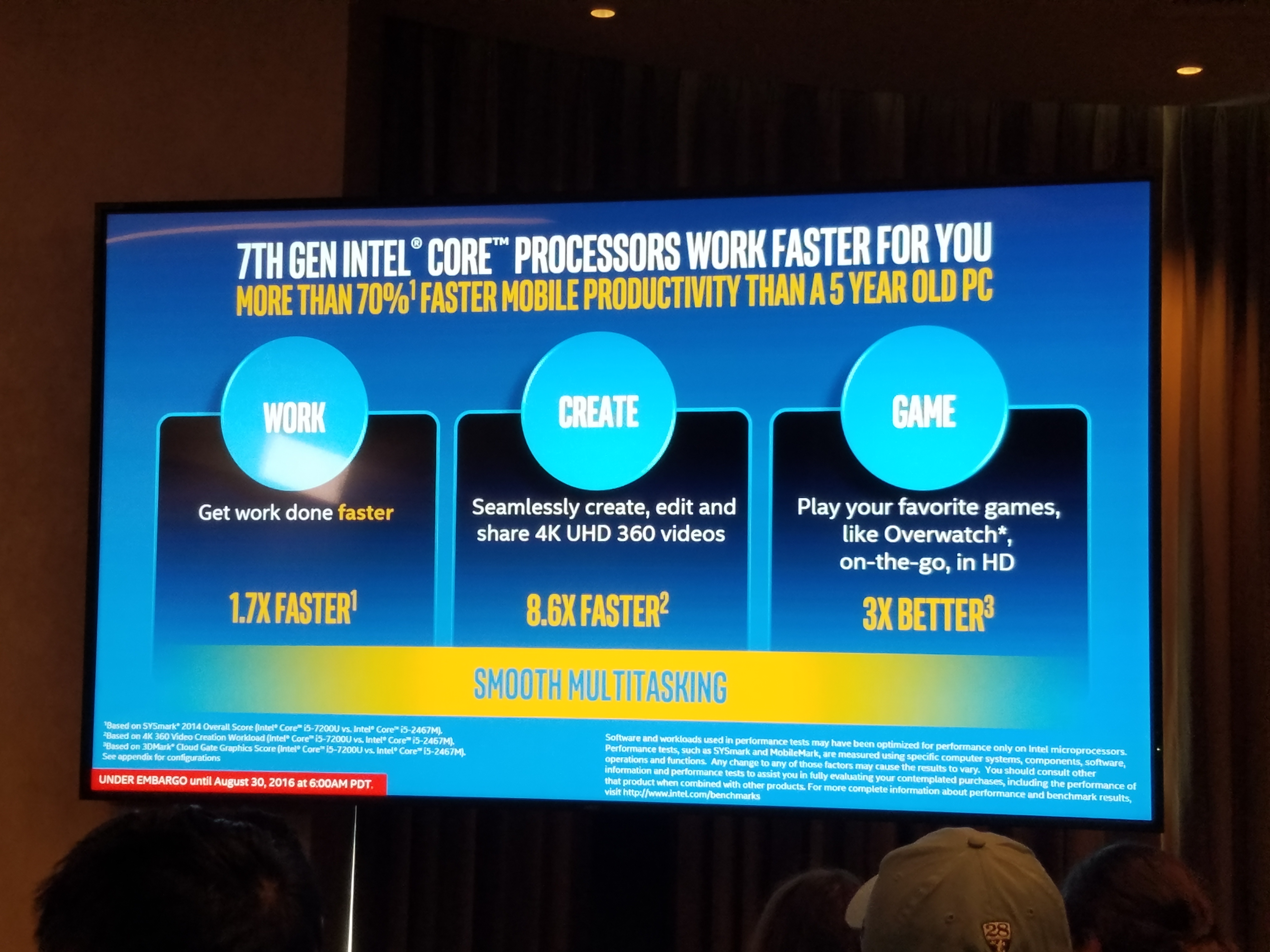
IDF, September 2016 – At the Intel Developer Forum, while a lot of the discussion was on IoT and smart connections, Intel continued their technology advancement and development of multi-core processors for the consumer computer market. The company held a briefing to announce their 7th generation Core series microprocessor.
The new processors continued the take advantage of the new process technology. The processors use the Intel 14nm+ technology which is an updated and advanced version of the 14nm process released a short time back. This new process is about 12% faster than the standard 14nm process and allows for increased productivity in the design. The new process is not only faster but also lower power so the designs of the new PC’s using them can be thinner and lighter with longer battery life.
The higher density design on the 14nm+ process allowed for the addition of a new graphics engine to be built into the chip that will now support UHD 4K video without an additional external GPU card or chip. This will all the computers for be used for immersive applications such as VR, and high resolution movies.
This year, there are supposed to be over 100 designs from multiple manufacturers that will be released with the new core generation core processors. These designs now support new standard functions such as USB 3.1, Thunderbolt 3, Windows Hello, a pen/stylus, and 4K display panels. These will enhance both gaming/entertainment and standard office productivity. The computers with the new processors, and supporting the new DDR4 DRAM memory and Flash memory storage solutions, are many times faster and more productive than a computer from as little as 5 years ago.


 Many of the conference centers today charge for travelling computer cases on wheels and some have even have changed their rules so drastically that they totally prohibit them on the expo floor.