by Lidia Paulinska | Mar 11, 2015
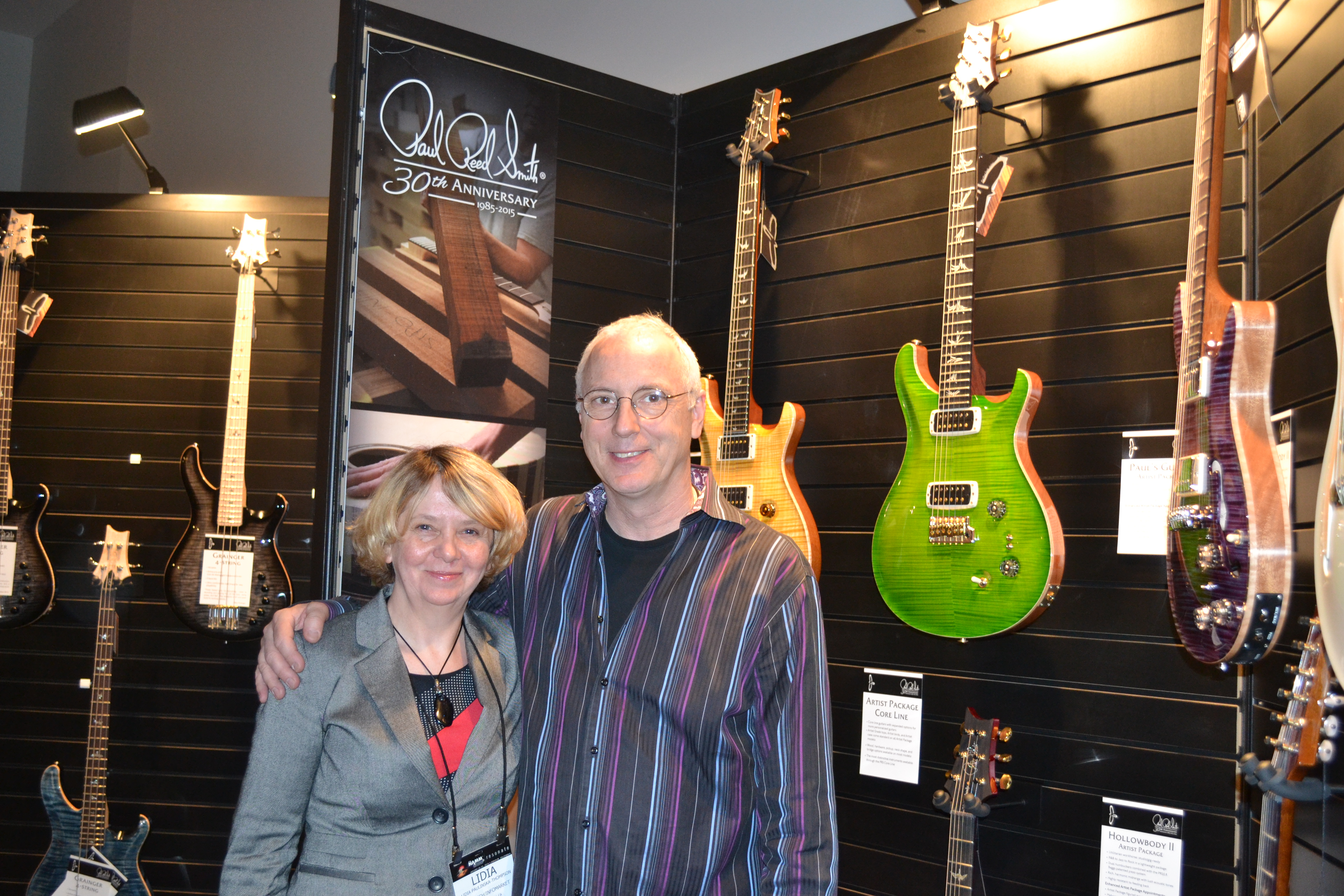
Paul Reed Smith is a master luthier and the founder and owner of PRS Guitars which is considered one of the top makers of high quality guitars in the United States. Carlos Santana, Orianthi, Jimmy Buffett all claim their PRS guitars are their favorite instruments. Ted Nugent has owned a PRS guitar for decades. Mike Oldfield, Larry LaLonde, Al Di Meola have also used PRS guitars in public performances.
It was a strong passion to make it?
There was a strong passion to be at the band. I wanted this piece of gear but I did not have money so I needed to make it. So if I wanted to base I made it if I wanted a guitar I made it. Because I wanted the staff people at the band have but I can’t get money from my family so I made it.
Apparently that was easy for me to do it, I can measure something and make it. That was fun I enjoy it and then I started to make living by making the instruments for professional musicians and I finally got Carlos Santana and Al Di Meola and Howard Leese. From that point he started his own company as he said: there was enough power in guitar business to be endorsed so people will pay attention when he goes to market”. Santana, Leese, Di Meola there were people they took me under their wings. He decided to do it.
If I could play in the band in high caliber as Carlos’s band or Deep Purple or whatever I would done it but I wasn’t good enough musician. My decision was financially driven. If I want my kids to go to good college I needed to make living. Otherwise I wouldn’t be able to rise the family.
How did you settle on what the product line was?
It is all like baby steps. If you making the instruments for somebody you are making modifications like baby steps. There were some big steps modifications – they wanted me to change a body shape that we are using now (big step), to put the burden laze (?) major step, when we switch to get more sound from the guitar (major step). But if I met somebody like Peter Frampton and I said I wonna make a guitar I would go to the rodeo and ask to play his guitars and get an idea what he liked and I would put in the middle between his instruments. You can learned about what musicians like by using what gears they use. If I walk to the studio and I see what gears a guy is using I get general feel for it, what he likes to use. Smith – you are making a judgement where to point the gun.
Do you feel like you good at the judgments?
Sometimes perfect shot is the first shot. Sometimes it takes 30 years. With Carlos Santana the first guitar I made for him he did not like it, the second one he really, really liked. From there that was fine. John McLauglin on other hand, I was waiting for him to order a guitar from me for 30 years. One day, son, you will be good enough, one day. Now we are working on giving a shot very, very good guitar players. We see. It depends, sometimes you know from day one, sometimes you have to wait.
What wakes you up at night?
The guitar business never wakes me up at night, but struggle with people does. Never when I struggle with gears. Things between people yes, but never things between me and physics.
What is more challenging finding a the right gears or finding the people?
It is all the same bucket, I can’t separate it. I can tell you that not finding the solution can be very painful. You have so many famous people out there, if you would find the right solution for them they will give you an order. If you have an employee you have disagreement with, it can even more painful than not getting an order. The people are the both the challenge and the prize.
What do you do to manage the challenges?
I used to have a cat that sat on my lap and calmed me down. But that cat died. Right now, I focus on my 5 children – 3 blood, 2 step. They are the calming influence.
Would like them to be your successors?
No, that not fun. Why? I want them to do what they want, you can’t forcing something on somebody. My dad wanted me to be a mathematician, but I thought that did not happen. But it turns out making guitars is pure math, it took me 30 years to figure that out. He was really good in one kind of math, I am good at visualizing geometrics. If you are guitar maker you need to be able rotate the design in your head in 3-4 dimensions before you make it.

by Lidia Paulinska | Feb 17, 2015
At the NAMM Winter Conference, the She Rocks Awards moved from their daytime subdued event to a full nighttime gala event with red carpet. The 2015 She Rocks Awards were hosted by the founder of WiMN Laura B. Whitmore and performer Orianthi.

The show opened with an opening performance by the fast rising group SHEL. The four sisters who make up the group are touring the US and Europe between recording new albums and music for television, film and commercials. Continuing the theme of celebrating Women in Music the award ceremony featured an all female house band. The house band was led by guitarist Gretchen Menn and included Zepparella members Angeline Saris on bass, Clementine on drums and guest keyboardist Jenna Paone.

The show had one non-female winner – Rob Christie was recognized for the Champion Award.

The highlight was the “ICON” award winner as major contirbutors to the field of Women in Music. This year’s award was given to The Bangles – Vicki Peterson, Debbie Peterson and Susanna Hoffs who also performed that evening with the host and house band.

Spanning all varieties of music, the “Mad Skills” award was given to Mindi Abair. Berklee College of Music graduate Mindi is receiving multiple recognitions in addition to the She Rocks Award with several Grammy nominations and increasing demand for her unique saxophone style and sound. Mindi addressed the crowd with the fact that in her music career a lot of her success is due to the support from her family and teachers who encouraged her to follow her own style and sound, and that she did not have to conform to “sound like someone else” she “can create and define her own sound”.

The “Legend” award was given to Capitol studios manager Paula Salvatore who in her 24 years at Capitol has been an integral part of recordings for some of the industry’s most iconic artists.

The “Inspire” award was given to Debbie Cavalier. Debbie is currently the Vice President for Online Learning and Continuing Education/CEO for Berklee’s award-winning online continuing education program, Berklee Online, and is also the leader of the award-winning kids/family band Debbie and Friends. She has also been the recipient of the 50 on Fire Award, the 2013 Education award, and also composed and recorded a song featured on the 2011 GRAMMY Award-winning CD for Best Children’s Album through her work with Debbie and Friends.

The “Excellence” award was given to Craigie Zildjian the first female CEO of the 400+ year old Avedis Zildjian Company. She has also sponsored the Zildjian Family Opportunity as well as the Zildjian Percussion Facility at Berklee College. Additionally, Craigie developed the American Drummers Achievement Awards, an event that honors drumming legends. She also is an active member in the musical community with past service on the Board of Directors for the International Music Products Association (NAMM), the Board of Advisers of the International Association of Jazz Educators and the Board of Overseers at New England Conservatory. Currently, she Chairs the Zildjian Board of Directors and is a Trustee Emeritus of the Berklee College of Music.

The “Video of the Year” award was given to performer Colbie Caillat. Colbie is a two time Grammy Award winning singer-songwriter who has sold over six million albums and ten million singles worldwide. Caillat released her fourth studio album Gypsy Heart, which features her hit single “Try” which was co-written by legendary producer and singer-songwriter, Babyface. The companion video for the song has become an online phenomenon, quickly amassing 30 million views. As was the video recognized with this award.

The “Next Generation” award was given to Katie Kailus. Katie Kailus is the editor of Music Inc. and UpBeat Daily magazines. She started at Music Inc. as an intern and was soon appointed associate editor. In January of 2014 she was named editor. She is one of the first women to ever be named editor of a musical instrument trade publication.

Also being recognized were Gayle Beacock and Amani Duncan. Gayle is co-owner of Beacock Music Company in Vancouver, Washington. Their Education Center is widely regarded as one of the top in the country. Amani is the Vice President of Brand Marketing for C.F. Martin & Co. A 17 year music industry veteran, Duncan’s experience runs the gamut from artist relations to visual marketing, digital and social media, campaign creation and strategic partnership negotiations.

by Lidia Paulinska | Feb 2, 2015
The current trend is to eliminate wires from all the computer peripherals and also allow the same access to mobile devices as you would have with a full computer. While the direction has been successful for most products, this success has come with the cost of speed, productivity, limited battery operating life, and reduced features to add the power and the extra parts to bring wireless capability. The wireless devices that dominate the market are also an added burden and SMB and SOHO locations that have limited, consumer oriented networks.
Addressing this trend is a new product in the marketplace that took a different approach. The Fujitsu ScanSnap ix500 is a business class, high productivity scanner that added wireless capability, rather than throw out features to bring in wireless. The 25 page per minute full duplex (simultaneous both side scanning) color scanning feature has simultaneous multiple feed paths that are set for full standard pages (8.5” x 11” and A size sheets), a receipt width path and a business card path. To supplement the scanning and simplify the results in the output, they added a hardware chip that incorporates a licensed Adobe PDF generation engine, that takes the raw scan and creates fully annotated and OCR compatible PDF files in the time most system provide a JPEG. The interpretation engine is smart enough to re-orient documents in case pages are upside down or sideways, so all the results are usable and readable. The business card section is also smart enough to “bind” the front and back of a double side card as one set of information for use in importing the cards to your contacts manager.
This high speed and built in PDF engine now allow professional and business level scanning of documents to connect to a mobile device. When the output is directed to a mobile phone or tablet, the result is a single file with a fully functioning PDF document on the mobile device with no delay for processing and using the limited computing power of the phone/tablet – the document is just usable. This allows for the ability to take full reports that you may receive on paper, scan it, and have a readable document directly on the phone/tablet in seconds with no other programs needed – just the existing Adobe reader on your phone/tablet.
The scanner is plugged in the wall for power, so it is a 24/7 available device – not limited by battery time. Since it is plugged into the wall, it can be placed in a central location to be shared by many people, so it is not a 1:1 accessory to person device. To enhance sharing among people, the device works as a full wireless client device in a network. It has a simple setup for joining an existing wireless network, and can be addressed by any device on the network. Each of the devices that talks to it needs to have software to “request” getting a scan from the device, and one can be designated as the “default” device. In default mode, any pages that are placed in the scanner, and the scan button pressed on the unit, will send the results to that computer.
A big difference in this scanner versus other wireless devices, is the ability to switch to “wireless direct” mode. The unit has WiFi host adapter electronics that let the scanner directly connect to just one device – a laptop, phone or tablet – if you are in an area where that device is not part of the main wifi network. This is especially useful when someone is visiting the office, and you do not want to give them access to your business network. You just select the option on the menu for the scanner for direct connection, open the app on the mobile device and select the scanner as the wifi network, put in the password for the scanner and all the results from the scanner are sent to that device wirelessly and securely up to 25ft away.
The devices comes with Adobe Acrobat Standard software for the PC & Mac that allows you to manage and manipulate the output of the scanner. This saves the cost of purchasing an additional software product to be able to merge multiple scans into one document of break up a big scan into several files. As the unit is a full color scanner, it also allows you to pull out a high resolution scanned picture from a scanned page that may have text or other photos on it, without and additional programs.
The scanner is currently available from Fujitsu and its retailers.
by Lidia Paulinska | Nov 7, 2014
At the 2014 NAB Show in Las Vegas, we were lucky enough to get rare, extended, and quiet interview time with film industry icon and controversial technology developer/evangelist Dr Barry Sandrew.
Unlike a lot of folks in the film industry – the “Dr” is not honorary, how did you get over to the film industry?
BS – The film and effects industry is my second career. I actually went to school and got my doctorate in neurosciences, and then ended up transitioning from studies to being on the faculty at Harvard. While there, I established three different labs in the area of neuroscience. One of those was the first neuroscience imaging lab, a part of the Department of Radiology, that focused on MRI, CAT and PET scanning and imaging of the brain. I also served as a staff member at Massachusetts General Hospital and at the Columbia University, College of Physicians and Surgeons.
Way back in the late 80’s, an entrepreneur came to me and asked if I could develop or invent a process for colorizing black and white movies. I knew that it already had been done in analog form and it was terrible. Everybody knew that. What they wanted was a digital version of the colorization process. The reason for doing that was, if you take public domain black and white movie and you colorized it, you owned the copyright of that colorized version for 95 years. This opportunity caused me to leave academia and form American Film Technology where we invented the new colorization process.
I was involved in the colorization business through the early 2000’s. In 2006, an associate came to talk to me about 3-D, and showed me that Mitsubishi already had a 65” 3-D ready TV., unfortunately, the store owners did not even know how to hook it up to display 3-D images. My partner and I saw an opportunity and looked into the business and technology of 2-D to 3-D conversion. There was an old patent from almost 40 years ago that described a methodology, but it was very crude and, of course, not digital. Interestingly, almost 65 percent of the flow that was needed was already part of my colorization flow, so I moved by efforts to the 3D conversion business.
As you are now in the 3D business, what did you see at the start?
BS – First of all 3-D is not dead. The technology is strong and can bring new options to story telling, but I think the industry did a horrible job in trying to educate the consumers. Additionally, the media did not understand the process or the product, the retailers obviously did not understand any of it, and they did not even know how to sell the product to the audience.
When I first got involved with 3-D, I was amazed at the opportunity and I realized that all I had to do was to develop the last part of the flow. I did some research, and I knew what was happening with Cameron on Avatar. I knew that some money was being spent on it and more would follow. I knew a lot of people were working on it. It was very very clear to me, that it is either going to be a game-changer or the biggest disaster that ever happened in Hollywood. I wanted this conversion technology to be ready by the time of the Avatar release. We completed development and were able to start doing demos for the studios in 2009.
One of the challenges is that media says the product (3-D) did not take off this time, as it has in the past. Part of this is due to the fact that initially some 3-D content was not that good, I can honestly admit. There was a rush to market by the studios. Everything we did at Legend3D was perfect, but some of the new stuff like “Clash of the Titans” was horrible. But keep in mind it was not the fault of conversation process. This was the first movie conversion for the company that did the the work.. When the decision was made to go 3-D, they had only 5 weeks and almost no budget. The only mistake was to say yes to the project. This gave 3-D a bad name as the major follow-up to the game changing film “Avatar”.
What do you believe it will be the future of 3-D?
BS – The directors are getting better and more sophisticated about 3-D, not just using it as a gimmick, but are including it in the story. We worked with Zack Snyder on “Man of Steel”. At first, he was not sure what could be done. Then, after seeing some conversions, he learned how to incorporate the VFX into the story line and enhance the plot or feeling of a scene. It is key to include this technology aspect as part of the story, not just an add-on. It affects the shot, to know what needs to be filmed and framed, so it can be converted and keep the audience involved with the film.
One of the big futures will be 3-D TV. There is currently a lack of content, but that is being addressed. Then you have the confusion of active glasses versus passive glasses, it is a real mess. Right now, the technology in TVs is that most of them are 3-D capable for almost no extra cost, and people are buying them that way – but not using them as 3D sets, because they don’t need to. But once it is in the home and “Little Johnny” comes from next door and says that he just saw Shrek in 3-D and asks “Why we do not have a 3-D TV?”, they probably will realize they do. Once that happens, then they are going to use it.
But I think that there is going to be something more important. That is second screen. The second screen is going to be ubiquitous. It will appear both in the home and virtually everywhere. It is the anytime, anywhere, any device. I believe that 3-D is going to happen, but it is going to happen via Internet rather than though broadcast, cable, or satellite. The mobile devices will be connected to it first. On the second screen, the issues of glasses-free 3-D viewing (auto-stereo) are solvable with today’s technology at approximately the same price point as a 2-D second screen. This is because it is a single viewer environment.
Most of the current auto-stereo technology is some sort of lens based solution, that ends up having multiple sweet spots for the 3D effects. Once the devices incorporate eye tracking, which is already appearing in some products, you are going be getting people looking at it and saying it is amazing, rather than getting sick from it.
It seems in your career you have chosen to run the company instead of work for a company. But when you talk about the companies you are saying “we” rather than “you”.
BS – Yes and no. I have started several companies. I never worked for a company. I developed the colorization and 3-D flows and tools. About 2 years ago, I was president CEO, CTO, COO and Chief Creative Officer (CCO) at Legend3D. When I started all those companies, I held of all those titles. And then as I hire the people I think can do better than I can, I turn over those roles to them. Instead of what happened, 18 months ago, we got a new group of investors and I turned the CEO role over to my general manager. I took the more creative role, and I maintained my CTO role. I became some sort of luminary for 3-D and I have been giving talks all over the world. No, I do not run the company any more, but I do represent the company and enjoy being the creative force in getting them going.
What is ahead for Dr Sandrew in the future? Are there any other personal goals you are trying to achieve?
BS – I love creating and working with creative people. I have a number of new things in mind and visible on the horizon, but I can’t talk about those right now. I think the real thing is that I enjoy the controversy about “can this be done?”. I have been in the right place at the right time, so the controversy has actually helped promote the businesses on a financial basis. It helps bring out the early adopters and risk takers. I am not done yet – there are always things coming up as new opportunities.
by Lidia Paulinska | Nov 2, 2014
Michael Ironside is best known for his long career as an actor, producer, film director, and screenwriter in many movies and TV series. He is best known for his acting credentials where he perennially playing tough guys or psychopaths like his memorable role in David Cronenberg early film “Scanners”. Some of us remembered him from the silver screen hits “The Machinist”, “Total Recall”, “Top Gun”, and “X-Men. First Class”. Others enjoyed his performances in TV series like SeaQuest 2032.
Known to the gaming community as the voice of Splinter Cell’s Sam Fisher, now he is reprising his activity in the gaming space with a new game and character by lending his deep commanding voice and ability to build a relatable character with only his voice to Colonel John Killgore for Tank Domination. Even though he confessed that he is not a gamer (his daughters are) he sees the power of communication in the gaming business and finds the opportunity.
Michael sat down for a spirited discussion covering a variety of topics – all of which he was exuberantly open and opinionated about.
On why he likes the gaming industry
MI – Over the years, I traveled all around the world, and I found out that corporations have so much control now. They control communication, they control media, and they control everything, so they can pretty much put forward what they want without being chastised for it. In comparison, the gamers communicate online together.
I remember I was talking to one kid, who was in Johannesburg, South Africa, and I said oh my god, there is something going on in this area in the world. “I don’t want to talk about it” he answered, but I said, “It’s got me frightened because I got family there”. He went on to his gaming console and was talking to some people from that place, and asked what is going on? They said, “oh no, there was a food riot. When the people get to their food stamps, they just went over. There is no big riot”.
But the press had pumped it up. So gamers get to communicate with each other and tell the truth to each other from all over the world, it is kind of a back door into the corporations and politicians. The corporations can’t control that. There is an honesty and there is kind of neutrality in the way they communicate. You can go online at any time, you are playing with someone from South Africa, from Moscow, from Johannesburg, from NY, from LA, from Sydney. They will tell each other the truth. There is integrity in that and I like that. Anything that encourages communication, even if it is under the auspices under so called violent gamers or social gaming is a good thing.
On the storytelling in games
MI – We have been telling stories to each other since mankind climbed out of the primeval ooze, put a loin cloth on, covered up their breasts, sat around the campfire, and told stories to educate their children. Games are not storytelling. Games are being part of the story. It is a interactive storytelling. This is play. This is taking the place of “tag”, this is taking place of baseball or hockey. It is a community and a group thing. Film is also a community and group thing, but it is observational not interactive. That is storytelling, that is tutoring, that is teaching. Games are different, as you get to be part of the story, interact, change it direct it new ways, and develop a personal experience that other people don’t have, it is a 1:1 real time memory that is being created – not just a replay with the same story and outcome every time. That is why we are all in trouble, guys, because so many major corporations are holding that media and directing what experience and what memory we should have. That is a problem. I’m kind of opinionated to talk about it.
On the Colonel Killgore character
MI – Scripts for gaming are generally not very good and for me it is kind of a challenge. There was some expectation of the character based on the prior work done on the Sam Fisher character, which is why, based on the scripts, I chose not to continue that character. The Tank Domination opportunity was different. It was brought to me by a friend, and did not have a finalized script. Some parts of Kilgore character are linear, and had the result that the Kilgore character is not very deep. Specifically, 70 per cent of that character’s function is to create action to manipulate a person and give them information on where they go and stuff to do. The other part of the character and script is also extremely stereotypical. The character is the hard ass kind of no-bullshit military guy. The project was fun in a couple of places to try and make him kind of human. There are a few places in the game where I am allowed in the game to say “hmmm, alright you did okay” and that is the part that I had fun.
I enjoy the ability to participate in and help tell or be part of a story. For me, the exciting part of my work in TV, Films, Commercials and gaming is – “How do you show something that is almost impossible to make human with just a voice, a look, a stance and a movement?” That is what I spend making my career doing.